Longdianjing: When AI Stopped Diagnosing and Picked Up the Needle
Chinese company Longdianjing has made a significant breakthrough: its navigation robot for percutaneous puncture has received a Class III medical device license from the NMPA. It is the first time in China that a deep-learning device has been officially cleared not merely for diagnosis but for direct participation in treatment. The robot helps a doctor insert a needle with a precision the human eye cannot match, accounting for micro-movements of organs and tissue. While Western companies debate ethics, Beijing is moving AI from the category of "advisers" to the category of "executors."
AI-processed from 36Kr (36氪); edited by Hamidun News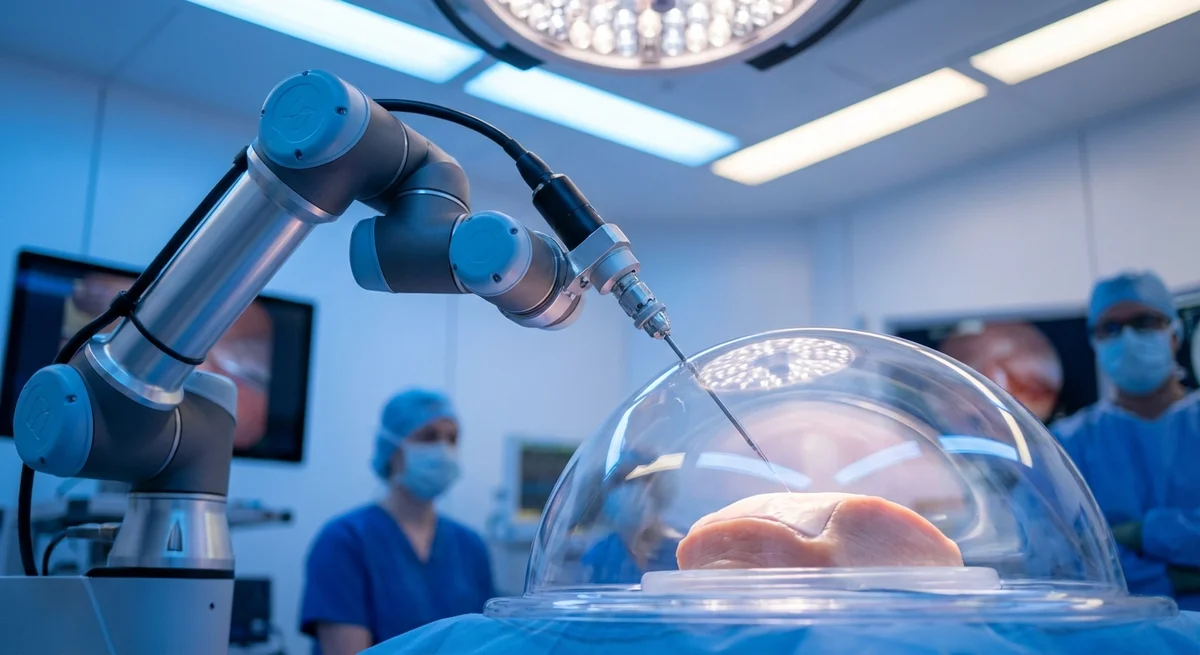
For a long time, artificial intelligence in medicine resembled a very erudite but extremely lazy intern. It could spend hours studying MRI scans, spotting suspicious shadows and offering advice, but as soon as it came to an actual scalpel or needle, the AI politely stepped aside. That has changed. This week it emerged that Longdianjing, a Chinese company from Wuhan, has received a "green light" from China's National Medical Products Administration (NMPA) to use its navigation robot for percutaneous puncture. This is not just another license; it is official recognition that algorithms are ready for physical contact with a patient in the operating room.
To grasp the scale of the news, it helps to understand what a Class III license means in China. It is the highest category of complexity and risk. Obtaining it for deep-learning-based software is like running an obstacle course through fire. The regulator confirmed that the Longdianjing system can do more than draw pretty pictures on a monitor: it can act as a high-precision navigator during invasive procedures.
Percutaneous puncture is a method in which a needle must be delivered through a tiny hole in the skin precisely to its target, whether a tumor for biopsy or a site for drug delivery. The problem is that everything inside the human body moves: the patient breathes, the heart beats, tissues shift. It is hard for a person to account for all these variables in real time, while AI handles them in milliseconds.
This robot marks a fundamental shift in the industry. We are seeing a transition from "assisted diagnosis" to "assisted treatment." Where neural networks once helped doctors avoid missing a cancer on a scan, they now help physically remove or destroy it. Longdianjing stresses that its host system combines deep-learning software with the mechanical precision of robotics. In essence, this turns a complex operation, whose outcome used to depend on the steadiness and experience of an individual surgeon, into a standardized technological process.
It is a classic example of how AI democratizes quality medicine: high-tech care may now become available not only in the top clinics of Beijing but also in regions that lack star surgeons.
China is acting aggressively and consistently here. While the global community argues over whether algorithms can be trusted with a patient's life, Chinese companies, backed by the state, are churning out real-world use cases. The Wuhan technology hub is becoming a kind of proving ground for such solutions. It is important to understand that Longdianjing is not just a piece of hardware but a complex software-and-hardware system trained on thousands of clinical cases. The irony is that the robot does not replace the doctor; it makes the doctor "superhuman" by removing fatigue and hand tremor.
What does this mean for the market? First, it is a signal to Western giants such as Intuitive Surgical that competition in surgical robotics is shifting toward software and adaptive intelligence. Second, we are entering an era in which the phrase "a robot operated on me" stops being science-fiction material and becomes a line in an insurance policy. The only question is how quickly trust in such systems will become widespread. China, by all appearances, has decided not to wait for decades and has started integrating now, turning "smart diagnosis" into "smart action."
The bottom line: AI has officially stopped being a mere spectator in the operating room. Is the world ready for a neural network, rather than a doctor's many years of experience, to be responsible for the accuracy of an injection?
- Nov 2, 2026Bank Architect: In a METR Test, AI Made Experienced Developers' Tasks Take 19% Longer
- Nov 2, 2026Steering vectors in LLM fine-tuning improved SFT and distillation across three seeds
- Nov 2, 2026ASTC Compresses Agent Context Without Training, Cutting Attention Pairs by 50.68%
- Nov 2, 2026DLC Correction Keeps KL to On-Policy Training Within Two Noise Floors on Qwen3
Test Frontier LLMs & Autonomous Agents in One Workspace
Run Claude Opus 5.5, GPT-6, Gemini 3.1, and DeepSeek side-by-side in Nomad AI (nomadnet.ai) — unified model routing, deep research, and multimodal workflows under one subscription.
The AI world, distilled — once a week
Seven stories that actually mattered, hand-picked. No noise, no reposts, no press releases.
Done! Check your inbox for a confirmation.