China's chip slump: why the Shanghai index dragged the AI sector down
The Shanghai index accelerated its decline in the afternoon session, losing 2%. The selloff hit commodity giants as well as the semiconductor sector, which is critical to the AI industry. In total, more than 3700 stocks fell. For the AI industry, this is a warning sign: Chinese chipmakers are the foundation of the country's global ambitions. If investors lose faith in hardware, development of domestic accelerators may slow down. The drop goes beyond chart volatility. It tests the resilience of China's entire tech-sovereignty strategy under sanctions pressure.
AI-processed from 36Kr (36氪); edited by Hamidun News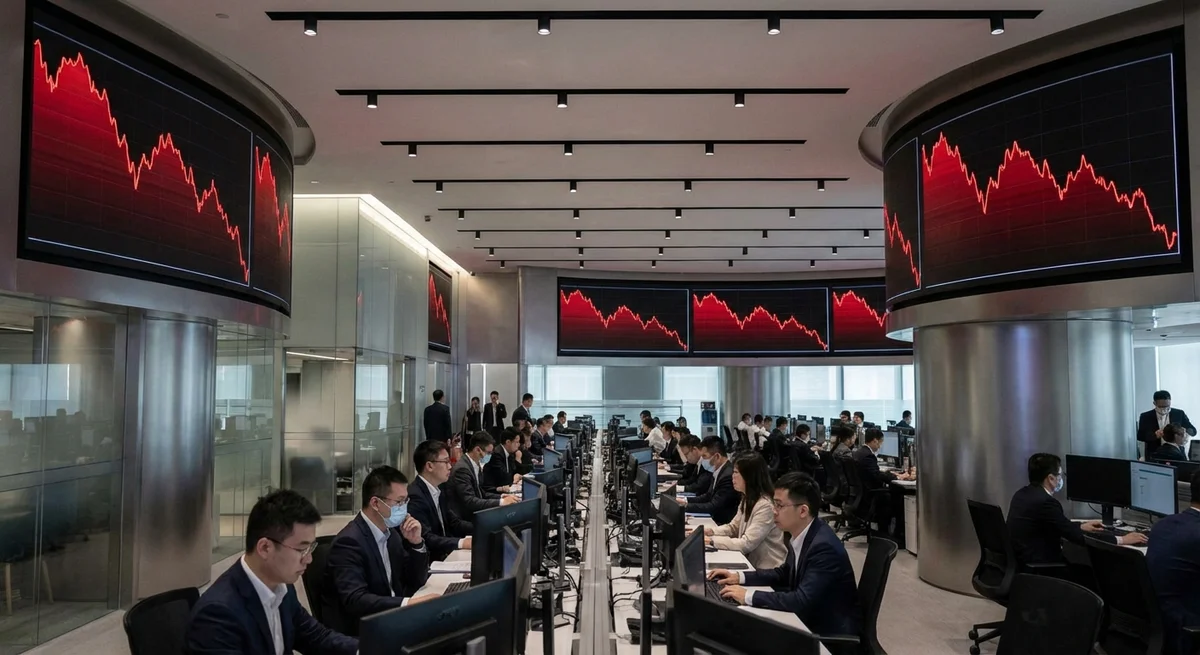
When the charts on the Shanghai stock market turn red, the trouble rarely stays confined to oil or metals. Today, the Shanghai index slid a full 2% in the afternoon session, a clear illustration of how nervously the market reacts to any shock in the tech sector. Semiconductors took an especially hard hit, and for today's AI race, they mean almost everything. If you don't have your own chips, your neural networks remain nothing more than elegant code on paper.
Some context. China is in a state of permanent technological mobilization. After the US cut off access to NVIDIA's top-tier accelerators, Beijing bet on domestic production. The semiconductor sector became a sacred cow, with billions pumped in through state funds. But the market is cynical. When overall economic confidence falls, investors start pulling out of risky assets, and chip development is the riskiest, most capital-intensive asset there is.
The decline hit more than 3700 companies. This was a mass exodus, not a local correction. Besides chipmakers, cyclical resource stocks also took a beating: metals, oil and gas, and chemicals. What does any of this have to do with AI? The link is direct. Microelectronics manufacturing consumes enormous amounts of specialized materials and energy. When the commodities sector gets choppy, it inevitably hits production costs and logistics for high-tech manufacturing. We're watching a chain reaction in which weakness in the real economy undercuts ambitions for a digital future.
Why does this matter right now? The whole world is waiting to see whether China can deliver a real alternative to the Hopper or Blackwell architecture. Companies such as Biren Technology and Moore Threads depend heavily on market sentiment and their ability to raise private capital. If the index keeps falling, private investment in AI hardware may dry up, leaving startups with only state subsidies, which are not always enough to fund breakthrough innovation.
It's interesting to watch geopolitics intertwine with domestic market mechanics. On one side, companies have guaranteed government contracts; on the other, investors see the risk of a global economic slowdown. The current crash is a cold shower for anyone who believed China's tech sector could grow in isolation from broader market trends. Without a stable financial foundation, building "smart cities" and training giant language models becomes many times harder and more expensive.
The bottom line: a slowdown in China's semiconductor sector may give Western companies a much-needed breather in the AI arms race. Or is this just a temporary correction before the next leap forward? The question is how deep this drop will run for the companies building the "brains" of the future.
*Meta is recognized as an extremist organization and banned in the Russian Federation.
- Nov 2, 2026Meta's Muse assistant keeps dossiers on loved ones and gets root on Ubuntu by default
- Nov 2, 2026The Verge reviewer builds a $50 Meta Muse Charm alternative with Claude Code
- Nov 1, 2026MoneyGate safety layer blocked all 42 fraudulent requests to local AI models
- Oct 31, 2026Open-source LLM gateway KTMS 1.0 plugs your own GPUs into the cloud and survives outages
Test Frontier LLMs & Autonomous Agents in One Workspace
Run Claude Opus 5.5, GPT-6, Gemini 3.1, and DeepSeek side-by-side in Nomad AI (nomadnet.ai) — unified model routing, deep research, and multimodal workflows under one subscription.
The AI world, distilled — once a week
Seven stories that actually mattered, hand-picked. No noise, no reposts, no press releases.
Done! Check your inbox for a confirmation.