ChiNext in a Nosedive: China's AI Sector Puts Investors' Nerves to the Test
The ChiNext index, often called China's answer to NASDAQ, posted a classic reversal today. After a brisk 1% gain, prices tumbled by more than a percent. This isn't just market noise: it reflects jitters around China's tech sector. Beijing is betting on an AI breakthrough, but investors are starting to doubt that the multibillion-dollar sums poured into model training will pay off quickly. The volatility in Shenzhen sends a clear signal: the euphoria over "China's answer to OpenAI" is giving way to a harsh reality check and a hunt for actual profits.
AI-processed from 36Kr (36氪); edited by Hamidun News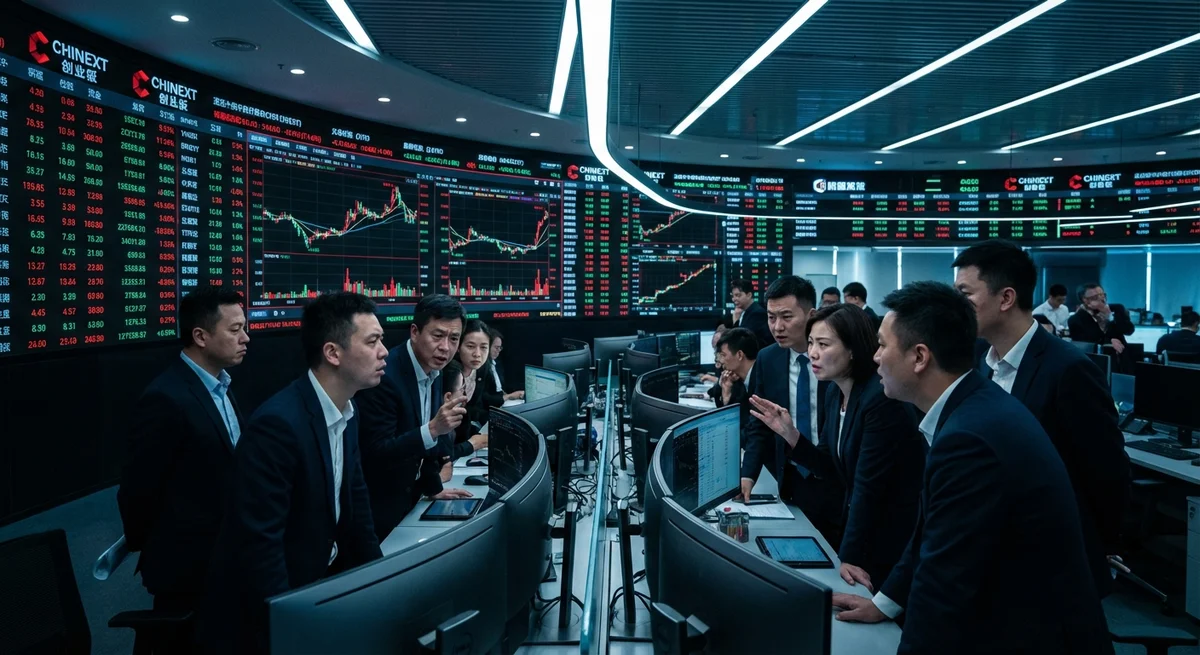
Picture a party where everyone is talking about a bright future and robots, until the music suddenly cuts out and the guests start frantically checking their wallets. That's roughly what happened today on the Shenzhen Stock Exchange. The ChiNext index, China's main showcase for innovation and home to most of its ambitious AI startups, pulled off a painful about-face. The market opened the day with a confident gain of more than 1%, then abruptly changed its mind and fell into the red by the same amount. For anyone tracking China's tech sector, it came as a cold shower.
To see why this matters, look at the context. ChiNext isn't just numbers on a screen; it's a barometer of confidence in China's "new economy." In recent months, the index has been inflated by expectations around generative AI. Every report that another model from Baidu or Alibaba had caught up with GPT-4 pushed prices higher. Today, though, the market bared its teeth. Investors appear to be realizing that the road from an impressive chatbot demo to steady quarterly profits is far longer and rockier than it looked at the height of the hype.
External factors complicate the picture. As Chinese companies fight the "model wars," a shortage of compute hangs over them like the sword of Damocles. Sanctions on shipments of advanced Nvidia chips force businesses to spend enormous budgets on workarounds or on building their own solutions, which don't always match global standards yet. When ChiNext changes direction this sharply, it often means big money has decided to lock in profits before the bubble of expectations stretches too thin.
Notably, the reversal came amid active government efforts to stimulate the high-tech sector. Beijing is pouring billions into semiconductors and quantum computing, but the market is a fickle creature. It wants more than promises of technological sovereignty: it wants concrete cases of AI deployed in the real economy that bring in yuan here and now. Today's volatility makes the point: investors are no longer willing to buy "the future" at any price.
What does this mean for the industry as a whole? Most likely, interest in smaller players will cool, and resources will consolidate around giants with enough of a safety margin. The era when any mention of neural networks in a press release guaranteed a stock pop is officially over. From now on, companies will have to prove their viability amid fierce competition and limited access to global capital markets. China's AI sector is entering a phase of maturity, and that phase always comes with a painful correction.
The key question: is China's tech sector ready for a long fight without cheap money and easy optimism?
- Nov 1, 2026Voice bots built on LLMs turn to Jev, a fast classifier, for decisions in 200–500 ms
- Nov 1, 2026Local AI models agreed to pay scammers, while simple rules blocked all 42 schemes
- Oct 31, 2026A 22B-Parameter Video Model Runs on an RTX 3080 with 10 GB of VRAM
- Oct 30, 2026Mistral opens Large 4 weights: strong at code, but Chinese models score 32 to its 26
Test Frontier LLMs & Autonomous Agents in One Workspace
Run Claude Opus 5.5, GPT-6, Gemini 3.1, and DeepSeek side-by-side in Nomad AI (nomadnet.ai) — unified model routing, deep research, and multimodal workflows under one subscription.
The AI world, distilled — once a week
Seven stories that actually mattered, hand-picked. No noise, no reposts, no press releases.
Done! Check your inbox for a confirmation.