Huawei Goes Rural: AI Diagnostics Now Run on an Ordinary Office PC
Huawei Cloud has launched the industry's first "Dream Factory" project for medicine. The main new product is RuiPath, a system that lets doctors run complex tissue analysis on a budget PC through the cloud. It was developed jointly with Ruijin Hospital and includes specialized hardware and software. Doctors in the regions no longer have to wait weeks for answers from big cities. Huawei is effectively democratizing access to high-tech medicine by moving the computing load from local machines to its own servers. It is an important step against the shortage of qualified staff in the provinces, where AI takes the role of an experienced assistant.
AI-processed from 36Kr (36氪); edited by Hamidun News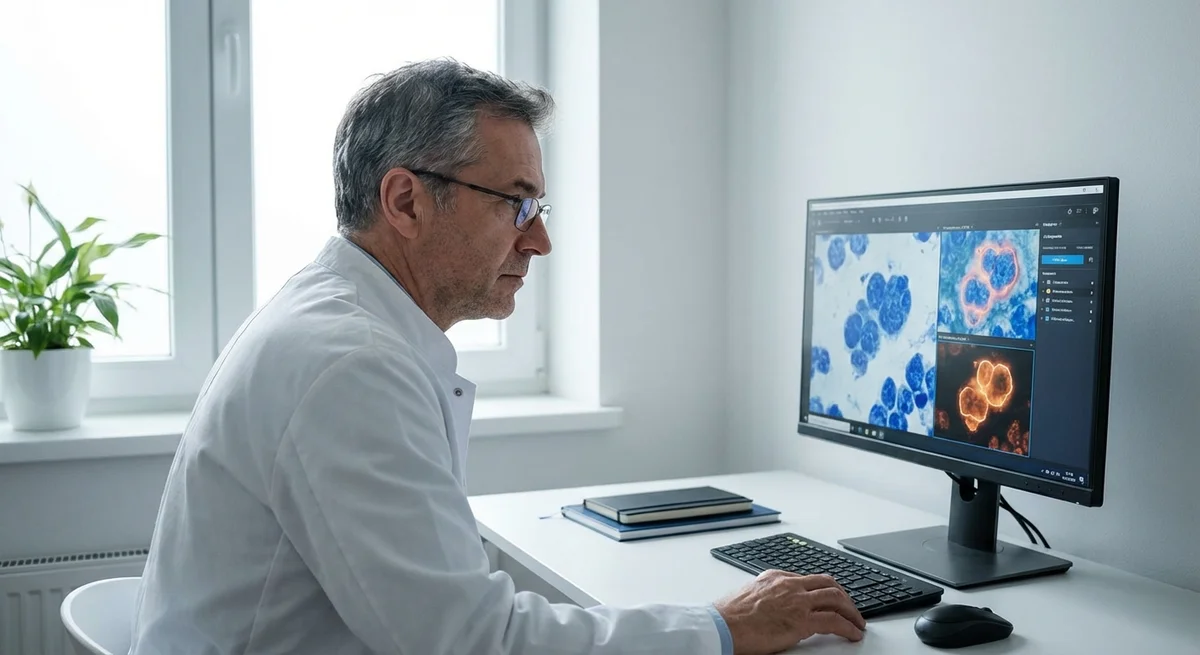
While Western tech giants compete over whose chatbot writes better poems, Huawei has chosen to tackle something genuinely down-to-earth and useful. The company is going after one of the sharpest problems in modern medicine: access to quality diagnostics in the regions. At a recent academic conference in 2026, Huawei Cloud head Zhou Yuefeng presented a project that could change the rules of the game for thousands of doctors in small hospitals. It is the first specialized medical sector within the company's industrial "Dream Factory" platform.
The core problem has always been that modern digital pathology demands enormous computing power. For AI to analyze a tissue scan and find signs of pathology, a hospital usually has to buy a server rack that costs as much as the annual budget of a small town. Huawei took a different route, adopting a cloud-terminal collaboration concept. The heavy lifting happens on the company's servers, while a doctor in the provinces sees the result on an ordinary work computer. No supercomputers under the desk: a simple internet connection and standard office hardware are enough.
At the center of the announcement is RuiPath, a hardware-and-software complex built in close partnership with the renowned Ruijin Hospital. It is not just software but a full "smart machine" for pathology. It ships with preinstalled RuiPath models already trained on huge datasets from one of China's best clinics. In effect, Huawei has packed the expertise of top metropolitan diagnosticians into a compact box and put it into mass production. A rural doctor can now get a second opinion from an algorithm that has seen more clinical cases than any human could in a lifetime.
Why does this matter right now? China, like many other countries, faces a vast gap between the quality of medicine in megacities and in the hinterland. The shortage of pathologists is a global problem, yet their conclusions determine the treatment strategy for cancer and other serious diseases. Huawei is not just selling hardware; it is building an infrastructure in which AI is not a replacement for the doctor but their eyes and memory. It is a classic example of "cloud-edge" technology finding an ideal use in the real economy, not only in self-driving cars or games.
It is interesting to watch Huawei Cloud aggressively capture vertical markets. A medical-focused "Dream Factory" is a clear signal to competitors. The company is building an ecosystem in which medical software developers do not need to think about where to find computing power. They simply come to the Huawei platform and get access to development and distribution tools. For the industry, this means a faster cycle from scientific publication to real deployment in hospital practice. If this path used to take years, it is now measured in months.
Ultimately, we are watching Huawei transform from a network equipment supplier into a full operator of intelligent services. The project with Ruijin Hospital is only the first swallow. Expect similar solutions soon for radiology, cardiology and other fields where visual data analysis plays a key role. The only question is how quickly the conservative medical community can adapt to an algorithm from the cloud becoming its main adviser.
Bottom line: Huawei is betting on the "democratization" of medical AI through cloud architecture. Will other cloud providers be able to offer equally deep integration with real medical hardware?
Test Frontier LLMs & Autonomous Agents in One Workspace
Run Claude Opus 5.5, GPT-6, Gemini 3.1, and DeepSeek side-by-side in Nomad AI (nomadnet.ai) — unified model routing, deep research, and multimodal workflows under one subscription.
The AI world, distilled — once a week
Seven stories that actually mattered, hand-picked. No noise, no reposts, no press releases.
Done! Check your inbox for a confirmation.