How to Run Ultra-Efficient 1-Bit Neural Networks Locally: A BitNet Guide
The bitnet.cpp project makes it possible to run advanced language models even on ordinary hardware. Built on the BitNet b1.58 architecture, the technology uses 1-bit weights, which sharply cuts memory and compute requirements without a critical loss of quality. The new guide walks through setting up the environment, downloading the weights and configuring a local chat server. It is an important step toward democratizing AI, letting users keep full control of their data privacy and stay independent of cloud providers.
AI-processed from KDnuggets; edited by Hamidun News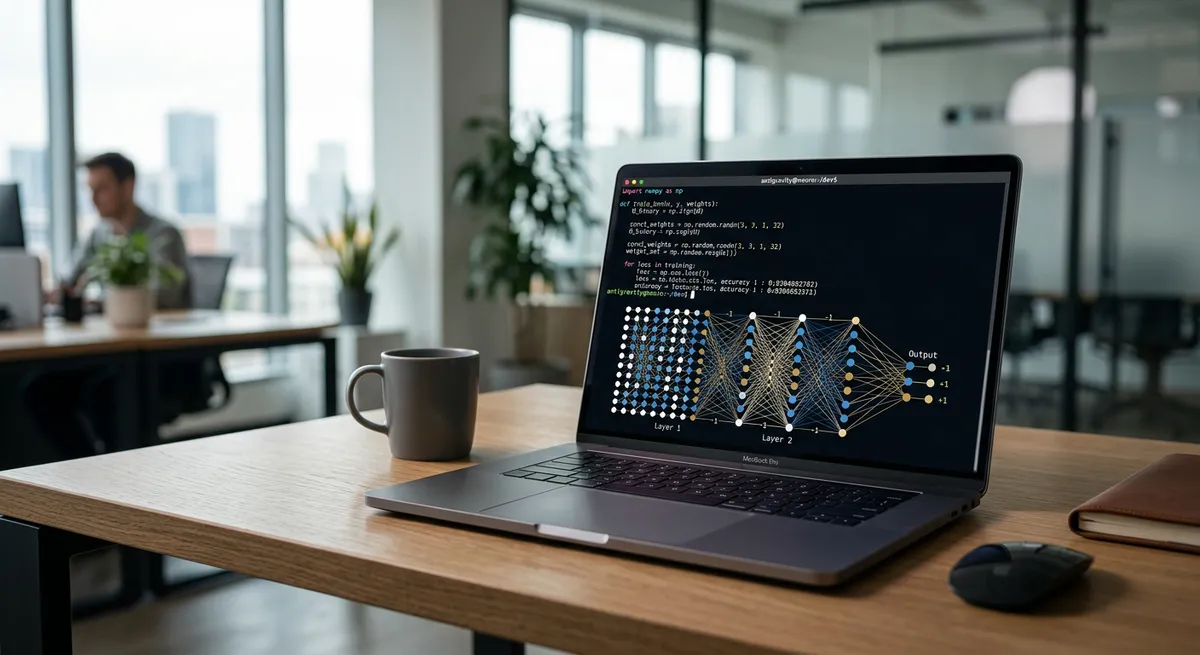
How to Run Ultra-Efficient 1-Bit Neural Networks Locally: A BitNet Guide
For a long time, the AI industry was dominated by the idea of scaling up compute. We got used to the notion that running a genuinely capable language model requires expensive GPUs with huge amounts of video memory. But in the shadow of giant server farms, a quiet revolution has been maturing, one that questions the very need for high-precision computation.
The arrival of the bitnet.cpp project and the BitNet b1.58 architecture marks a transition to an era of ultra-efficient computing, in which complex neural networks can run on ordinary home or office hardware.
The technology does not merely optimize existing processes; it radically changes the rules, making it possible to run advanced algorithms at a single bit while keeping an impressive level of capability.
To understand why this breakthrough matters, it helps to look at the technical context of traditional machine learning. Most modern models use the FP16 or BF16 format, where each parameter takes 16 bits. Even quantization, popular today, which compresses weights to 4 or 8 bits, remains only an attempt to fit heavyweight structures onto consumer hardware.
The BitNet b1.58 architecture takes a fundamentally different approach. Instead of trying to preserve fractional values with high precision, Microsoft researchers proposed a ternary weight system, in which weights take only the values minus one, zero and one.
Mathematically, this turns matrix multiplication, the main consumer of resources in processors, into simple addition and subtraction. This approach not only cuts RAM requirements several times over, but also lets CPUs process data at speeds previously available only to specialized chips.
The practical implementation of this concept in bitnet.cpp gives users a direct path to running AI locally. Deployment starts with preparing the environment, which requires installing basic compilation tools and libraries for working with Python.
Once the environment is configured and the repository cloned, you move on to the model weights. Unlike standard solutions, the specialized BitNet b1.58 weights are optimized specifically for the ternary structure.
Downloading them and converting them to a format the local server understands has become significantly simpler thanks to automated scripts. The result is a full chat server running directly on your machine. It is worth noting that on an ordinary laptop CPU, such a system can outperform quantized models of similar size running on mid-range graphics cards, which makes the technology well suited to budget setups.
The deeper consequences of democratizing AI through 1-bit networks go far beyond simple hardware savings. First of all, it is a fundamental shift in privacy and digital sovereignty. When a model runs locally, a user's confidential data never leaves the device, which is critical for medicine, law and personal communications.
In addition, lower power consumption makes these models more environmentally friendly, answering the global demand to reduce the carbon footprint of IT infrastructure. We are on the verge of a new type of "smart" device, from wearables to Internet of Things sensors, with built-in intelligence that needs neither a constant cloud connection nor giant batteries. This opens access to advanced technology for millions of people in regions with unstable internet or limited access to modern semiconductors.
In summary, bitnet.cpp and its underlying BitNet b1.58 architecture are among the most promising directions in applied artificial intelligence. Moving from excessive precision to architectural efficiency helps return control over technology to end users. Although the technology is still under active development and needs further work for certain specific tasks, the foundation for mass adoption of local AI has already been laid. A future in which powerful artificial intelligence lives in every pocket and on every desktop, without relying on the might of corporate data centers, is becoming reality today.
- Nov 2, 2026Anthropic needs to grow revenue 32% a year to cover $850 billion in contracts
- Nov 2, 2026Microsoft releases 4B model Mage-VL-Cowork, which solves 66.0% of OSWorld-Verified tasks
- Nov 1, 2026Google's StreamVibe video agent beats other models by 10.7% on response timing and quality
- Oct 30, 2026Mistral opens Large 4 weights: strong at code, but Chinese models score 32 to its 26
Test Frontier LLMs & Autonomous Agents in One Workspace
Run Claude Opus 5.5, GPT-6, Gemini 3.1, and DeepSeek side-by-side in Nomad AI (nomadnet.ai) — unified model routing, deep research, and multimodal workflows under one subscription.
The AI world, distilled — once a week
Seven stories that actually mattered, hand-picked. No noise, no reposts, no press releases.
Done! Check your inbox for a confirmation.