SpaceX and a Million Satellites: Musk Is Building an AI Cloud in Orbit
SpaceX has filed an ambitious application with the FCC for a network of 1 million satellites. This is not just an expansion of Starlink but a full infrastructure for orbital data centers. Satellites at altitudes of 500 to 2,000 km would run AI inference for billions of users, using laser links to move data. Musk plans to build a distributed space supercomputer that would ease the latency and capacity shortages on Earth. If regulators approve the project, it would become the largest computing network in human history, running literally over our heads.
AI-processed from 36Kr (36氪); edited by Hamidun News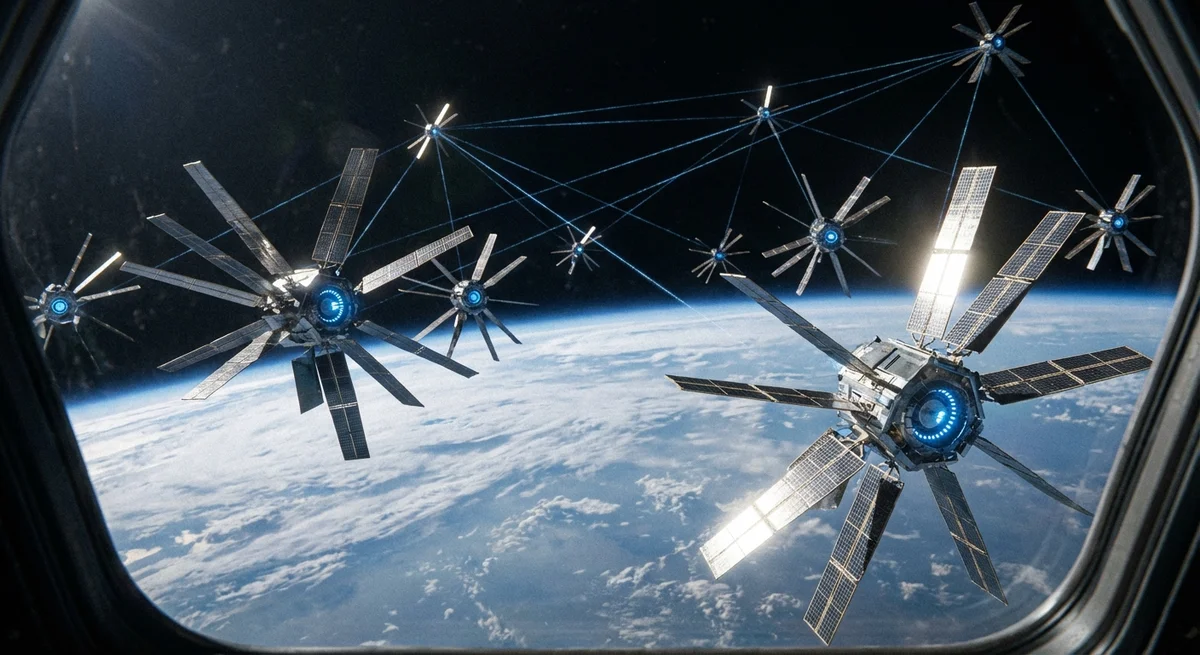
Imagine looking at the night sky and realizing that what is passing overhead is not just a piece of metal handing out internet, but a working chip processing someone's neural network query at that very moment. SpaceX has just made a move that makes even the boldest Starlink growth forecasts look modest. The company has filed an official application with the US Federal Communications Commission (FCC) to deploy a constellation of one million satellites. The number looks like a typo, but the documents are entirely serious: they describe a global network of orbital data centers optimized for artificial intelligence workloads.
Why would Musk need a million satellites when the current Starlink constellation has barely passed six thousand? The answer lies in one word: inference. Modern neural networks demand enormous compute not only for training but also for everyday operation. Today your queries travel to huge ground-based facilities somewhere in Iowa or Finland. SpaceX proposes moving that computation into space. The satellites would be placed at altitudes of 500 to 2,000 kilometers in very narrow orbital shells just 50 kilometers wide. That would let operators pack compute nodes as densely as possible while keeping a safe distance for maneuvers and avoiding collisions with other spacecraft.
The technical side reads like science fiction made real. The satellites would run on solar power and talk to each other over optical laser links. That creates a single high-speed network in which data can travel at the speed of light in a vacuum, which is 30–40% faster than in fiber on Earth. In effect, SpaceX is building a giant distributed supercomputer that wraps around the planet. This architecture would minimize latency for the end user, because the signal would be processed by the nearest satellite instead of making a long trip through terrestrial backbones and routers.
The context of this event cannot be ignored. We are in the middle of a "compute fever," with Nvidia unable to ship chips fast enough and state power grids straining under the appetite of new data centers. Moving computation into orbit addresses two fundamental problems: cooling and space. Space has no shortage of room, and heat dissipation, though a hard engineering problem in a vacuum, removes the need to spend millions of tonnes of water and gigawatts of electricity on air conditioning for ground-based halls. Such a network would also be practically immune to local disasters or political upheaval on the ground.
Of course, the question is whether the FCC will let anyone turn orbit into one continuous server rack. A million objects is a colossal load on space debris tracking systems and on astronomy. Astronomers already complain about "light pollution" from Starlink, and a 150-fold increase in satellites could shut down optical observation of the stars for good. Still, Musk has always operated on the principle of "act first, negotiate later." If even 10% of this project is realized, SpaceX will turn from a transport and telecom company into the planet's main AI provider, controlling not only the communication channels but the intelligence that flows through them.
Bottom line: SpaceX is moving from selling traffic to selling compute, building the first "space brain" in history. Will competitors be able to offer anything comparable in scale, or will orbit become the private property of a single corporation?
- Nov 2, 2026TensorFold 1.2.0 boosts Qwen3.8-27B throughput on M3 Ultra by 44.2% at 16 streams
- Nov 1, 2026Local models lose to Opus and Codex: 0.21 on a MacBook versus 1.00 for Codex
- Nov 1, 2026Habr author fine-tunes YOLOv8l on dental X-rays and pushes mAP50 to 0.642
- Nov 1, 2026Voice bots built on LLMs turn to Jev, a fast classifier, for decisions in 200–500 ms
Test Frontier LLMs & Autonomous Agents in One Workspace
Run Claude Opus 5.5, GPT-6, Gemini 3.1, and DeepSeek side-by-side in Nomad AI (nomadnet.ai) — unified model routing, deep research, and multimodal workflows under one subscription.
The AI world, distilled — once a week
Seven stories that actually mattered, hand-picked. No noise, no reposts, no press releases.
Done! Check your inbox for a confirmation.