Snowpocalypse: When Reality Looks Like a Bad Sora Prompt
Footage of cities buried in snow up to their rooftops has flooded social media. For the AI industry, it is an important wake-up call: while we train models to generate hyperrealistic videos of disasters, our predictive systems often fail against real anomalies. That highlights the gap between a "picture" and a deep understanding of the physics behind these processes. While OpenAI's Sora scares us with its realism, nature shows who the true master of special effects is, and why a training set is not everything.
AI-processed from Futurism; edited by Hamidun News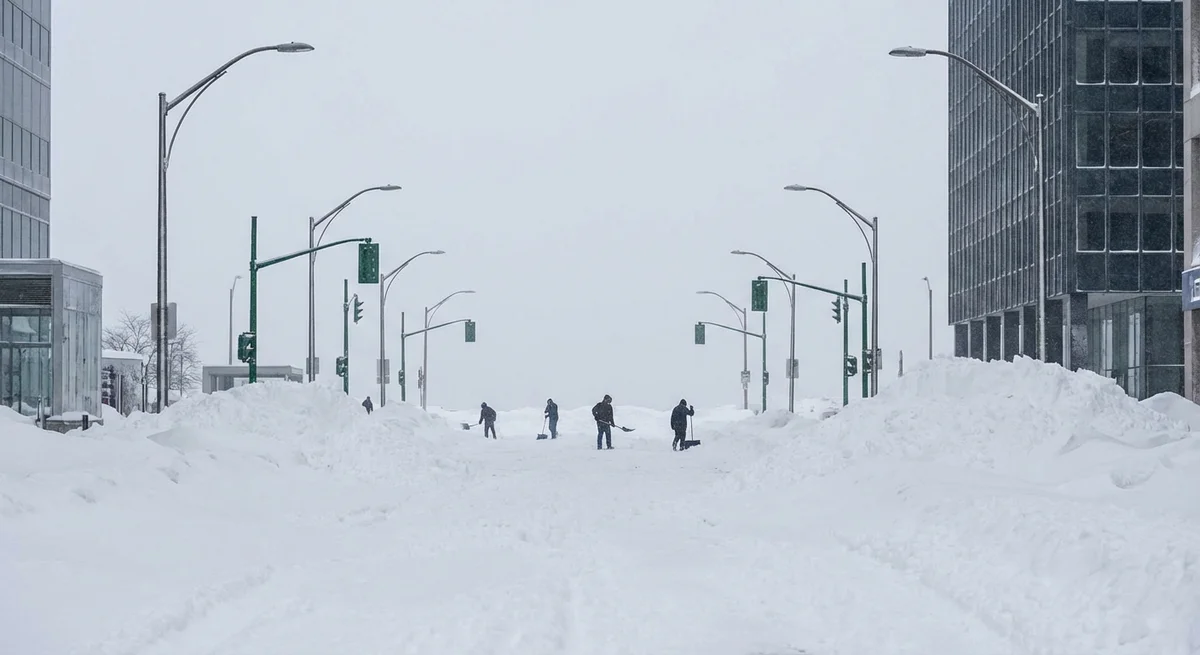
Look at these clips from social media: cities literally wiped off the face of the earth by a snow layer many meters deep. If I told you this was a new demo reel from OpenAI or Runway, you would probably believe me. We have reached the point where real natural disasters inspire less trust than neural-network generations. But behind the viral videos lies a serious problem for our whole cozy tech bubble. While we argue over whether ChatGPT will replace programmers, the real world keeps throwing up problems that modern AI has still not learned to solve.
The context is simple: the past two years have been a time of "meteorological hype" in AI. Google DeepMind launched GraphCast, NVIDIA is building Earth-2, and Huawei is promoting Pangu-Weather. These models promised us a revolution, predicting the weather in seconds with an accuracy that traditional numerical methods on supercomputers cannot match. The irony is that when it comes to extreme "black swans" like this epic snowfall, the much-praised neural networks often do no better than a fortune teller. Here is why.
The main trouble is that AI is essentially a very sophisticated machine for averaging experience. It trains on historical data from the last 40-50 years. If that sample contained no anomaly of this scale, the model simply cannot imagine one. To a neural network, such an event is statistical noise that needs to be "smoothed out." The result: AI predicts tomorrow's rain in London superbly, yet is completely blind to a once-in-a-century catastrophe. This is a fundamental limitation of the architecture: models work well inside the data distribution but get lost outside it.
There is another aspect, ironic and a little frightening. We pour billions of dollars into generative AI so that it can draw us beautiful pictures of the apocalypse. We teach Sora to understand how light falls on snowflakes and how snowdrifts move. Yet we spend far fewer resources teaching AI to understand the physics of these processes at the level of forecasting. We are building digital mirrors of reality that look flawless but have no solid ground beneath them. As a result, the picture on your smartphone becomes more "real" than the snowdrift outside your window, the one paralyzing data centers and logistics.
What does this mean for the industry? It is time to admit that the purely statistical approach in AI has hit a ceiling. The future belongs not to huge language models but to hybrid systems, so-called Physics-informed Neural Networks (PINNs). These are neural networks whose "brains" have the laws of thermodynamics and fluid dynamics built in at the architecture level. Only then can we move from simply painting pixels to genuinely managing risk in the physical world. For now, all we can do is watch the videos and marvel at how easily nature outplays any GPU.
The bottom line: nature remains the best content generator, while our AI models are still too dependent on the past to predict the future. Will weather startups start hiring physicists as eagerly as they hire prompt specialists?
- Nov 2, 2026Meta's Muse assistant keeps dossiers on loved ones and gets root on Ubuntu by default
- Nov 1, 2026Local models lose to Opus and Codex: 0.21 on a MacBook versus 1.00 for Codex
- Nov 1, 2026Kimi scores 96.2% on a 1C database analytics test and emerges as a fallback if Claude access is blocked
- Nov 1, 2026OpenAI Rewrites GPT Behavior Rules: Five Values and a Chain of Command
Test Frontier LLMs & Autonomous Agents in One Workspace
Run Claude Opus 5.5, GPT-6, Gemini 3.1, and DeepSeek side-by-side in Nomad AI (nomadnet.ai) — unified model routing, deep research, and multimodal workflows under one subscription.
The AI world, distilled — once a week
Seven stories that actually mattered, hand-picked. No noise, no reposts, no press releases.
Done! Check your inbox for a confirmation.