Stanford Posts Marco Pavone's Lecture on Graph-Based Robot Motion Planning
Stanford Online has put Lecture 6 of the AA274A course Principles of Robotic Autonomy on YouTube: "Motion Planning I: Graph Search Methods." The lecturer is Marco Pavone, a Stanford professor and senior director of autonomous vehicle research at NVIDIA who previously worked at NASA's JPL. The recording dates from fall 2019, and the course has changed since then. The textbook Principles of Robot Autonomy is free at porabook.com, and the current syllabus is on the ASL lab website. • Lecture 6 of AA274A, on motion planning via graph search • The speaker splits his time between Stanford and NVIDIA • The textbook is free, and the schedule for the current version of the course is public
AI-processed from YouTube: Stanford Online; edited by Hamidun News
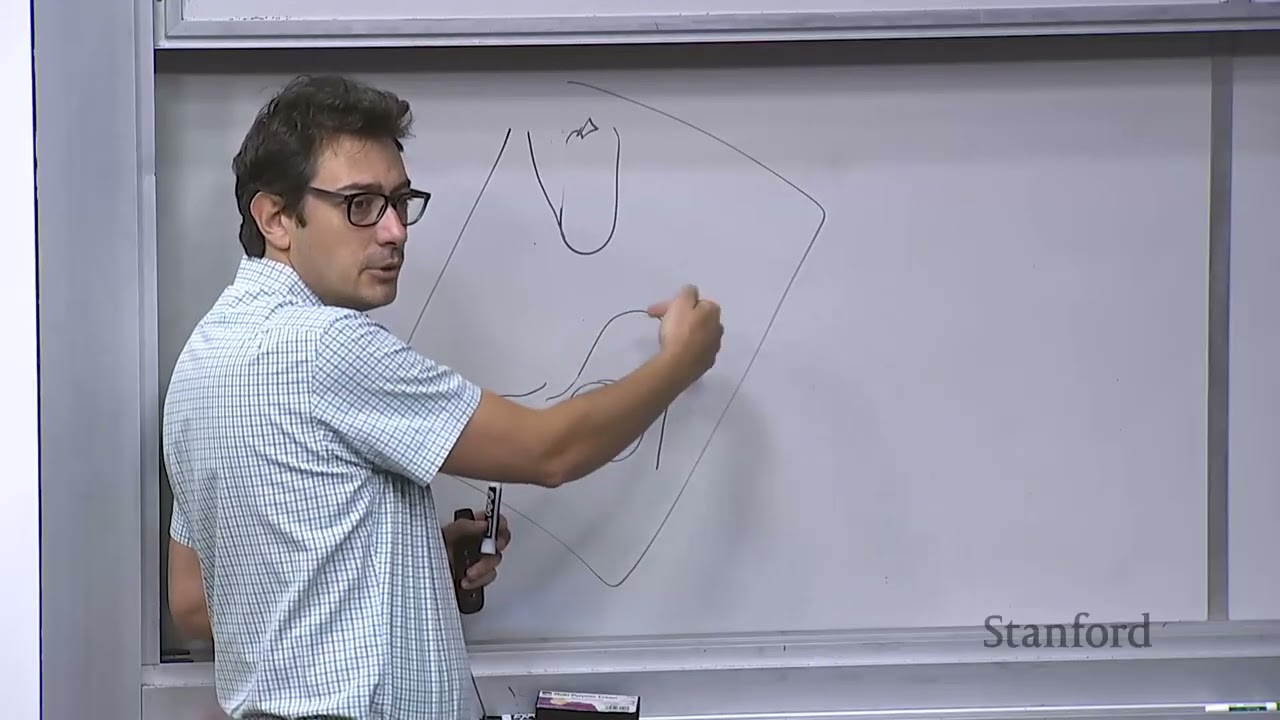
Stanford Online has posted Lecture 6 of the AA274A course Principles of Robotic Autonomy on YouTube. It covers motion planning with graph search methods (Motion Planning I). The lecturer is Marco Pavone: an associate professor of aeronautics and astronautics at Stanford, senior director of autonomous vehicle research at NVIDIA, and formerly a researcher in the robotics group at NASA's JPL. The recording was made in fall 2019. The publishers explicitly warn that the course structure, assignments and materials may have changed since then.
This is teaching material, not release news. But it covers one of the foundational topics of any robotics stack, and it comes with unusually strong authorial context.
What the lecture covers
Graph-based motion planning reduces a robot's task to a search problem. The space of possible positions is discretized: nodes represent states, edges represent permitted transitions, and each edge has a cost. The goal is then to find a path from start to goal with the lowest total cost.
The standard toolkit for this formulation is well known. Dijkstra's algorithm finds the optimal path but expands vertices in every direction. A adds a heuristic estimate of the distance to the goal and searches in a more directed way. If the heuristic is admissible, meaning it does not overestimate the true cost, A keeps its optimality guarantee. Dijkstra's algorithm is then a special case of A* with a zero heuristic. For the exact contents of the lecture, check the video itself: its description lists only the topic.
Why the lecturer matters
Pavone works at the intersection of academic robotics and industrial autonomous driving development. That shows in the course itself: it is built as a path from perception and state estimation to planning and control, not as a collection of disconnected algorithms. A standalone lecture on graph search serves as a foundation here. More complex planners and learning-based methods build on it later.
Publication details:
- Course: AA274A Principles of Robotic Autonomy, Lecture 6
- Topic: Motion Planning I, graph search methods
- Speaker: Marco Pavone, Stanford and NVIDIA
- Recording date: fall 2019
- Format: video on the Stanford Online channel
- Textbook: Principles of Robot Autonomy, free at porabook.com
- Current schedule: stanfordasl.github.io/PoRA-I
How to use the material
It is worth watching the lecture alongside the corresponding textbook chapter. The best way to test your understanding is to write A* on a 2D grid in a few dozen lines of Python. Then compare it with Dijkstra's algorithm on the same map with obstacles and count how many vertices each one expands. The difference in the number of expanded nodes quickly shows what a heuristic does in practice.
Engineers who work with mobile platforms or drones will find it useful to compare the lecture with the planner in their own stack. Often it turns out that edge costs, discretization step and the choice of heuristic affect the robot's behavior more than the search algorithm itself.
One caveat. The recording belongs to the 2019 version of the course. If you need the curriculum as it stands now, including new topics and assignments, check the current syllabus on the ASL lab website. The lecture works as a free entry point for anyone who wants to understand the basics of planning before moving on to more modern approaches.
Delegate Deep Research, Coding & Workflows to an AI Agent
Deploy autonomous multi-step execution with NomadNet Agent (agent.nomadnet.ai) — automated web research, data synthesis, code generation, and complex task orchestration.
The AI world, distilled — once a week
Seven stories that actually mattered, hand-picked. No noise, no reposts, no press releases.
Done! Check your inbox for a confirmation.