Stanford Posts Pavone's Stereo Vision Lecture: AA274A Course and a Free Textbook
Stanford Online has posted the tenth lecture of AA274A "Principles of Robotic Autonomy" on YouTube. It covers stereo vision. The recording dates from fall 2019. The lecturer is Marco Pavone, an assistant professor at Stanford and senior director of autonomous vehicle research at NVIDIA. He previously worked at NASA's JPL. The course comes with a free textbook, Principles of Robot Autonomy (porabook.com), and the current schedule is on the ASL lab website. Stanford warns that the syllabus has changed since then. • The lecture is from 2019; the course materials have been updated since. • The PoRA textbook is free and online. • The lecturer splits his time between Stanford and NVIDIA.
AI-processed from YouTube: Stanford Online; edited by Hamidun News
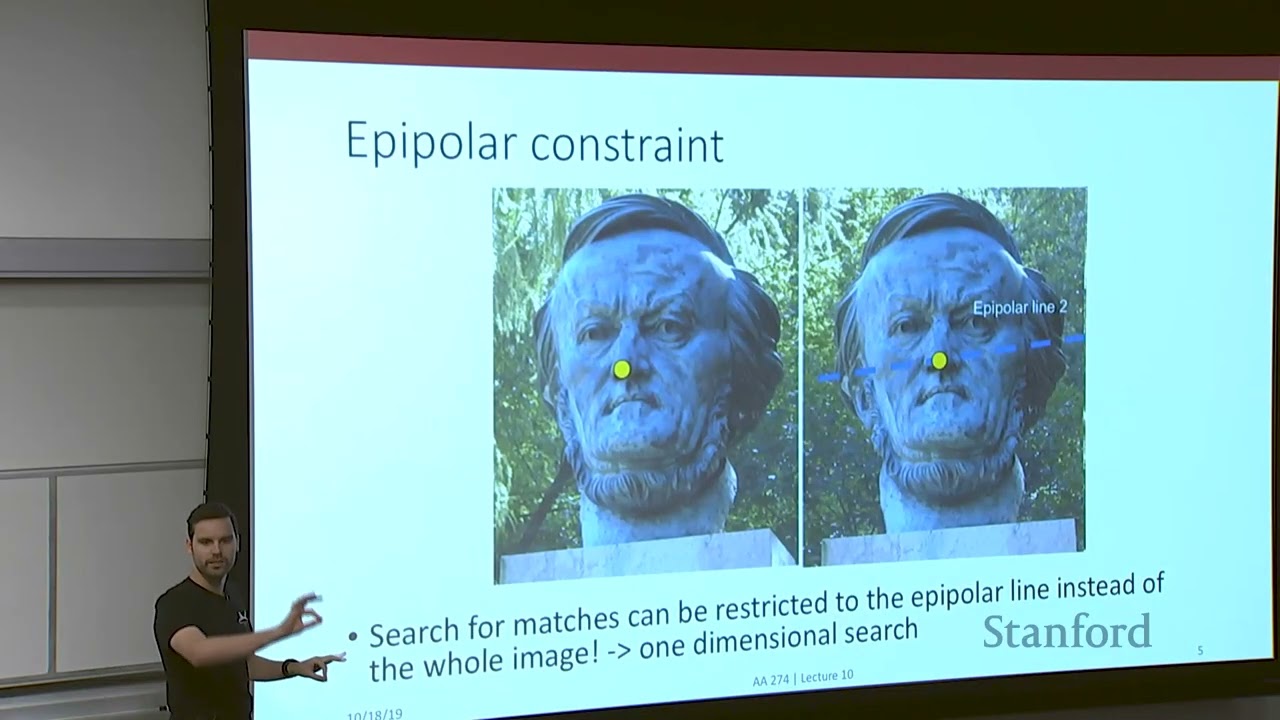
Stanford Online has published Lecture 10 of the AA274A course "Principles of Robotic Autonomy" on YouTube. It covers stereo vision. The recording dates from fall 2019, so the material is seven years old. The lecture is given by Marco Pavone, an assistant professor in Stanford's Department of Aeronautics and Astronautics and senior director of autonomous vehicle research at NVIDIA. He previously worked at NASA's Jet Propulsion Laboratory. Calling this news is a stretch: the video contains no fresh results. But for anyone entering robotics, it is a free walkthrough of a foundational topic from someone who now works on autonomous driving in industry.
What we know about the recording itself
The lecture description is short. It lists the title, the lecturer, and links to the textbook and the schedule. It gives no detailed list of topics, so summarizing the content minute by minute would mean making it up. Stanford itself notes that the course structure, assignments and materials may have changed since 2019, and that the links point to the current version. Treat the video as an archival recording and go to stanfordasl.github.io/PoRA-I for the up-to-date syllabus.
The textbook Principles of Robot Autonomy is available for free at porabook.com. It is a rare case of a university robotics course packaged as an open set of lectures, a book and a schedule.
Why a robot needs two eyes
Stereo vision estimates depth from a pair of images taken by two cameras set apart from each other. The classic formula for a rectified pair is Z = f·B / d. Here Z is the distance to a point, f is the focal length in pixels, B is the baseline between the cameras, and d is the disparity, meaning the shift of the point between the left and right frames.
Here is an illustrative example (the numbers are hypothetical and not from the lecture): f = 700 pixels, B = 12 cm, d = 10 pixels. Then Z = 700 × 0.12 / 10 = 8.4 m. A one-pixel disparity error produces a depth error of roughly Z² / (f·B), or about 0.84 m at this distance. The error grows quadratically with distance, which is why stereo pairs work well up close and worse far away. It follows that increasing the baseline and resolution is worth it mainly when you need range.
Key concepts of the topic
Courses on autonomy usually cover stereo vision in several blocks. This is a general outline of the subject area, not the syllabus of this particular lecture:
- epipolar geometry: the matching point in the second frame lies on a known line;
- rectification: transforming the pair so that these lines become horizontal;
- correspondence search: matching blocks or features between frames;
- the disparity map and its conversion into a point cloud;
- how baseline, focal length and resolution affect depth accuracy.
The trickiest part is correspondence search. Uniform walls, glare and repeating textures break the matching, and depth in those regions comes out noisy or goes missing.
How to use the material
If you are just starting in robotics, watch the lecture alongside the corresponding textbook chapter. It is best to test the formulas in code right away: take an open stereo pair, for example from the KITTI dataset, and build a disparity map with OpenCV. Then change the matching parameters and see how the result breaks down on smooth surfaces.
Keep the age of the recording in mind. Since 2019, much of vision for autonomous systems has shifted toward learned models, but the geometry is unchanged: the depth formulas and the sources of error have not become outdated. In practice, this gives you a solid foundation for working out where errors come from in any modern system, whether a neural stereo pipeline or a camera on a robot.
Delegate Deep Research, Coding & Workflows to an AI Agent
Deploy autonomous multi-step execution with NomadNet Agent (agent.nomadnet.ai) — automated web research, data synthesis, code generation, and complex task orchestration.
The AI world, distilled — once a week
Seven stories that actually mattered, hand-picked. No noise, no reposts, no press releases.
Done! Check your inbox for a confirmation.