Stanford Breaks Down the Retina as an Interpretable Neural Network in Course EE292R
Stanford Online has published a lecture by Stephen Baccus, a professor of neurobiology at Stanford, from the 2026 fall course EE292R "AI and Data for Science." The topic is mechanistically interpretable models of computation in the early visual system, meaning the retina. The video description lists no results, figures or claims, so treat the material as an announcement. The retina is a convenient testbed for interpretability: about 100 million photoreceptors pass signals to roughly 1 million ganglion cells, and both input and output can be recorded. • The course links AI and scientific data. • The retina works as a natural experiment in interpretability. • The lecture is available on YouTube.
AI-processed from YouTube: Stanford Online; edited by Hamidun News
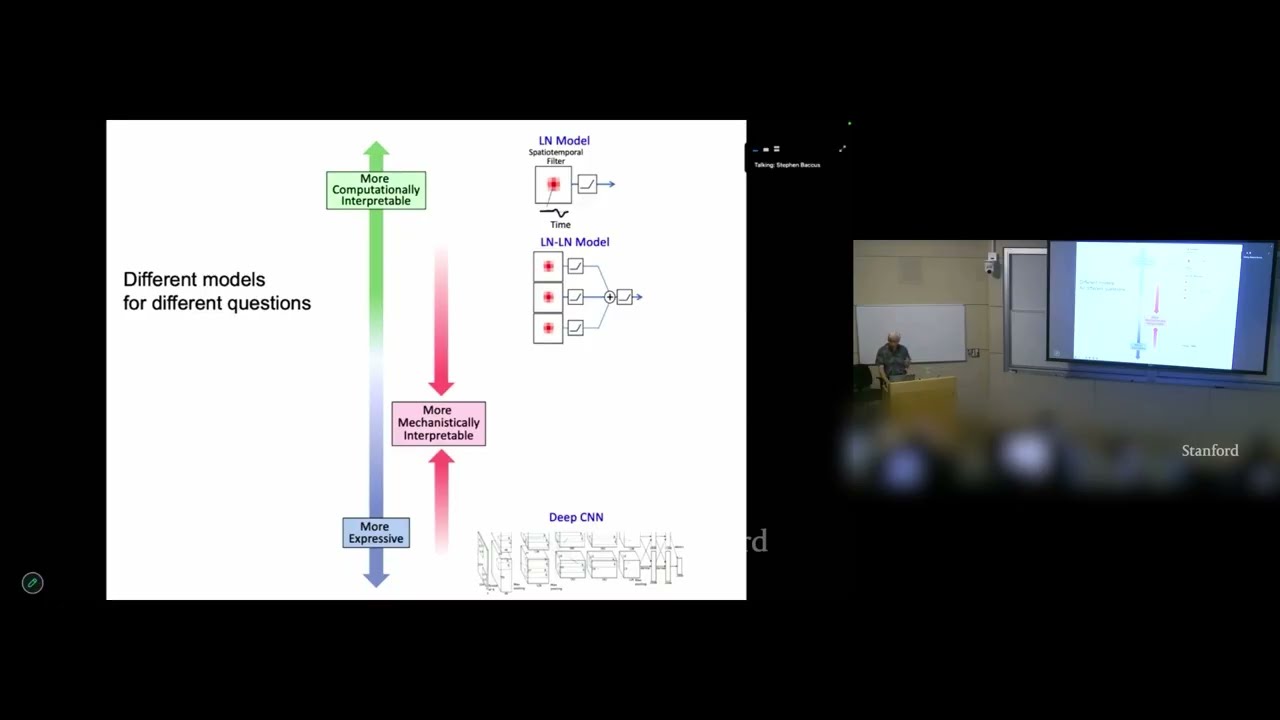
Stanford Online has posted on YouTube a lecture by Stephen Baccus, a professor of neurobiology at Stanford University. It was given as part of the course EE292R "AI and Data for Science" in fall 2026. The stated topic is mechanistically interpretable models of computation in the early visual system. That means the retina: it holds on the order of 100 million photoreceptors, yet information reaches the brain through roughly a million optic nerve fibers. The result is heavy compression, and how exactly it works remains a good problem for interpretability.
What we know about the lecture
The video description is short on specifics. It names the speaker and the course, links to the fall 2026 schedule, and carries the hashtags #ComputationalNeuroscience, #MechanisticInterpretability and #Neuroscience. It mentions no results, datasets or metrics. Anything beyond that list is marked below as context from previously published work, not as a summary of the lecture.
The course itself is positioned as a bridge between AI and scientific data. For machine learning engineers this is a rare format: the biological system is a proving ground for testing interpretability methods, not a source of metaphors.
Why the retina suits mechanistic interpretability
The retina has three properties that most large models lack.
First, the input is fully known. It is the image that the experimenter shows to the tissue. Second, the output can be recorded: electrophysiologists measure the activity of ganglion cells. Third, the intermediate layers (photoreceptors, bipolar cells and amacrine cells) have been studied for a long time, and independent data exist for them.
That creates a rare situation: for a model, you can compare not only the predictions at the output but also internal nodes against real neurons. In LLM interpretability, this kind of "ground-truth labeling" of internal states is usually missing.
Context: what Baccus's lab has already done
Baccus's group, including in collaboration with Surya Ganguli, has previously published work on convolutional neural networks as models of the retina. In a 2016 NIPS paper, such models predicted ganglion cell responses to natural scenes more accurately than classical linear-nonlinear models. In a later paper published in Neuron, the researchers analyzed the internal structure of trained networks and matched their components to retinal cells. Judging by its stated topic, the lecture continues this line of work, but that can only be confirmed after watching it.
Key parameters of the problem:
- input: natural scenes and controlled visual stimuli;
- output: ganglion cell responses, about 1 million per human retina;
- compression: from on the order of 100 million photoreceptors to a single output channel;
- method: mechanistic interpretability, meaning the search for specific computational elements inside a model;
- validation: matching internal units to recordings from real neurons.
How to use this material in practice
If you work on model interpretability, watch the lecture with a specific question in mind: how do the authors prove that a mechanism found in a model corresponds to the biological one, rather than merely matching it statistically? This criterion carries over to any task where you have data on a system's internal states.
If you build models for scientific data, pay attention to the choice of architecture. For the retina, it matters that the network's layers correspond to the anatomy; otherwise the comparison with neurons loses its meaning.
Finally, before you cite the lecture or draw conclusions from it, check its content against the video itself and the course schedule. The announcement does not contain a single result figure.
Access Frontier LLMs & Multimodal AI in One Workspace
Discover NomadNet AI (nomadnet.ai) — unified access to frontier language models, research synthesis, and multimodal workflows.
The AI world, distilled — once a week
Seven stories that actually mattered, hand-picked. No noise, no reposts, no press releases.
Done! Check your inbox for a confirmation.