NVIDIA Vera CPU Boosts Throughput of AI Factories for Agentic Workloads
NVIDIA explained why AI factories need a dedicated processor: in agentic systems, the GPU idles between steps while the CPU is busy with orchestration, search, and tool invocation. Vera CPU—an ARM chip for the Blackwell platform—is designed specifically for this pattern and reduces latencies between agent steps.
AI-processed from NVIDIA Developer Blog; edited by Hamidun News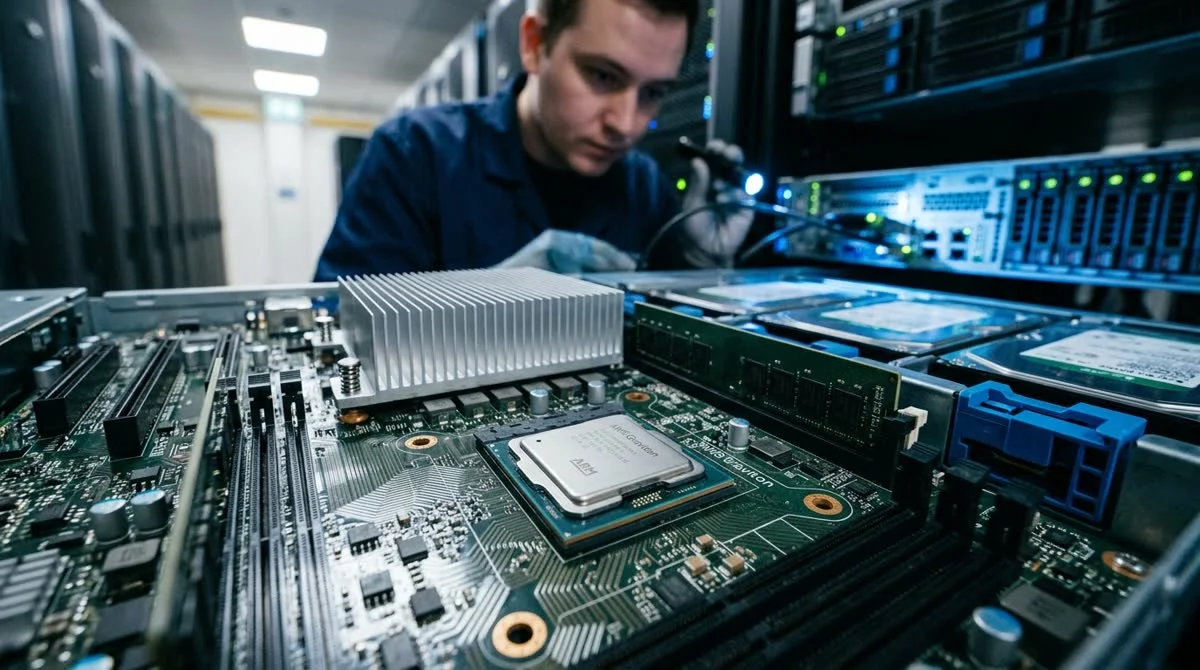
NVIDIA in July 2026 published a technical breakdown on the Developer Blog of the role of the Vera CPU in agent-based AI systems: as agent-based workloads scale in industrial AI factories, system performance is increasingly determined not only by GPU acceleration but also by the speed of CPU work between inference steps.
Why GPU alone is insufficient for agent systems?
An agent system is not a single model call. It executes multi-step chains: inference, tool invocation, code execution, vector search, orchestration and result processing. Between each step the GPU waits: the CPU must parse the model response, launch a tool, execute a search across the knowledge base and pass control to the next step.
If the CPU cannot handle this load, the GPU idles — and the overall throughput of the AI factory declines. When scaling to hundreds of parallel agent workers this effect compounds: aggregate CPU load becomes a system bottleneck. Traditional server processors were designed for a different usage pattern and are not optimized for agent workflows.
What Vera CPU changes in the AI factory
Vera CPU is an ARM processor from NVIDIA designed to work in tandem with the Blackwell series GPU. Unlike standard server CPUs, it is engineered specifically for agent workload characteristics: high parallelism, frequent context switches, close integration with GPU memory subsystems.
Typical tasks that Vera CPU handles in an agent pipeline:
- Orchestration of multi-step workflows — rapid switching between agent steps
- Code and tool execution in direct coupling with GPU computations
- Vector search and RAG steps with minimal latency
- Parsing and routing results between model invocations
- Agent context management: history cache, sliding window memory
Vera CPU is part of the Vera Blackwell platform, where the processor connects to the GPU via high-speed interfaces with low latency. This allows the GPU to receive the next request faster after each CPU step and reduces the "wait" fraction in the full agent cycle.
NVIDIA emphasizes: optimizing the AI factory for agent workloads is a task of balanced system design across the entire stack, not merely maximizing GPU throughput.
What this means
Agent-based AI systems are transitioning from research prototypes into industrial deployment — and this changes infrastructure requirements. Until recently, AI task performance was measured almost exclusively in GPU terms: FLOPS, memory throughput, number of tensor cores. Vera CPU signals a shift in this model.
For AI infrastructure developers and engineers this means a new reference point when selecting hardware: alongside GPU capacity, the CPU subsystem matters — it determines how fast an agent moves from one step to the next. In industrial agent systems, precisely this speed is beginning to limit overall performance.
Delegate Deep Research, Coding & Workflows to an AI Agent
Deploy autonomous multi-step execution with NomadNet Agent (agent.nomadnet.ai) — automated web research, data synthesis, code generation, and complex task orchestration.
The AI world, distilled — once a week
Seven stories that actually mattered, hand-picked. No noise, no reposts, no press releases.
Done! Check your inbox for a confirmation.