Perplexity among the first AI companies to adopt Nvidia's new Vera processor
Perplexity AI has become one of the first major AI companies to build on Nvidia's new Vera processor. The company plans to run agent workloads on it. Vera is Nvidia's first in-house general-purpose CPU, marking the company's move beyond the GPU accelerators that helped make it the world's most valuable public company.
AI-processed from TNW; edited by Hamidun News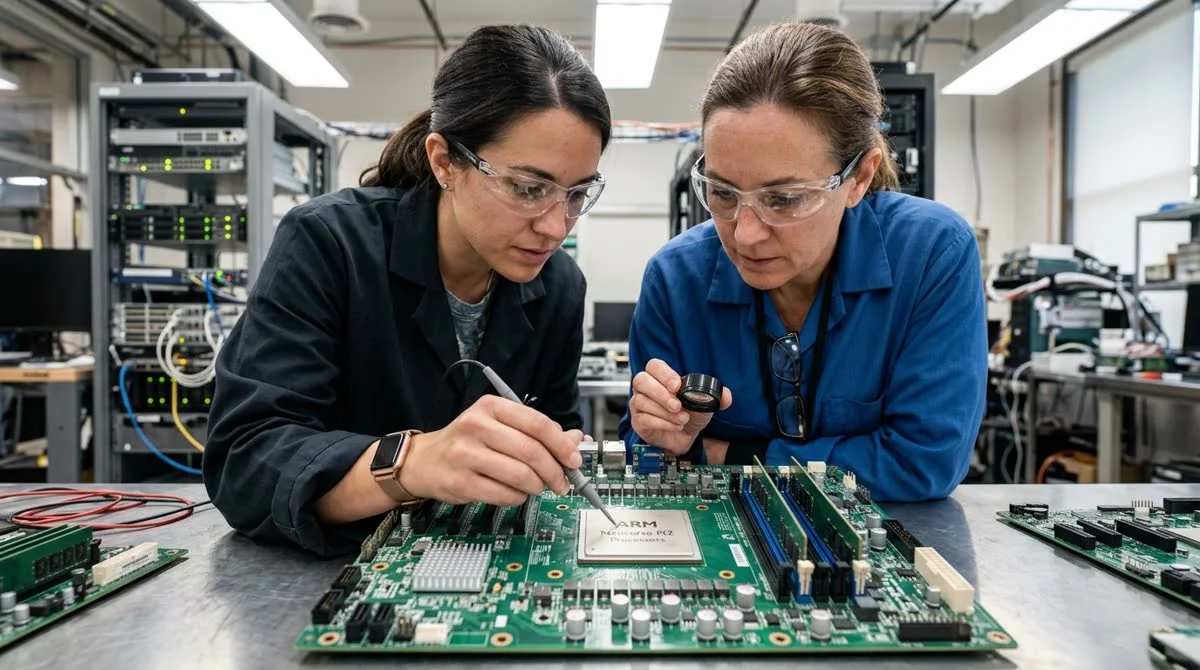
Perplexity AI has become one of the first major AI companies to publicly confirm plans to build on Nvidia's new Vera processor — a universal CPU that the chipmaker intends to use to break beyond the GPU accelerator market that has given Nvidia the status of the most valuable public company in the world. The company plans to use Vera for running agent workloads.
What is Nvidia Vera Processor
Vera is Nvidia's first proprietary general-purpose CPU, built on ARM architecture. Until now, Nvidia has dominated almost exclusively through GPUs and specialized AI accelerators: the H100 series and its successors have made the company the primary supplier of computing power for OpenAI, Google, Microsoft, and hundreds of AI startups. At its peak, Nvidia's market capitalization exceeded $3 trillion, making it the most valuable company in the world.
Vera changes the trajectory. It is not an accelerator for matrix operations, but a processor for management infrastructure — a layer that coordinates tasks, manages memory, and orchestrates interaction between system components. Architecturally, Vera is part of the Vera Rubin platform — the next generation after Blackwell — where CPUs and GPUs are created as an interconnected stack with a common API for developers. Nvidia's goal is to move from selling individual accelerators to supplying a unified computing platform.
Why Agent Workloads Require a Different CPU
Perplexity positions itself as a next-generation AI search engine, but is strategically moving toward agent systems — scenarios where AI not only generates an answer, but executes long multi-step pipelines: researches sources, calls external tools and APIs, verifies data, and composes a final result.
Such pipelines differ fundamentally in load profile from classical language model inference:
- Frequent task switching — a traditional CPU strength
- Numerous external API calls and file operations
- Management of call trees and agent memory
- Short GPU spikes during individual inference steps within a long pipeline
A CPU optimized for AI infrastructure and tightly integrated with GPU in a unified Nvidia stack provides an architectural advantage over standard server chips from Intel or AMD, which were not originally designed for such scenarios. This is why Perplexity chooses Vera as the foundation for agent infrastructure: heavy computation remains on the GPU, orchestration — on the CPU.
What This Means
Perplexity's emergence among the first Vera supporters is a signal that Nvidia is seriously contending for the server CPU market, which has been dominated by Intel and AMD until now. Several conclusions follow for the AI industry.
First: leading AI companies are beginning to differentiate chip selection for specific workload profiles rather than opting for a universal solution. Second: Nvidia gains a tool for deeper customer lock-in through selling a unified stack — CPU plus GPU — instead of individual accelerators; this creates higher switching costs and larger average deal size. Third: Intel and AMD face a competitor with an established partner network and CUDA ecosystem.
For Perplexity, this is a public demonstration of technological ambitions: the company is building its own AI infrastructure, rather than only renting capacity from cloud providers.
Delegate Deep Research, Coding & Workflows to an AI Agent
Deploy autonomous multi-step execution with NomadNet Agent (agent.nomadnet.ai) — automated web research, data synthesis, code generation, and complex task orchestration.
The AI world, distilled — once a week
Seven stories that actually mattered, hand-picked. No noise, no reposts, no press releases.
Done! Check your inbox for a confirmation.