NVIDIA TensorRT turns FP8 checkpoints into engines for fast inference
NVIDIA has published a detailed guide to converting FP8-quantized checkpoints into TensorRT engines, the final step before production deployment. Quantization halves the size of the model weights, while TensorRT rebuilds the computation graph for a specific GPU. Together they speed up inference by 2–4x at the same accuracy. The walkthrough uses the CLIP model from diffusion pipelines as its example.
AI-processed from NVIDIA Developer Blog; edited by Hamidun News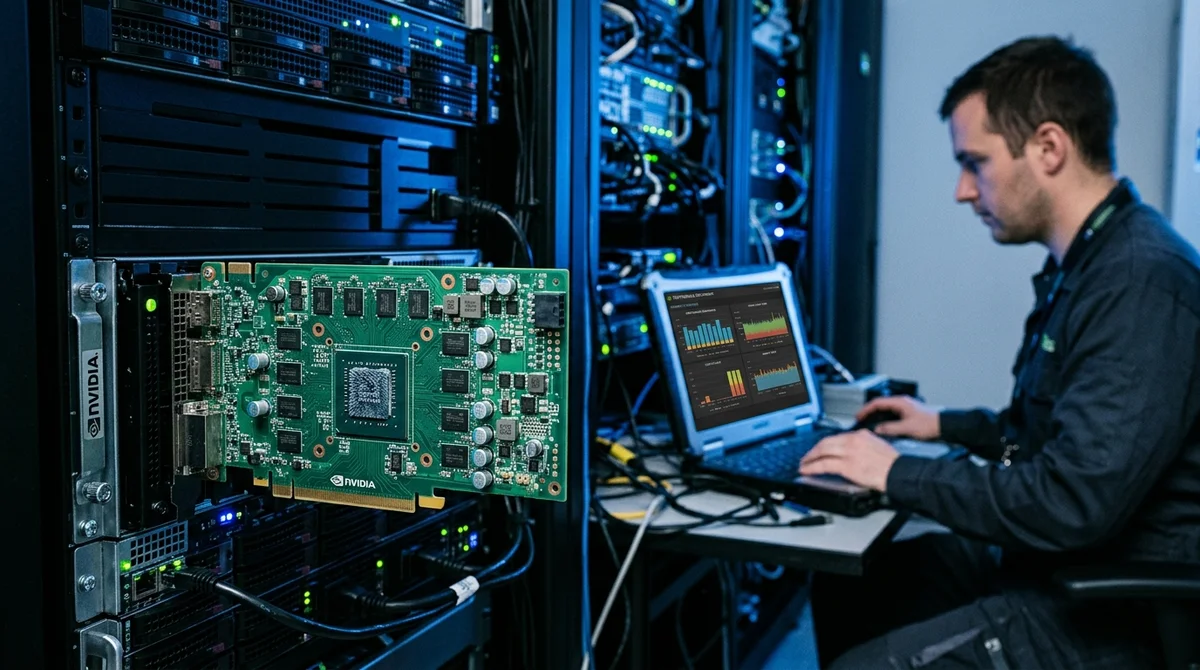
NVIDIA has published a detailed guide to converting FP8-quantized checkpoints into TensorRT engines, the final step that determines the real speed and cost of inference in production.
Why this step is needed
Quantizing a model is only half the job. Once the weights are compressed from 16-bit to 8-bit precision, the checkpoint file is stored in an optimized format, but the GPU cannot work with it directly. An additional step is required: compilation into a specialized engine.
TensorRT takes the quantized computation graph and restructures it for the specific hardware. It fuses compatible operations (layer fusion), picks the most efficient CUDA kernels for each operation, and allocates memory in advance. The result is a single compact .engine file tailored to a particular GPU and CUDA version.
What FP8 + TensorRT delivers
FP8, an 8-bit floating-point format, has become the de facto standard for quantization on Hopper (H100) and Ada Lovelace (RTX 4090) cards. Advantages over FP16:
- Half the VRAM for model weights
- Twice the matrix-operation throughput on tensor cores
- Significantly smaller accuracy loss compared with INT8
- Hardware-level support, with no software emulation
When an FP8 model is compiled into a TensorRT engine, the effects add up. NVIDIA engineers report inference speedups of 2–4x over an FP16 PyTorch baseline, with comparable accuracy.
CLIP as a worked example
The guide is built around CLIP (Contrastive Language-Image Pretraining), a dual encoder that links text descriptions to images. CLIP is part of most diffusion pipelines, including Stable Diffusion, FLUX and similar models. Its speed directly affects the generation time of each image.
"We produce a high-quality FP8-quantized CLIP checkpoint with TensorRT Model Optimizer, then convert it into a full inference engine,"
NVIDIA engineers say of the guide's goal.
Technically, the process looks like this: load the checkpoint through the TensorRT Model Optimizer API, trace the ONNX graph, then compile with the trtexec utility or the Python bindings. TensorRT automatically tries different tactics for each layer and picks the fastest. This takes several minutes, but the result is cached and not recomputed.
An important limitation: the .engine file is tied to a specific GPU and CUDA version. An engine built for the H100 will not run on an A100 or RTX 4090. Heterogeneous clusters need a separate engine for each accelerator type, and this has to be built into the deployment CI/CD pipeline.
What this means
TensorRT + FP8 is becoming the standard for production deployment of large models. A 2–4x speedup on a single GPU means either direct savings on the cluster or the ability to serve twice as many users on the same hardware. NVIDIA's guide lowers the barrier to entry: this is no longer expert exotica but a documented process with ready-made code.
- Nov 18, 2026Together AI replaces megakernels with AI agents and speeds up Llama 1B by 28% on B200
- Nov 18, 2026A $3,000 Mining Card Turned Into an A100 Equivalent: From 8 to 80 GB of Memory
- Nov 18, 2026Meituan open-sources 1.6-trillion-parameter agentic model trained without Nvidia
- Nov 12, 2026Jensen Huang steps down as Nvidia CEO: company loses $1.4 trillion in two weeks
Key Questions Answered
Why this step is needed?
Quantizing a model is only half the job. Once the weights are compressed from 16-bit to 8-bit precision, the checkpoint file is stored in an optimized format, but the GPU cannot work with it directly. An additional step is required: compilation into a specialized engine. TensorRT takes the quantized computation graph and restructures it for the specific hardware. It fuses compatible operations (layer fusion), picks the most efficient CUDA kernels for each operation, and allocates memory in advance.
What FP8 + TensorRT delivers?
FP8, an 8-bit floating-point format, has become the de facto standard for quantization on Hopper (H100) and Ada Lovelace (RTX 4090) cards. Advantages over FP16: Half the VRAM for model weights Twice the matrix-operation throughput on tensor cores Significantly smaller accuracy loss compared with INT8 Hardware-level support, with no software emulation When an FP8 model is compiled into a TensorRT engine, the effects add up.
What are the key details on CLIP as a worked example?
The guide is built around CLIP (Contrastive Language-Image Pretraining), a dual encoder that links text descriptions to images. CLIP is part of most diffusion pipelines, including Stable Diffusion, FLUX and similar models. Its speed directly affects the generation time of each image. "We produce a high-quality FP8-quantized CLIP checkpoint with TensorRT Model Optimizer, then convert it into a full inference engine," NVIDIA engineers say of the guide's goal.
Test Frontier LLMs & Autonomous Agents in One Workspace
Run Claude Opus 5.5, GPT-6, Gemini 3.1, and DeepSeek side-by-side in Nomad AI (nomadnet.ai) — unified model routing, deep research, and multimodal workflows under one subscription.
The AI world, distilled — once a week
Seven stories that actually mattered, hand-picked. No noise, no reposts, no press releases.
Done! Check your inbox for a confirmation.