NVIDIA optimized BEV pooling on GPU for autonomous vehicles, robots, and spatial AI
NVIDIA explained how to accelerate BEV pooling on GPU — a key operation in perception systems for autonomous vehicles and robots. BEV models combine images from multiple cameras into a single top-down map, helping AI see lanes, cars, and pedestrians. NVIDIA offers optimized CUDA kernels, a TensorRT plugin, and index precomputation so perception can run in real time even on embedded Jetson chips.
AI-processed from NVIDIA Developer Blog; edited by Hamidun News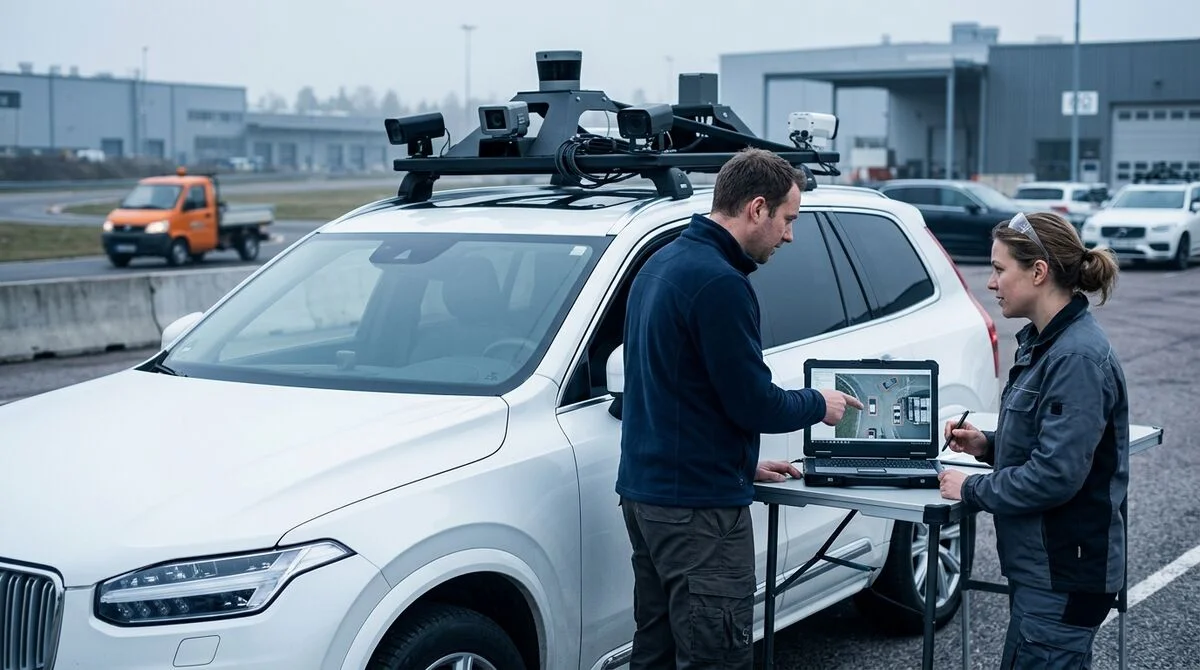
NVIDIA has published a detailed technical guide for accelerating BEV pooling on its GPUs — an operation that is becoming mandatory for any system with multiple cameras: from autonomous vehicles to industrial robots and spatial AI systems.
What is BEV perception
BEV stands for Bird's-Eye-View — a top-down perspective. Instead of processing images from six to eight cameras separately, the model projects features from each of them onto a single top-down map. On this map, AI reasons about space the same way a human looks at a road map: it sees lanes, cars, pedestrians, and free space in a single coordinate system.
Before BEV emerged, most systems used independent detectors for each camera and a separate data fusion module. This created inconsistencies at the boundaries of each camera's view and complicated distance estimation. BEV solves the problem fundamentally — projecting into a single space eliminates the seams between cameras and simplifies subsequent route planning. BEV models have become the de facto standard in autopilots and robotics. In industrial robotics, this approach allows the navigation stack to get a coherent picture of the surrounding environment without complex data fusion between multiple independent classifiers.
Where the bottleneck arises
The key operation in the BEV pipeline is pooling itself: each point on the top-down map must be "queried" against each of the cameras, retrieve the corresponding feature from the feature map, and average the results. At a BEV map resolution of 200×200 cells and six cameras, this amounts to tens of millions of operations with chaotic memory access patterns.
- Non-linear memory access is incompatible with GPU cache — each access can result in a cache miss
- Memory bandwidth becomes the true bottleneck, not the computational power of the cores
- BEV pooling accounts for 30–40% of the total inference cycle time
- When the map is updated at a frequency of 20 Hz, latencies accumulate critically fast
- Naive CUDA implementations perform poorly even on powerful data center GPUs and Orin chips
NVIDIA details why the problem cannot be solved by simply increasing GPU power — the memory access pattern and the order of computations themselves must be optimized.
What NVIDIA proposes
The main solution is optimized CUDA kernels with carefully designed operation ordering and active use of shared memory. The key idea is to group requests so that multiple threads access neighboring addresses simultaneously. This transforms chaotic single accesses into efficient batch transactions, which the GPU processes significantly faster.
NVIDIA also provides a ready-made plugin for TensorRT: it integrates into any inference pipeline without rewriting the model. For teams already using TensorRT in production, this is particularly valuable — the optimization is applied without changing the network architecture.
A separate technique describes precomputation of projection indices: the mappings between BEV cells and camera pixels are computed once during initialization and stored in memory. On Jetson Xavier and Orin chips — which power real robots and autonomous vehicles — this provides a noticeable boost precisely because of their limited computational power compared to data center GPUs.
"Correct BEV pooling implementation is the difference between a system
that operates in real time and a system that falls behind," according to NVIDIA's technical material.
What this means
BEV perception is transforming from a research concept into a fundamental component of Physical AI — a term NVIDIA increasingly uses to describe robots, autonomous vehicles, and industrial automation. Optimization of basic operations like BEV pooling directly determines how many cameras can be leveraged and how frequently the perception map can be updated. For teams working on the NVIDIA Jetson platform or using TensorRT, this guide provides concrete acceleration tools without the need to change the model architecture.
Want to stop reading about AI and start using it?
AI News is a curated feed of AI/tech news. Hamidun Academy teaches you to use AI systematically in your work.
The AI world, distilled — once a week
Seven stories that actually mattered, hand-picked. No noise, no reposts, no press releases.
Done! Check your inbox for a confirmation.