NVIDIA представила Halos — систему функциональной безопасности для роботов с AI
NVIDIA анонсировала Halos — полный стек функциональной безопасности для роботов с AI, работающих рядом с людьми. Традиционная безопасность, построенная на…
AI-processed from NVIDIA Developer Blog; edited by Hamidun News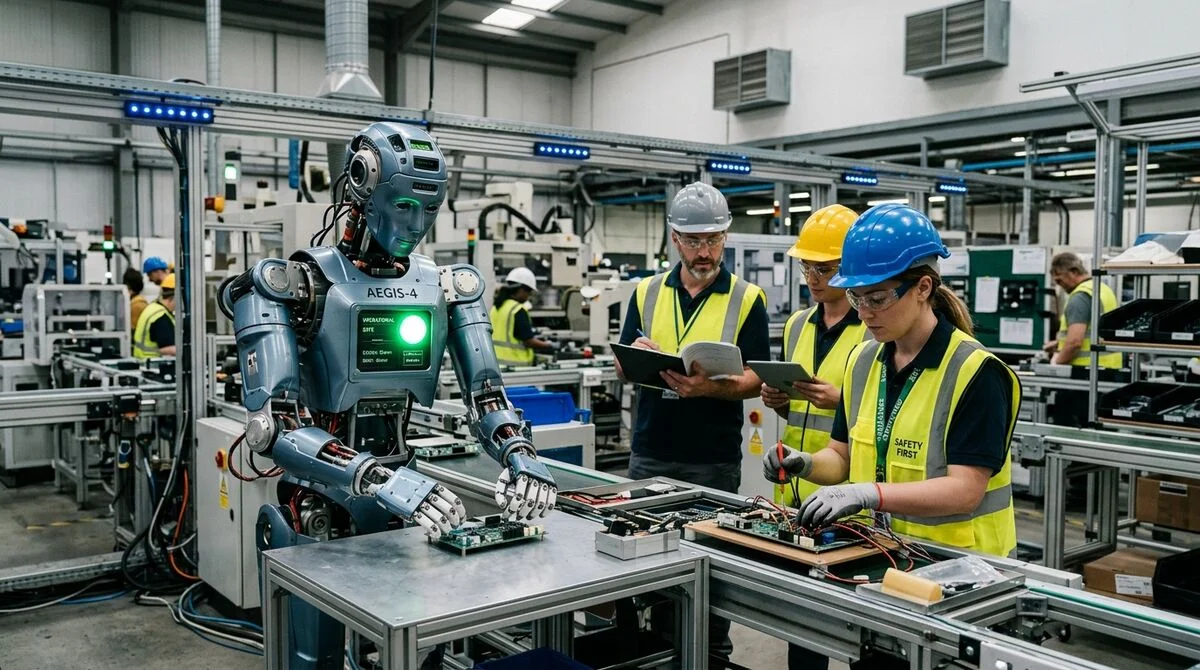
NVIDIA announced Halos — a comprehensive functional safety stack created specifically for physical AI: autonomous robots that work alongside people in factory floors, warehouses, hospitals, and homes.
Why Old Safety Doesn't Work
For decades, industrial robots operated behind metal cages and barriers. Their safety relied on the principle of isolation: if a person entered a hazardous zone, the machine would stop. Sensors were simple, the environment was predictable, and robot behavior was fully deterministic.
Physical AI changes the rules. Humanoid robots, mobile manipulators, and next-generation autonomous delivery systems operate in unstructured, constantly changing environments alongside people. Their behavior is determined by neural networks — complex, opaque, probabilistic systems. Traditional safety verification methods, built on deterministic algorithms, simply do not apply to such systems. Moreover, neural network solutions are difficult to verify with a comprehensive set of tests: there is no explicit logic to traverse and cover.
According to analyst forecasts, by 2030 there will be over a million autonomous robots operating in industrial and service sectors. Without reliable safety architecture for physical AI, this growth will remain blocked — both regulatorily and commercially. NVIDIA Halos is designed to close precisely this gap.
What Halos Comprises
Halos is not a separate module, but a safety architecture that permeates the entire computational stack of a robot. The system covers several levels:
- Perception safety — real-time monitoring of data from cameras, lidars, and other sensors, detection of failures and anomalies before they reach models
- Planning safety — verification of AI planner decisions for compliance with formal safety constraints before execution
- Control safety — hardware and software mechanisms for emergency shutdown and failsafe transitions
- Independent system monitor — a separate component that monitors the rest and is intentionally independent from the main AI stack
- Tracing for certification — automatic documentation for compliance with ISO 26262 and IEC 61508 standards
Halos was developed as a native part of the NVIDIA Isaac platform. Integration with Isaac Sim enables testing safety in virtual scenarios with thousands of hours of simulated human interaction — long before the first physical prototype on real production sites.
Who This Matters to Right Now
The primary recipients are companies already bringing humanoid and mobile robots to commercial markets. Warehouse logistics, production lines with human-machine collaboration, medical facilities — everywhere regulatory requirements are becoming stricter and the cost of error is higher.
"Physical AI is arriving faster than most expected.
AI safety is the key," — NVIDIA Developer Blog.
For robot manufacturers, Halos changes the equation: instead of building functional safety from scratch in each individual product, they get a ready-made verified architecture. This reduces time to market and lowers risks during certification. This is especially critical for medicine and public spaces — where safety is not a technical parameter but a legal and ethical requirement.
What This Means
NVIDIA is consistently building a vertical stack for the era of physical AI: from specialized chips (Jetson, Thor) and simulators to training frameworks and now — functional safety systems. Halos closes the last major gap in this chain.
Until now, robot manufacturers addressed safety engineering questions alone, without standardized tools. For small teams, compliance with ISO 26262 standards meant years of expertise and a separate staff of functional safety specialists. NVIDIA's platform approach is capable of changing this — and notably accelerating the commercialization of physical AI in industry and beyond.
Need AI working inside your business — not just in your newsfeed?
I build production AI for companies — custom CRM, internal tools, autonomous agents, workflow automation. Owned by you, shaped to your process, no per-seat tax. Built by Zhemal Khamidun, CPO of AlpinaGPT (AI platform, 6,000+ users).
The AI world, distilled — once a week
Seven stories that actually mattered, hand-picked. No noise, no reposts, no press releases.
Done! Check your inbox for a confirmation.