Vivo and Daxiao Robotics: a ChatGPT moment for humanoid robots could take up to 10 years
Chinese developers of humanoid robots are not yet expecting a rapid mass breakthrough: at the Boao Forum, estimates ranged from two to ten years. Daxiao Robotics is betting on simulations and world models, while Vivo's lab says the market lacks low-cost real-world data, reliability, safe operation in the home, and trust from people.
AI-processed from 3DNews AI; edited by Hamidun News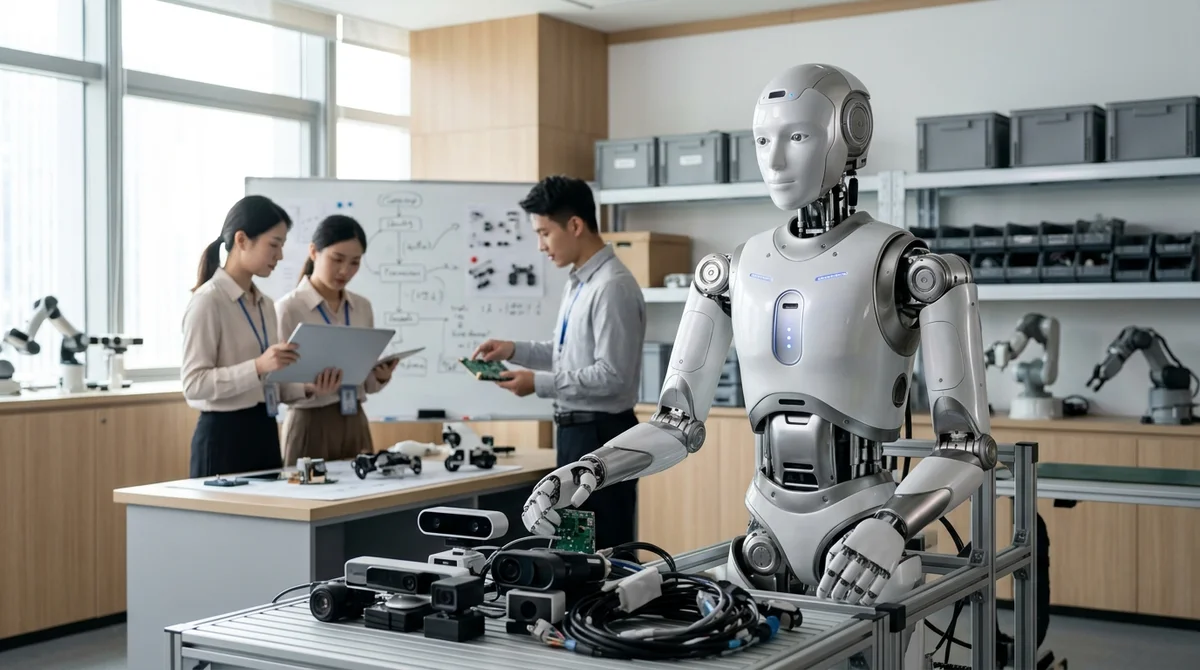
A mass breakthrough in humanoid robots comparable in scale to ChatGPT's release is unlikely to happen tomorrow. At the Boao Forum for Asia, market participants cited a timeframe ranging from two to ten years and nearly unanimously acknowledged that the main barrier is not hype, but data, reliability, and trust.
Range of Assessments
At a panel on the future of humanoid robotics in Hainan on March 25, 2026, Daxiao Robotics CEO Wang Xiaogang offered the most optimistic forecast. According to him, the industry could achieve its own "ChatGPT moment" within just a couple of years if it dramatically increases the volume of training data and makes more active use of world models and simulations. The idea is straightforward: robots need to be trained not only through expensive real-world experiments, but also in digital environments where thousands of scenarios can be run faster and more cheaply.
Other panelists took a more cautious stance. Shao Hao from Vivo's robotics laboratory stated that a comparable breakthrough is more likely to occur in around ten years, since the market still lacks large datasets of affordable real-world data. Baidu likewise does not expect an immediate leap: the company's vice president Shen Dou compared the desired point of mass adoption more to an "iPhone moment" and emphasized that it is still far away.
The panel's overall conclusion was that the breakthrough will not be instantaneous; rather, it will progress in stages, across individual industries and practical applications.
What's Holding Back the Market
The issues developers discuss look decidedly down-to-earth. Despite impressive public demonstrations, the industry still faces obstacles that prevent robots from being safely deployed in ordinary homes, shops, warehouses, or hospitals.
Impressive performances featuring dancing, acrobatics, and kung fu do not yet mean that a machine is ready to act confidently among people in unpredictable circumstances. This is precisely what separates a laboratory prototype from a mass-market product.
- Lack of cheap and diverse real-world data
- Weak stability, durability, and dexterity of the robotic body
- Difficulty operating in changing domestic and industrial environments
- High demands for industrial reliability and safety
This is where the line between spectacle and product is drawn. At China's Lunar New Year gala, humanoid robots have already demonstrated complex movements, but experts remind us that such performances are typically executed in controlled environments, following pre-prepared scripts, and with extensive tuning.
For a robot to independently navigate around a chair, pick up a dropped object, avoid bumping into a child, and continue its task without error, it needs vastly different volumes of training and a different level of physical reliability.
Trust and Regulation
Technical improvements alone are not enough if people are not ready to live and work alongside such machines. Former New Zealand Prime Minister Jenny Shipley said at the same panel that trust in robots will be built around clear boundaries, predictability, and accountability.
According to her logic, robots are expected to provide useful functional support, but not emotional judgment or intrusion into human space where decisions should remain with humans.
"I don't know who's in control right now."
This remark from Shipley was directed not at the robots themselves, but at the governance system surrounding AI and automation.
Panelists separately raised questions about who is responsible for consequences, how to use the visual and audio data these machines collect, and what to do about people being displaced from certain professions.
Singapore's framework for agentic AI was mentioned as one reference point, where emphasis is placed on risk management, human control, and accountability.
What This Means
The humanoid robotics market has entered a phase where impressive demos are no longer enough. The next major leap will depend less on the "wow factor" and more on training infrastructure, hardware quality, safety standards, and clear accountability rules.
Therefore, a mass-market domestic helper robot looks not like a canceled future, but rather a challenge several iterations ahead.
Need AI working inside your business — not just in your newsfeed?
I build production AI for companies — custom CRM, internal tools, autonomous agents, workflow automation. Owned by you, shaped to your process, no per-seat tax. Built by Zhemal Khamidun, CPO of AlpinaGPT (AI platform, 6,000+ users).
The AI world, distilled — once a week
Seven stories that actually mattered, hand-picked. No noise, no reposts, no press releases.
Done! Check your inbox for a confirmation.