Нейросеть для прогноза ВВП на C++ без TensorFlow: работает на Arduino за 400 рублей
Разработчик с Хабра построил нейросеть для прогноза ВВП на чистом C++20 — без TensorFlow, PyTorch и любых сторонних библиотек. Математика написана с нуля…
AI-processed from Habr AI; edited by Hamidun News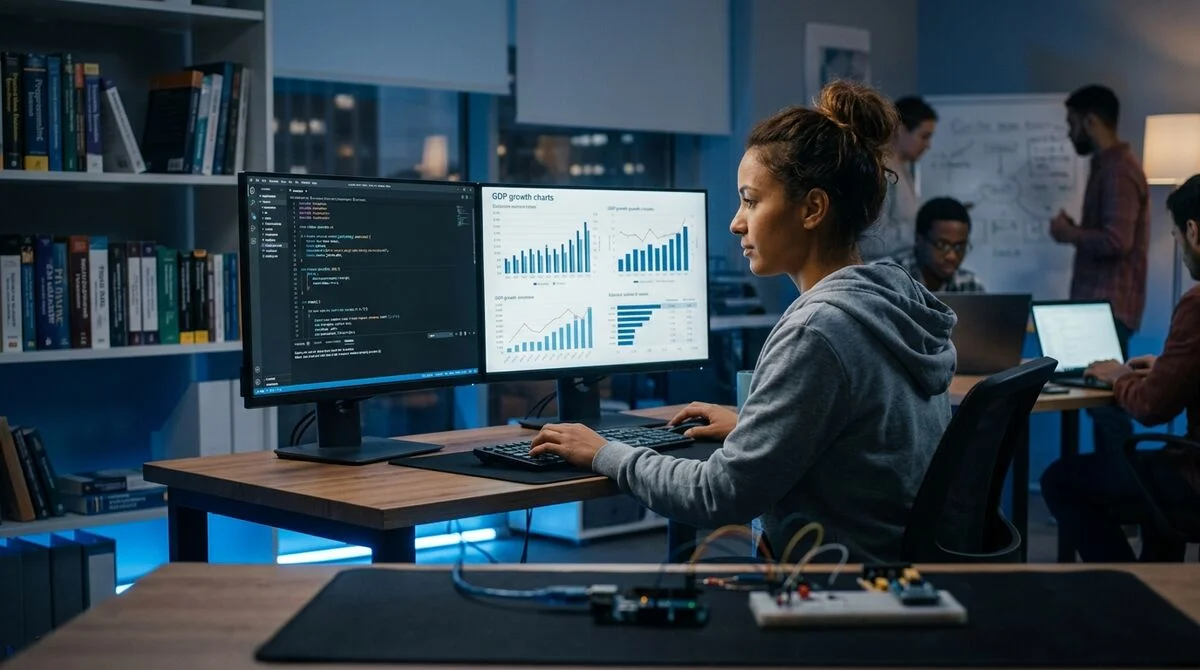
A Habr developer has created a neural network for forecasting GDP dynamics entirely in C++20 — without TensorFlow, PyTorch, or any third-party frameworks. All the mathematics is written from scratch, and the resulting model can run on an Arduino board for 300–400 rubles with a memory limit of 32 KB.
Why abandon Python
The standard approach to macroeconomic modeling assumes powerful servers and heavy Python libraries. TensorFlow and PyTorch excel at large-scale tasks, but come with dozens of gigabytes of dependencies and require full computational infrastructure. For a corporate data center this is normal — for a field device or budget microcontroller it is an insurmountable barrier.
Arduino boards with 32 KB of RAM and a price tag of 300–400 rubles physically cannot run a Python interpreter, let alone TensorFlow. The gap between "smart" analytics and real budget hardware seemed insurmountable — until the author decided to write everything from scratch. All the mathematics of neural layers is implemented in pure C++20 without external dependencies.
For fast weight selection during development on a PC, NVIDIA CUDA is connected — only at the development stage. The trained model is exported to a compact binary format and runs on any hardware, including microcontrollers.
Architecture: from capital to neuron
The neural network does not simply approximate time series — it mimics real capital circulation cycles. The network structure reflects economic logic, not just statistical patterns in numbers. Four hidden layers of a nonlinear network compress to six projection neurons according to World Bank methodology. Key technical characteristics:
- C++20 without external dependencies — full memory control
- NVIDIA CUDA for accelerating training at the development stage
- 4 hidden layers with nonlinear activation functions
- Compression to 6 projection neurons according to WB methodology
- Compatibility with Arduino with a 32 KB memory limit
Six output neurons — not an arbitrary number: each corresponds to one of the key indicators under World Bank methodology. This makes the model interpretable: an analyst understands which factor influenced the forecast, instead of blindly trusting a "black box".
Neural networks and macroeconomics: history
Neural networks for GDP forecasting are not new. In the late twentieth century, Swanson and White were among the first to prove: nonlinear models better capture hidden economic cycles in American data than classical linear ones. Kuan and Liu showed that pre-cleaning time series before feeding them into the network significantly reduces forecast error.
In the early 2000s, Marcellino, Neusser and Wagner confirmed the superiority of multilayer networks over ARIMA when analyzing GDP of European countries over long horizons. Lin and Chen developed a weight-switching scheme that allows the model to recognize crisis periods and structural shifts in the economy. In 2024, Zhang and Bian conducted large-scale tests on Chinese economic data and confirmed: nonlinear activation functions provide a sustained advantage in tracking long-term GDP growth rates.
"Four hidden layers of a nonlinear network compress to six projection neurons according to
World Bank methodology" — this is how the author describes the central architectural decision.
What this means
The project proves: serious economic modeling does not require expensive infrastructure. If the architecture is well thought out, a neural network for GDP forecasting fits in 32 KB and runs on a board for 400 rubles. For embedded systems developers this is a direct signal: the boundary between macroeconomic AI and edge computing is thinner than commonly believed.
Want to stop reading about AI and start using it?
AI News is a curated feed of AI/tech news. Hamidun Academy teaches you to use AI systematically in your work.
The AI world, distilled — once a week
Seven stories that actually mattered, hand-picked. No noise, no reposts, no press releases.
Done! Check your inbox for a confirmation.