Russian scientists developed a neural network to predict oil properties and speed up production
Russian scientists developed a neural network to predict the interfacial tension between oil and saline water. The system can replace months of laboratory experiments with faster digital modeling and help engineers determine in advance the salinity of injected water and the composition of dissolved gases. For the oil and gas industry, this is a chance to speed up production setup and reduce the cost of trial scenarios at fields already at the design stage.
AI-processed from CNews AI; edited by Hamidun News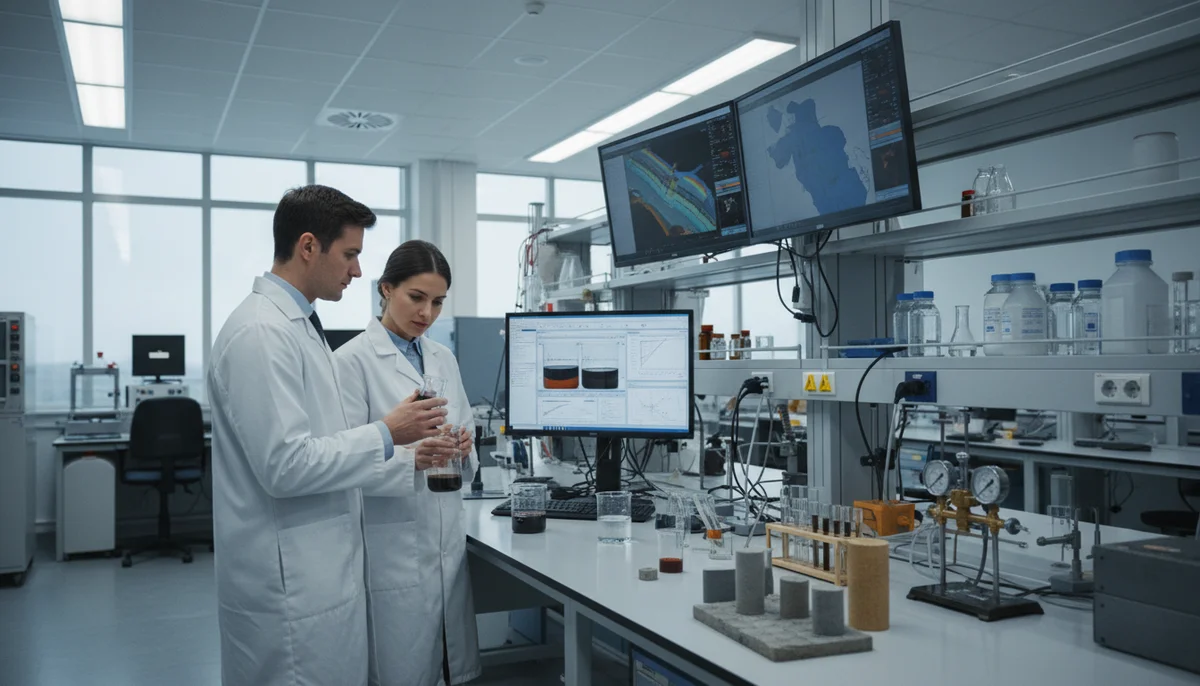
Russian scientists have developed a neural network and a digital machine learning system that predicts interfacial tension between oil and saltwater. For the industry, this is a practical task: the model can reduce months of laboratory experiments and help faster select extraction parameters for a specific formation.
How the model works
Interfacial tension is one of the key parameters when working with oil reservoirs, where oil, formation water, and injected solutions interact during extraction. Usually, such characteristics are checked through a series of physical tests: salinity is varied, the composition of dissolved gases, environmental conditions are changed, and then the result is measured. The new approach transfers a significant portion of this work into the digital environment.
The neural network analyzes input data and produces a forecast without the need to repeat the long cycle of testing for each new scenario. In fact, this is not about a single formula, but about an applied digital system that can be used to simulate formation behavior before moving to the stage of expensive field solutions. If the forecast is accurate enough, engineers get a tool for earlier evaluation of development options.
This is especially important where an error in selecting water or gas injection parameters leads not only to additional costs, but also to lost time on re-testing.
Where time is saved
The main value of the system is that it removes part of routine experimental work from the process. Instead of several months of laboratory checks, specialists can faster assemble a set of scenarios, compare them with each other, and select the most promising ones. According to the development description, the model helps determine in advance exactly how to adjust the impact conditions on the formation so that extraction proceeds more efficiently. In practice, this can affect several stages of design and operation at once:
- selection of optimal salinity of injected water
- assessment of the influence of dissolved gases on mixture behavior
- simulation of an oil reservoir without a series of expensive physical tests
- acceleration of engineering decisions before work begins
What changes for the industry
For the oil and gas industry, what matters is not the fact of using AI itself, but that it solves a specific production task. Interfacial tension affects how oil is displaced by water from the rock, how effectively the selected injection mode works, and what losses may occur in the process. When these parameters can be forecast in advance, the company obtains a more manageable development scheme for the field.
As a result, dependence on long cycles of trial and error, which traditionally slow down the launch or adjustment of a project, is reduced. Another effect is related to research economics. Full-scale experiments require equipment, specialist time, and multiple repetition of measurements as conditions change.
The digital model does not completely replace the laboratory, but allows narrowing the range of options before physical testing begins. This means that resources can be directed not to testing all possible combinations, but to validating the most probable and useful scenarios. For an industry with high cost of error, such a shift is particularly significant.
Separately important is the ability to use such models as part of a broader digital development chain for fields. When the interfacial tension forecast is built into engineering software, specialists can recalculate scenarios faster when source data changes and see consequences almost immediately. This is convenient not only at the planning stage, but also when adjusting already ongoing work.
The faster the team receives a calculated answer, the fewer pauses between analysis, hypothesis verification, and actual management decision.
What this means
If the system confirms accuracy on real production cases, Russian oil and gas can obtain a clear AI-based tool with measurable impact: less time on experiments, faster parameter tuning, and more predictable extraction. This is not abstract AI for reports, but a model built into the engineering process and directly affecting decision-making speed. For companies, it is a way to make decisions not after a long series of measurements, but noticeably earlier.
Build & Ship Production AI Apps with Vibe Coding
Join Zhemal Khamidun's hands-on Vibe Coding Intensive at hamidun.com/vibecoding — master Claude Code, Cursor, and autonomous agentic workflows.
The AI world, distilled — once a week
Seven stories that actually mattered, hand-picked. No noise, no reposts, no press releases.
Done! Check your inbox for a confirmation.