MarkTechPost
AI news source. Articles are auto-selected and adapted by Hamidun News editors.
Latest publications

Baidu releases Qianfan-OCR, a 4B model for document recognition and understanding
Baidu has unveiled Qianfan-OCR, a single 4B model that parses document structure, recognizes text and, on request, extracts tables or answers questions.

MarkTechPost shows how to build an LLM system with self-evaluation, confidence scores and web search
MarkTechPost outlines a practical uncertainty-aware LLM design: the model answers and rates its confidence, then double-checks itself and triggers a web search when in doubt.

GitAgent proposes a single AI agent format for LangChain, AutoGen and Claude Code
GitAgent stores an AI agent's logic, memory and rules in a Git repository, then exports the same agent to LangChain, AutoGen, Claude Code and other environments.

Google releases colab-mcp: how agents automate Colab notebooks in production
Google has shown colab-mcp, an open-source server that controls Colab notebooks over MCP: an agent can add cells, run code and build resilient workflows without manual routine.

Yann LeCun unveils LeWorldModel, a JEPA model that trains on pixels without representation collapse
Yann LeCun's team has introduced LeWorldModel, a world model that trains directly on pixels with two loss terms, avoids representation collapse and plans up to 48 times faster than alternatives.

HKUDS details OpenSpace, a skill self-evolution engine for AI agents
HKUDS showed how OpenSpace turns AI agents into self-learning systems: the engine saves skills after every task, reuses them and noticeably cuts token spend.
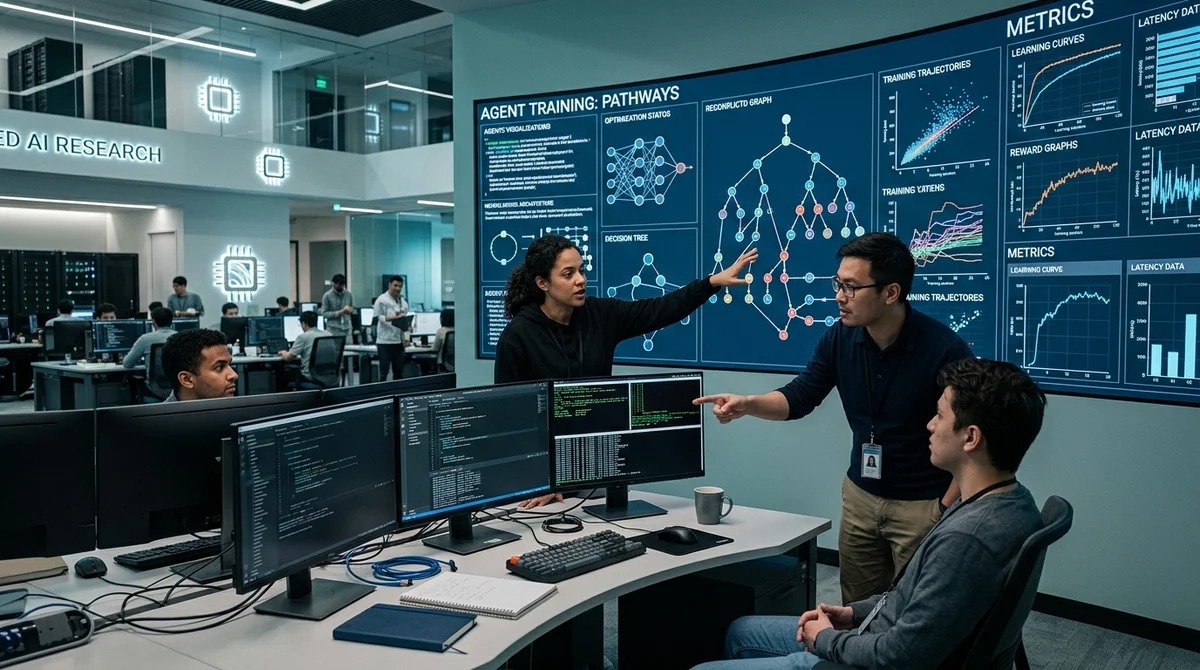
Nvidia unveils PivotRL, an AI agent training framework that cuts rollout turns by 4x
Nvidia's PivotRL fine-tunes AI agents without losing out-of-domain quality and matches E2E RL accuracy with 4x fewer rollout turns.
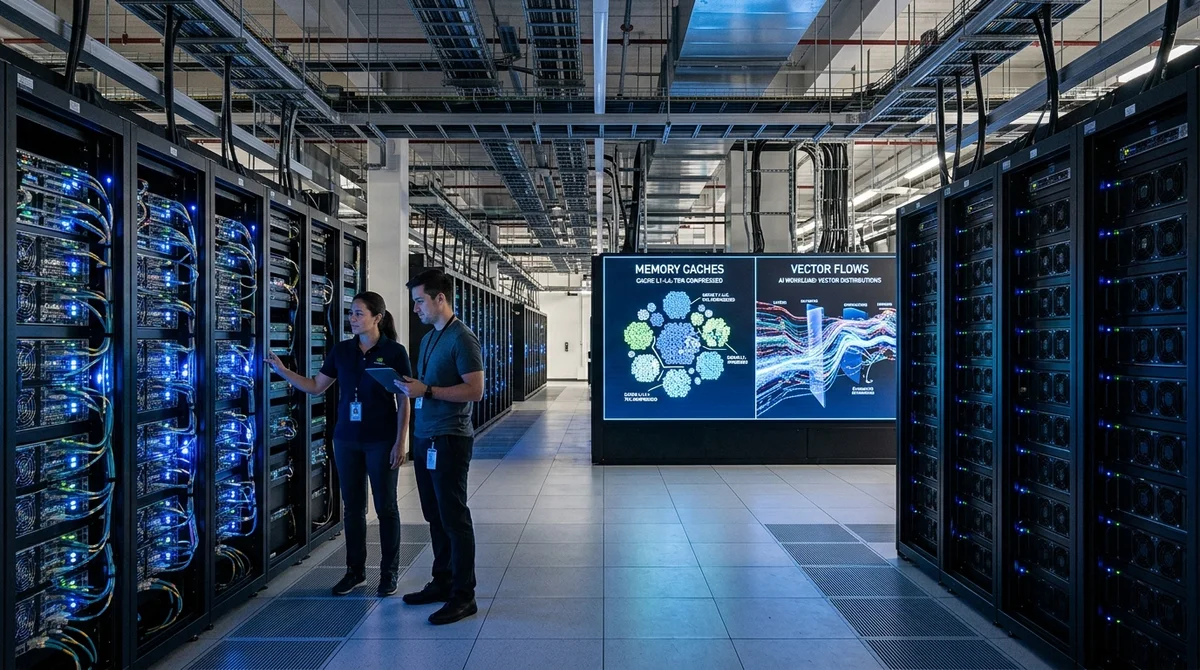
Google unveils TurboQuant: 6x LLM KV cache compression with no accuracy loss
Google Research has shown TurboQuant, an algorithm that compresses the KV cache of large language models at least sixfold and speeds up attention up to 8x with no quality drop.

Ai2's MolmoWeb-4B: A Web Agent That Sees Sites Like a Human, No HTML Parsing
Ai2 has released MolmoWeb-4B, an open multimodal web agent that controls a browser from screenshots alone, with no access to HTML or the DOM tree.

Tencent open-sources Covo-Audio, a 7B model for voice conversations and audio reasoning
Tencent AI Lab has open-sourced Covo-Audio, a 7B audio model that takes continuous speech, replies by voice, and targets real-time dialogue and reasoning.

Qwen3.5: Running Reasoning Models in GGUF and 4-Bit Format via Colab
A Colab pipeline runs Claude-style distilled Qwen3.5 reasoning models: a single setting switches between a 27B GGUF build and a lightweight 4-bit 2B version.
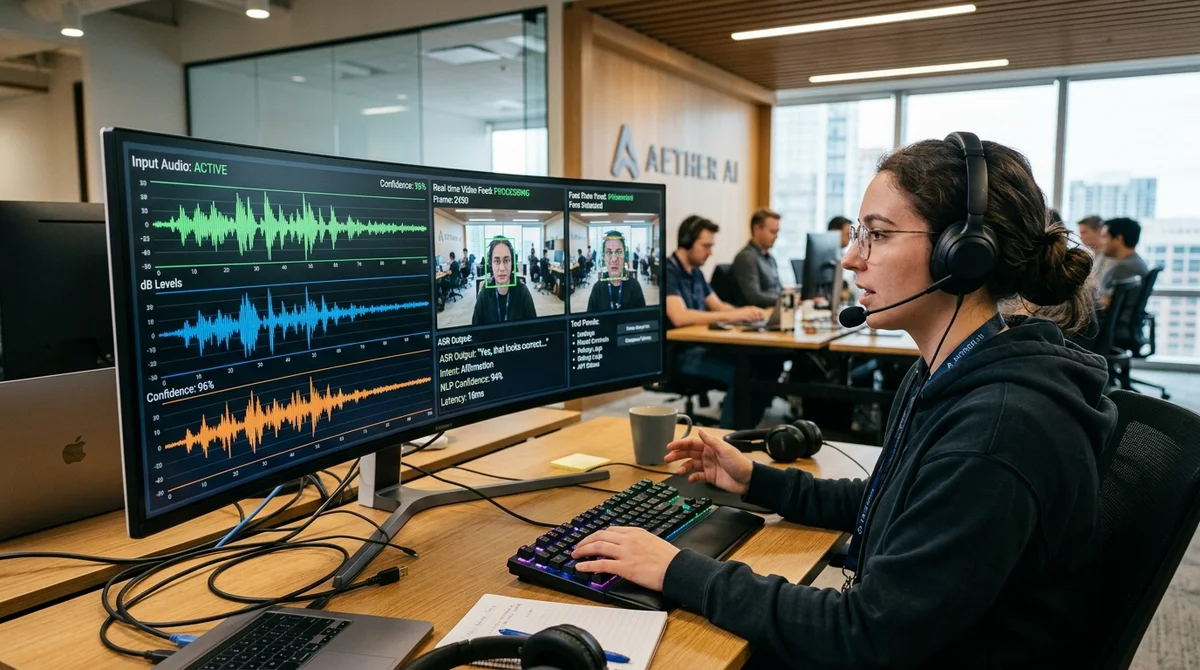
Google releases Gemini 3.1 Flash Live for voice AI agents and multimodal conversation
Google has opened preview access to Gemini 3.1 Flash Live, a low-latency model for voice and visual AI agents with tool support and more natural dialogue.

IWE and OpenAI: Turning Markdown Notes into a Knowledge Graph for AI Agents
A walkthrough shows how IWE builds a local knowledge graph from markdown, plugs in OpenAI function calling and runs agentic RAG that traverses links between notes.

Google explains the difference between Google-Agent and Googlebot for AI access and indexing
Google has described how its new Google-Agent differs from Googlebot: the former performs actions on a site at a user's request, the latter automatically crawls the web for indexing.

Amazon-linked researchers unveil A-Evolve to automatically evolve AI agents
Amazon-linked researchers unveiled A-Evolve, a system that automates AI agent development by replacing manual tuning with state evolution and self-correction.

Agent-Infra unveils AIO Sandbox, a single environment for AI agents with a browser and shell
Agent-Infra has released AIO Sandbox, an open-source container environment that puts a browser, shell, shared file layer and MCP in one runtime for AI agents.

Cursor launches TypeScript SDK for coding agents with cloud sandboxes and token-based billing
Cursor's TypeScript SDK is in public beta: developers can run coding agents locally, in the cloud, or on their own workers, with sandboxed VMs, subagents, hooks, and token billing.

Alibaba releases Qwen3.5-Omni, a native multimodal model for text, audio and video
Alibaba has unveiled Qwen3.5-Omni, a native omnimodal model that understands text, images, audio and video in a single architecture and can reply by voice in real time.

OpenAI releases Privacy Filter, an open model for stripping personal data from text
OpenAI has published Privacy Filter, an open-source model that detects and replaces personal data automatically. It runs in the browser with no server infrastructure.

OpenAI and Promptflow: Building an LLM Pipeline With Tracing and Quality Evaluation
A guide shows how to build an LLM pipeline in Google Colab with Promptflow, Prompty and OpenAI, with secure key setup, run tracing and built-in quality evaluation.

Meta FAIR releases NeuralSet, a Python package linking neural data and AI models
Meta FAIR has open-sourced NeuralSet, a Python framework that merges fMRI, M/EEG, spikes and Hugging Face embeddings into a single PyTorch pipeline for Neuro-AI research. *Meta is designated an extremist organization an

Qwen Team Releases FlashQLA: Up to 3× Faster Linear Attention on NVIDIA Hopper
QwenLM has released FlashQLA, a CUDA kernel library for Gated Delta Network that delivers up to 3× higher performance on NVIDIA Hopper GPUs for pretraining and agentic inference.

OpenAI Privacy Filter: Building a Production Pipeline to Find and Mask PII
A guide to OpenAI Privacy Filter walks through a full pipeline for detecting and masking personal data, from loading the model to automatic text redaction.

DeepSeek, Google and Meta: 10 Ways to Compress the LLM KV Cache and Cut Inference Memory
The KV cache has become a GPU memory hog in large LLMs. A new survey covers 10 approaches, from H2O and SnapKV to TurboQuant and DeepSeek's MLA, that cut memory use without rebuilding the model.

Poolside releases Laguna XS.2 and M.1, models built for agentic coding
Poolside unveiled two Laguna models for agentic coding: the open XS.2 runs locally, while the more powerful M.1 targets long tasks involving code edits, tests and terminal work.

LlamaIndex ParseBench: How to Test Document Parsing with Python and Hugging Face
A hands-on walkthrough shows how to build a document-parser evaluation pipeline on the LlamaIndex ParseBench dataset: load PDFs from Hugging Face, compare extracted text and measure quality.

Deep-unlearning's smol-audio: Colab notebooks for fine-tuning audio models
Deep-unlearning has released smol-audio, a collection of Colab-compatible notebooks for fine-tuning Whisper, Parakeet, Voxtral, Granite Speech and other audio models.

Top 10 Physical AI Models Controlling Real Robots in 2026
In 18 months, the gap between LLMs and real-world robotics has narrowed sharply: physical AI models now run in factories, warehouses and research labs.

Hugging Face and Gemma 3 1B: Building a Production-Ready Generation Pipeline in Colab
A walkthrough shows how to run Gemma 3 1B Instruct in Colab with Hugging Face Transformers, using secure authentication, chat templates and a reproducible inference pipeline.

Z.ai releases GLM-5V-Turbo, a natively multimodal model for visual programming
Chinese lab Z.ai has released GLM-5V-Turbo, a model that reads architecture diagrams and screenshots and generates working code from them for agentic engineering systems.