Habr AI
AI news source. Articles are auto-selected and adapted by Hamidun News editors.
Latest publications

Cursor and Microsoft Research Test Whether AI Agents Need Full Debugger Access
An experiment with Debug2Fix and Cursor Debug Mode shows that breakpoints, step-by-step execution, and expression evaluation can help AI agents fix real bugs significantly more often.

Raft showed how to prioritize AI initiatives and build a realistic roadmap
Raft analyzed how to evaluate the value of AI initiatives, filter out weak ideas through a feasibility matrix, and build a phased transformation roadmap.

Gemma 4 in Codex CLI: local execution works, but still lags behind cloud
Testing local Gemma 4 in Codex CLI showed the model already handles tool calling and passes tests, but remains inferior to cloud GPT-5.4 in quality, stability, and execution time.

Why LLMs Create an Illusion of Creativity and Don't Guarantee Real Novelty of Ideas
LLMs help quickly develop an idea and bring it to final form, but their confident style easily masks secondariness, compilation, and the absence of real novelty.

How AI Agents and IBM Are Changing IT Project Management and the Project Manager Role
AI agents are moving beyond chatbots: they already help project managers plan sprints, assess risks, and resolve incidents, and IBM's case shows significant impact.

StudyAI: How Generative AI Undermines Trust in Texts, Voices, and Videos Online
StudyAI examines how generative AI makes deepfakes more convincing, devalues digital evidence, and pushes the internet toward an era of total distrust.
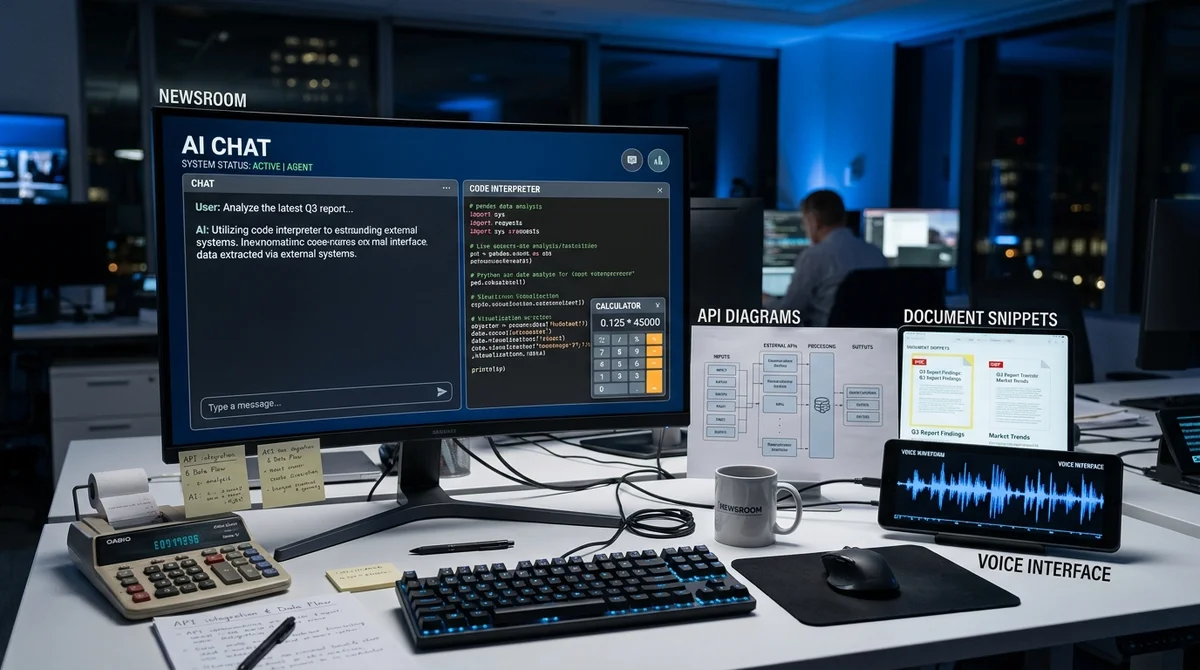
Habr AI Explains Why LLMs Don't Calculate, Don't Learn in Dialogue, and Depend on Tools
Habr AI explains that language models can only work with text on their own, while memory, calculations, search, agents, and 'digital employees' emerge through external tools.

Svoi.ru reduced test preparation by 70% using AI agents
Svoi.ru's team demonstrated how AI agents can automate requirements analysis and test documentation preparation, relieving QA of routine analytics and reducing this phase by 70%.

Kodik explains why public language model benchmarks are misleading
Kodik analyzed weaknesses in popular LLM tests and showed why for its AI code editor, an internal benchmark matters more than impressive percentages in other companies' tables.

How Google DeepMind and Competitors Are Transforming Music: Five AI Services for Track Generation
A collection of five AI services demonstrates how text-to-music generation has stopped being a toy and become a working tool for authors, brands, and independent producers.

WisprFlow, Whisper and GigaAM: who recognizes Russian-English speech better
The author compared five applications and five voice input models for Russian-English code-switching and showed how local open source solutions can already replace WisprFlow.

GPTunneL and the Forbes Trend: Why AI-Superapps Are Becoming the New Growth Driver for the Market
GPTunneL, which has grown to 2 million users, describes how AI-superapps are changing audience behavior, corporate demand, and market economics—from China and the US to Russia.

Habr showed how to train a mini-LLM in C# using ILGPU and integrated AMD graphics
Habr published a breakdown of how to build and train a tiny LLM in C# with ILGPU and OpenCL, export it to GGUF, and run it in LM Studio even on integrated AMD graphics.

Anthropic unveils Claude Mythos Preview via 244-page system card instead of standard release
Anthropic introduced Claude Mythos Preview not as a typical launch, but through a 244-page system card detailing the model's capabilities, risks, and reasons for limited access.

OpenAI and Anthropic shift language model pricing metrics: in 2026, task cost matters
OpenAI and Anthropic are changing LLM pricing rules: in 2026, tracking token price alone is no longer enough for businesses — calculating the full cost of solving a specific task is necessary.

Claude Code Turned into BABOK AI-Analyst: Assistant Conducts Interviews and Gathers Requirements
Based on Claude Code, they built an AI-assistant for business analysis following BABOK v3: it helps conduct interviews, gather requirements, avoid skipping steps, and document artifacts.

Claude Code and Codex: how to reduce token losses with three markdown files
Claude Code and Codex often spend most of their context on repeated project navigation; this can be solved with a hierarchy of a global map, CLAUDE.md, and memory of past sessions.

LM Studio and Qwen: How Local LLMs Handle Coding on MacBook M4 Pro
The author tested local Qwen, Gemma and other models for coding via LM Studio on MacBook M4 Pro: they are already viable in chat mode, but noticeably lag behind cloud solutions in agent mode.

Qwen 3.5 on MacBook Pro: Comparing Eight Local Servers for Team Workflows
The author tested eight MLX servers on MacBook Pro M2 Max with Qwen 3.5 35B, revealing that nearly all solutions significantly lose speed under parallel requests.

Selectel: AI doesn't take away jobs, but makes entering the profession significantly harder
Selectel describes a new labor market around AI: vacancies don't disappear, but it's harder for juniors to enter the profession, and demand and salaries shift toward those who can work with models.

Habr AI releases guide to ChatGPT, Claude, and mcp for newcomers
Habr AI explains without unnecessary theory the differences between local and cloud models, why to pay for subscriptions, how agents work, and why mcp is becoming the standard.

Joshua Bengio and LawZero: why fear of future AI distracts from today's threats
A text on 'Pascal's wager' in AI explains why fear of hypothetical superintelligence diverts attention from already real threats: surveillance, corporate power, and worker pressure.

Anthropic and Claude Opus 4.7: Actual Token Consumption Exceeded Claimed Figures
An author measured Claude Opus 4.7's new tokenizer and found consumption increased up to 45–47%, contrary to Anthropic's promised 0–35%, directly impacting quota burn, cache, and Max plan depletion rates.

OpenAI releases GPT-Rosalind for biology: capabilities and limits of the new model
OpenAI launched GPT-Rosalind for life sciences tasks and integrated it with a Codex research module, promising to accelerate hypotheses and experiments without manual assembly from dozens of services.

Cursor Security Audit Discovers Four Vulnerabilities in Code Editor Protection, but Authorization Remains Secure
Technical audit of Cursor revealed prototype pollution, a hidden dev field, and internal architecture leaks, but confirmed that subscription verification and premium model access remain server-side.

Anthropic released Opus 4.7, and OpenAI turned Codex into a computer work agent
This week in AI brought several shifts: Anthropic updated Opus 4.7, OpenAI gave Codex computer control, and Google and Baidu unveiled new voice and visual models.

ChatGPT Nailed the Diagnosis in Five Cases, But Failed on Treatment Planning
In a five-case medical comparison, ChatGPT never misdiagnosed the primary condition—but fell noticeably short on practical recommendations, testing, and patient management.

Why LLM Services Ignore Your Instructions and How to Actually Regain Control
Even a detailed prompt doesn't guarantee a compliant response: this article explains why LLMs break format, succumb to injections, and require not just text, but engineering constraints.

Google and OpenAI Hit the Limit: What Happens When the Internet Runs Out of Human Text
Generative AI not only drains website traffic through AI summaries, but also undermines its own training data foundation: the less incentive people have to write, the worse the internet and future models will become.

How Moscow Credit Bank Shows the Evolution of Employee Training in Banking — From Clerks to AI
Moscow Credit Bank traced how banks trained employees from coin verification and business correspondence to personalized onboarding, compliance, and AI assistants.