Apple ML Research
AI news source. Articles are auto-selected and adapted by Hamidun News editors.
Latest publications

Apple proposes SelfCompact: the agent decides for itself when to compress context
Apple researchers removed the fixed token threshold from context compression: in SelfCompact, the model chooses when and how to compact its context through a dedicated tool.

Apple Research Unveils Minions: A Virtual GPU Cloud Built on Idle Macs
Apple researchers describe Minions, a distributed cloud that pools idle Apple Silicon GPUs in macOS devices to run ML inference at scale.

Apple tested LLMs as translation judges: MQM and ESA are hard for both humans and models
Apple ML Research compared LLM and human quality annotations for machine translation under the MQM and ESA schemes. The title gives the verdict: both sides struggle.

Apple ML Research Studies Alignment in Multimodal LLMs and Their Tendency to Hallucinate
Apple ML Research has published a broad study of preference alignment in multimodal language models, and of why hallucinations there are more complex than in text-only LLMs.

Apple ML Research proposes compact models to fix speech recognition errors
Apple ML Research proposes compact seq2seq models instead of LLMs to correct ASR errors, training them on real and synthetic errors.

Apple ML Research presents Text-to-Sounding-Video, a method for generating video with sound from text
Apple ML Research outlined Text-to-Sounding-Video, which generates video with sound from text, and named two key unsolved problems in the field.

Apple ML Research unveils TopoPrimer, a topological context layer for forecasting models
Apple ML Research has introduced TopoPrimer, a framework that feeds the global topological structure of a dataset into time-series forecasting models.

Apple works out when on-policy distillation actually helps model training
Apple ML researchers identify the conditions under which on-policy distillation works for training reasoning models, and when it can be ineffective or even counterproductive.

Self-Reflective Program Search: Apple Improves How LLMs Handle Long Contexts
Apple ML Research has published a study of Self-Reflective Program Search, a method that improves language models' handling of long contexts by recursively breaking them into subqueries.

Apple develops TGPO to teach video models to understand time
Apple ML Research unveils TGPO, a method that teaches video models the order and evolution of events in egocentric video by reinforcing temporal reasoning.

AI Vulnerability: A Single Neuron Can Bypass Safety Guardrails in Large Language Models, Apple Finds
Apple researchers show that LLM safety protections can be fully bypassed by manipulating a single neuron, with no fine-tuning or prompt changes, across seven models from two families.

Apple's FlowEval Uses AI to Grade AI-Generated Interfaces
Apple ML Research has built FlowEval, a framework that automatically scores AI-generated interfaces by comparing their navigation trajectories with those of real websites.

Apple ML Research unveils Weblica, a scalable environment for training visual web agents
Apple has released Weblica, a framework that replays interactive web page states and uses LLMs to generate training environments, aiming to train browser-based AI agents reliably.

Apple develops MT-EditFlow for multi-step AI image editing
Apple ML Research has unveiled MT-EditFlow, a reinforcement learning system that tackles the problem of errors piling up during iterative image editing.

LensVLM: A Neural Network for Reading Text in Compressed Images
Apple ML Research has proposed LensVLM, a framework that lets vision-language models read small text in compressed images without losing accuracy.

How to Fine-Tune an AI Model on New Tasks Without Losing Its Existing Abilities
Apple's DynaMiCS treats data selection during fine-tuning as a constrained problem, preserving a model's instruction-following, knowledge and safety while it adapts to new domains.
How Mixture-of-Experts Works: The Architecture Behind Modern Neural Networks
Apple researchers found that tokens in MoE architectures use only a tiny fraction of the theoretically possible routes, and they propose an architecture to fix it.

Speech neural networks scale like text models, Apple study finds
Apple ML Research found that speech language models built on continuous diffusion scale as predictably as autoregressive ones, and introduced a new metric, pJSD.

Apple ML Research tackles ASR accuracy loss on long audio recordings
Apple ML Research has published Segmental Attention Decoding, four architectural changes aimed at the main problem neural networks face with long audio recordings.

Apple publishes Fortress, a framework that stabilizes recommender systems by pruning features
Apple ML Research describes Fortress, a system that removes temporal instability from recommendation models by finding and deleting features that produce inconsistent predictions.

Apple ML Research examines why AI safety data annotators disagree
Apple ML Research has developed a method for analyzing disagreements among safety data annotators, the people who train AI models to tell acceptable content from dangerous content.

Apple ML Research proposes a way to generalize ML models to new domains without labeling
Apple ML Research has developed a domain generalization approach that relies on unlabeled data from the new domain instead of costly annotation.

A More Efficient Neural Network: How Apple Optimized Inference
Apple ML Research unveils Conformal Thinking, a framework that automatically manages the token budget of reasoning models, guaranteeing a set error rate with minimal compute.

Apple ML Research: How Diffusion Language Models Can Learn to Pick Tokens Without Hand-Tuned Heuristics
Apple ML Research proposes replacing hand-built token-selection heuristics in diffusion language models with learned policies, aiming to remove instability and manual parameter tuning.

Apple ML Research proposes MemoryLLM, an interpretable "memory" for transformers
Apple researchers describe feed-forward blocks in LLMs as neural lookup memory and propose a way to analyze them in isolation, without the self-attention mechanism.
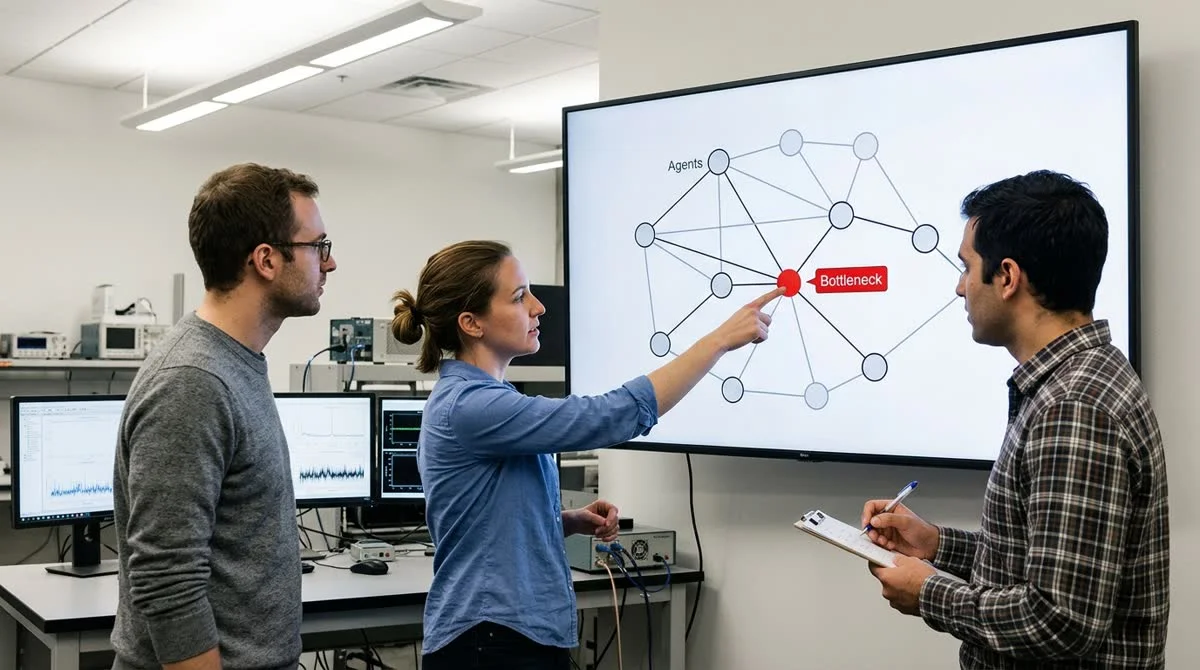
Apple ML Research: Multi-Agent LLM Teams Hold Back Their Expert Agents
Apple ML Research finds that self-organizing teams of language models produce no synergy. They hold expert agents back instead of boosting them.