Apple ML Research: Multi-Agent LLM Teams Hold Back Their Expert Agents
Apple ML Research has published a paper with an awkward conclusion: multi-agent LLM teams without fixed roles do not achieve synergy, and in practice hold their expert agents back. Drawing on organizational psychology, the authors introduce a metric called "strong synergy": a team outperforming the best of its individual members. Self-organizing teams do not clear that bar, while structured approaches with fixed roles remain more effective.
AI-processed from Apple ML Research; edited by Hamidun News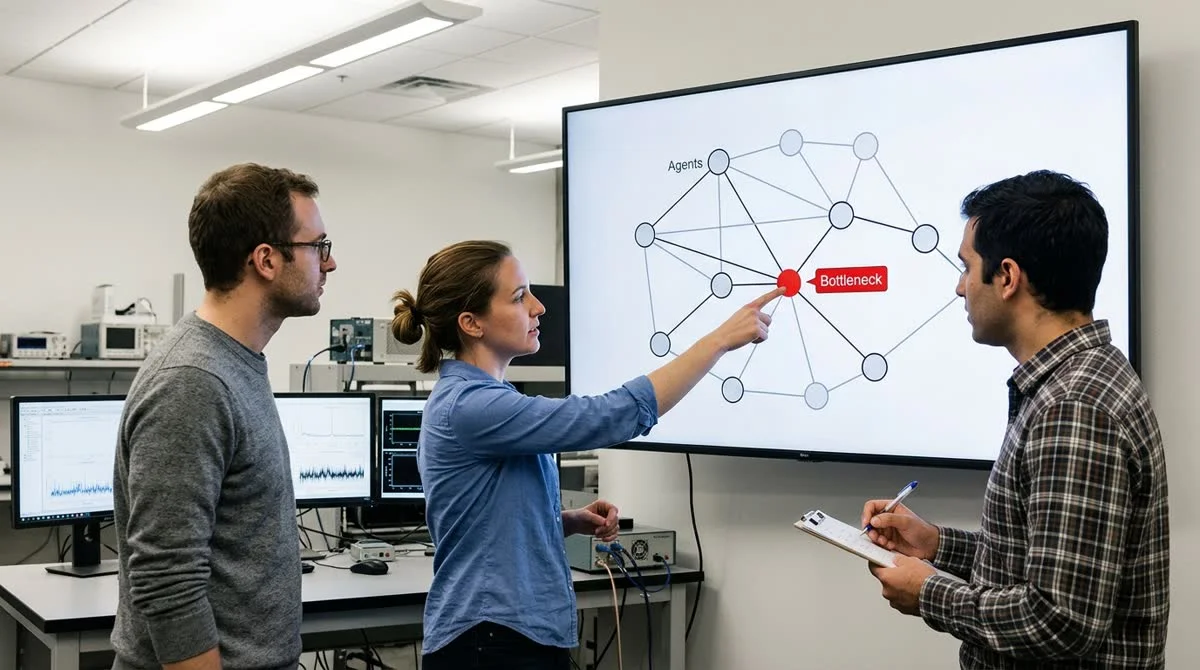
Multi-agent LLM systems in which model agents interact freely, without predefined roles or scripts, do not outperform a single well-calibrated expert. They hold it back. That is the main finding of a new paper from Apple ML Research, whose title says it all: "Multi-Agent Teams Hold Experts Back."
What Apple ML Research studied
Multi-agent systems are one of the key tools in modern AI applications: several specialized agents work together, with one collecting data, another analyzing it and a third formulating the answer. Most existing approaches coordinate agents through rigid structure: fixed roles, a set order of steps or rules for aggregating results. This works, but limits flexibility.
Apple ML Research asked what happens if those constraints are removed and agents are allowed to interact completely freely. The authors call such a system a "self-organizing team": coordination is not written in advance but has to emerge organically from the agents' interaction itself. The question matters for the whole industry, since modern agent orchestration frameworks are moving toward greater autonomy and free interaction.
Drawing on organizational psychology, the authors introduced a key metric, strong synergy: a team counts as synergistic only if it consistently outperforms the best of its members, not merely their average result.
The main result: no strong synergy
According to Apple ML Research, self-organizing LLM teams do not achieve strong synergy. Moreover, under unrestricted interaction the team holds back its expert members rather than amplifying them. The study's key findings:
- Multi-agent teams without fixed roles do not outperform the best expert agent among their members.
- Free coordination limits the potential of expert members instead of unlocking it.
- Structured approaches with predefined roles and aggregation rules are consistently more effective than unstructured ones.
- The "wisdom of the crowd" effect, well documented in human groups, does not reproduce in LLM agents.
Why "wisdom of the crowd" fails for LLMs
This is a break from how humans work. In human groups without a rigid hierarchy, mutual error correction and a diversity of viewpoints often make it possible to find solutions that no single member could reach alone. Through the lens of organizational psychology, this is explained by an accumulated culture of collaboration and by the shared context a group builds over time.
Language models do not accumulate such context: every session starts from scratch, with no shared history and no established norms of interaction between agents. As a result, free coordination produces noise rather than synergy, and an expert agent inside such a team performs worse than it would acting alone.
What this means for developers of agentic systems
The practical takeaway: if coordination is not built in explicitly, through roles, workflows or result-aggregation rules, a multi-agent system risks losing to a single well-calibrated specialist. Adding agents is easy; organizing their interaction so that it actually works is much harder.
The Apple ML Research paper is a weighty argument for structured design of multi-agent systems: synergy does not arise from free interaction on its own and has to be engineered explicitly. Until language models learn to build coordination organically, as human groups do through culture and experience, self-organizing AI teams will lose to structured ones, and will hold back rather than amplify the best agents in their ranks.
What is "strong synergy" in the Apple ML Research study?
Strong synergy is a metric introduced by the study's authors, based on organizational psychology: a team of LLM agents counts as synergistic only when it consistently outperforms the best of its individual members, not merely when it scores above the team average. According to Apple ML Research, self-organizing agent teams do not clear this threshold.
Why do self-organizing teams of LLM agents lose to lone experts?
Because language models lack what allows humans to coordinate effectively without rigid structure: an accumulated culture of collaboration and a shared context that builds up over time. Every LLM agent session starts from scratch with no shared history or established norms of interaction, so free interaction between agents produces noise rather than "wisdom of the crowd," and an expert agent inside such a team performs worse than it would acting alone.
How can you avoid a failed multi-agent system, according to
Apple ML Research?
Coordination has to be built in explicitly, through fixed roles for agents, a set order of steps (workflow) and defined rules for aggregating results. The study shows that such structured approaches are consistently more effective than free, unrestricted agent interaction, which risks holding back rather than strengthening the best expert on the team.
- Nov 2, 2026TensorFold 1.2.0 boosts Qwen3.8-27B throughput on M3 Ultra by 44.2% at 16 streams
- Nov 1, 2026Local models lose to Opus and Codex: 0.21 on a MacBook versus 1.00 for Codex
- Oct 29, 2026Claude Code Edits Video From a Transcript: How the video-use Skill With 30 000 Stars Works
- Oct 29, 2026Stanford AI tool verifies part of Signal's code in half a day for under $500, versus five months of expert work
Key Questions Answered
What is "strong synergy" in the Apple ML Research study?
Strong synergy is a metric introduced by the study's authors, based on organizational psychology: a team of LLM agents counts as synergistic only when it consistently outperforms the best of its individual members, not merely when it scores above the team average. According to Apple ML Research, self-organizing agent teams do not clear this threshold.
Why do self-organizing teams of LLM agents lose to lone experts?
Because language models lack what allows humans to coordinate effectively without rigid structure: an accumulated culture of collaboration and a shared context that builds up over time. Every LLM agent session starts from scratch with no shared history or established norms of interaction, so free interaction between agents produces noise rather than "wisdom of the crowd," and an expert agent inside such a team performs worse than it would acting alone.
How can you avoid a failed multi-agent system, according to Apple ML Research?
Coordination has to be built in explicitly, through fixed roles for agents, a set order of steps (workflow) and defined rules for aggregating results. The study shows that such structured approaches are consistently more effective than free, unrestricted agent interaction, which risks holding back rather than strengthening the best expert on the team.
Test Frontier LLMs & Autonomous Agents in One Workspace
Run Claude Opus 5.5, GPT-6, Gemini 3.1, and DeepSeek side-by-side in Nomad AI (nomadnet.ai) — unified model routing, deep research, and multimodal workflows under one subscription.
The AI world, distilled — once a week
Seven stories that actually mattered, hand-picked. No noise, no reposts, no press releases.
Done! Check your inbox for a confirmation.