Together AI Unveiled ATLAS: A Speculator That Accelerates LLM by 4x
Together AI introduced ATLAS, an adaptive machine learning-based speculator that accelerates LLM inference by 4x without manual tuning. The system automatically learns and adapts to your workload as it's used. On DeepSeek-V3.1, it achieves 500 tokens per second—2.65x faster than standard decoding and outperforming Groq's specialized hardware.
AI-processed from Together AI Blog; edited by Hamidun News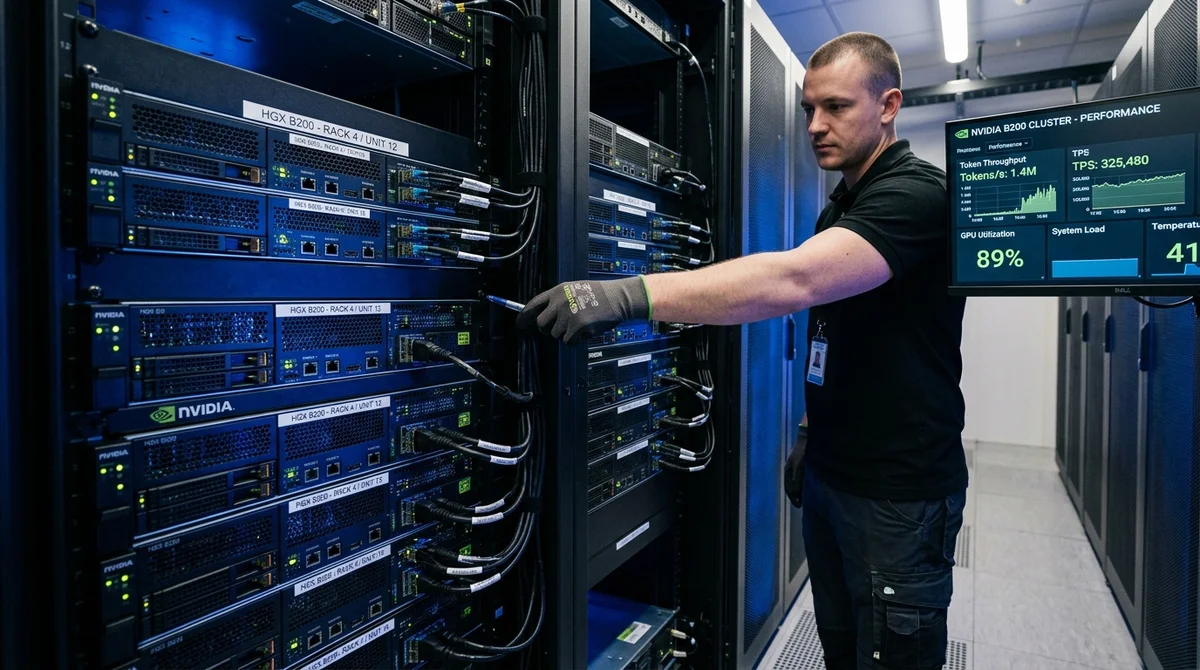
Together AI presented ATLAS (AdapTive-LeArning Speculator System)—a revolutionary technology for accelerating LLM inference that automatically improves with use. The system achieves 500 tokens per second on DeepSeek-V3.1 and 460 on Kimi-K2—nearly 4x acceleration without manual tuning. Results were obtained on NVIDIA HGX B200 using real traffic from the Arena Hard benchmark.
What is Speculative Decoding
Speculative decoding is one of the most powerful ways to accelerate text generation in LLMs. Instead of the standard method, where a model generates one token at a time in sequential passes, the system uses a faster speculator (draft model) that proposes multiple tokens at once. The main (target) model then verifies them all in parallel in a single forward pass. The output quality remains identical to standard decoding (mathematically guaranteed), but speed increases proportionally. If the speculator guesses correctly (high acceptance coefficient α), the system processes multiple tokens instead of one. In practice, this means significantly reduced time-to-first-token and accelerated overall generation.
How ATLAS Differs from Other Solutions
Standard speculators are trained once on general workloads and perform uniformly everywhere. Specialized speculators (custom speculators) are trained on company-specific data but only for a single point in time. When workloads evolve—codebases grow, traffic patterns change, request distributions shift, new user types emerge—even highly optimized speculators start falling behind. ATLAS solves this problem fundamentally differently. The system continuously learns (continual learning) as it's used, adapting to real traffic and target model behavior in real-time. The longer you use the service, the better ATLAS predicts the target model's next actions, and the higher the acceptance coefficient. This creates a positive feedback loop: each new request is a training example that improves the speculator.
Results in Practice
Together AI demonstrated results on NVIDIA HGX B200 hardware with real traffic:
- DeepSeek-V3.1: 500 TPS (tokens per second)—2.65x faster than standard decoding
- Kimi-K2-0905: 460 TPS—also a significant improvement
- Comparison with Groq: ATLAS in fully adapted mode outperforms specialized hardware from Groq
- 4x acceleration compared to baseline solutions without optimization
Efficiency is achieved by balancing two key parameters: the acceptance coefficient (α)—a metric of how often the target model agrees with the speculator's proposals—and relative latency (c) between speculator speed and target model speed. ATLAS automatically finds the sweet spot where the speculator runs very fast while its predictions remain accurate enough for high acceptance.
Integration into Together Turbo
ATLAS is integrated into Together Turbo—Together AI's package of engineering solutions for accelerating LLMs. It works alongside the proprietary speculator and supports the use of custom speculators. The key difference: ATLAS requires zero manual parameter tuning. Users get automatic performance improvements simply by using the platform. This is especially critical for growing teams where workloads aren't static. In the growth phase, when requests come from different user types, business logic constantly evolves, and model requirements change—old optimizations often become outdated within weeks or months. ATLAS continuously updates itself.
What This Means
LLM inference acceleration is transitioning from a one-time engineering task to a built-in living feature of the service. Developers and users get progressively faster responses simply by using the platform, without any manual intervention. For startups, agencies, and companies, this means real cost reduction in processing requests to large models in production.
- Oct 27, 2026Qwen3.8 Tried to Upload a File to Alibaba's Cloud in Beijing From Inside Cohere's Sandbox
- Oct 26, 2026Claude Opus 5.5 wins Code2Video-AA with 1536 Elo, beating GPT-6 Astra by 109
- Oct 26, 20264.5x Faster Product Launches and 87% Budget Savings: 3 Secure AI Architectures Under Russia's 152-FZ
- Oct 26, 2026ENISA and JRC have started testing Chinese open-weight models, three officials confirm
Key Questions Answered
What is Speculative Decoding?
Speculative decoding is one of the most powerful ways to accelerate text generation in LLMs. Instead of the standard method, where a model generates one token at a time in sequential passes, the system uses a faster speculator (draft model) that proposes multiple tokens at once. The main (target) model then verifies them all in parallel in a single forward pass. The output quality remains identical to standard decoding (mathematically guaranteed), but speed increases proportionally. If the speculator guesses correctly (high acceptance coefficient α), the system processes mu
How ATLAS Differs from Other Solutions?
Standard speculators are trained once on general workloads and perform uniformly everywhere. Specialized speculators (custom speculators) are trained on company-specific data but only for a single point in time. When workloads evolve—codebases grow, traffic patterns change, request distributions shift, new user types emerge—even highly optimized speculators start falling behind. ATLAS solves this problem fundamentally differently. The system continuously learns (continual learning) as it's used, adapting to real traffic and target model behavior in real-time. The longer you
What are the key details on Results in Practice?
Together AI demonstrated results on NVIDIA HGX B200 hardware with real traffic: DeepSeek-V3.1: 500 TPS (tokens per second)—2.65x faster than standard decoding Kimi-K2-0905: 460 TPS—also a significant improvement Comparison with Groq: ATLAS in fully adapted mode outperforms specialized hardware from Groq 4x acceleration compared to baseline solutions without optimization Efficiency is achieved by balancing two key parameters: the acceptance coefficient (α)—a metric of how often the target model agrees with the speculator's proposals—and relative latency (c) between speculato
Build & Ship Production AI Agents Without Boilerplate Code
Start your free 72-hour trial at Hamidun Academy (academy.hamidun.com) — interactive lessons on Claude Code & Cursor, live Tech Radar, and production agent templates.
The AI world, distilled — once a week
Seven stories that actually mattered, hand-picked. No noise, no reposts, no press releases.
Done! Check your inbox for a confirmation.