San Francisco uses AI to save whales from ship collisions
San Francisco has launched the ambitious AI system WhaleSpotter to protect gray whales from ship collisions. The system scans the bay 24/7, detecting whales up
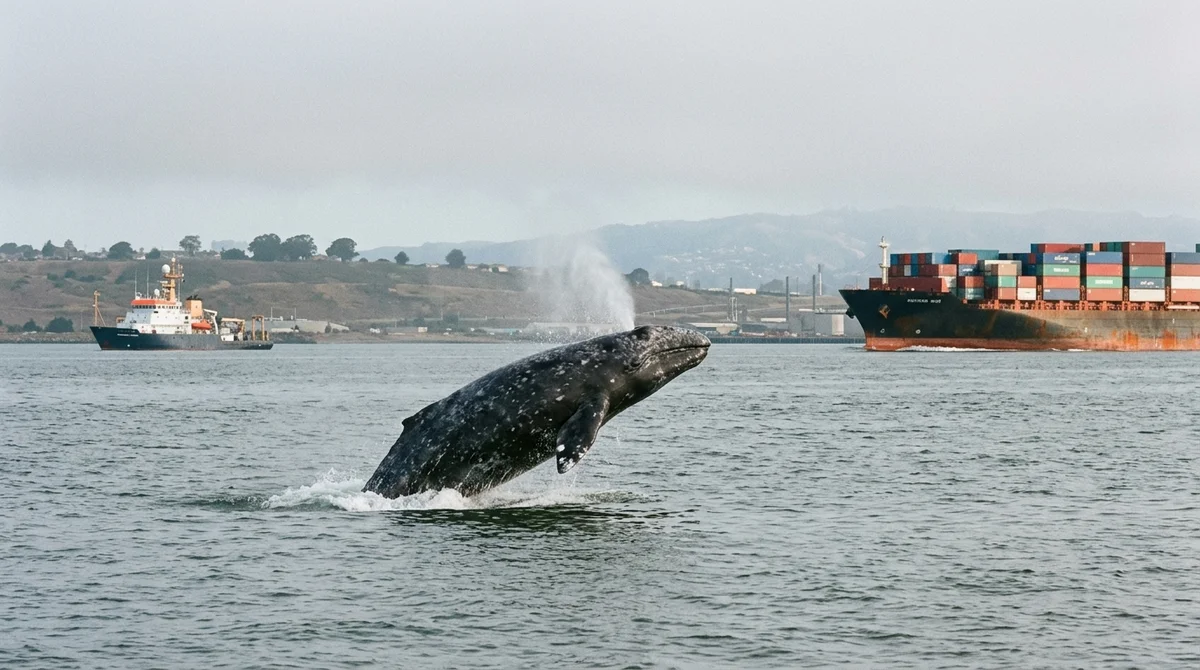
Climate change is pushing gray whales into San Francisco Bay in search of food, but the bay is one of the world's most intense and dangerous shipping lanes. AI has come to the rescue with a next-generation system.
Collisions on the Rise, Whales in Desperation
San Francisco Bay has already registered eight whale-ship collisions this season out of twenty-one cases of mortality — a staggering 40% of all fatal collisions in the season. Gray whales, undertaking annual migration between the Arctic (where they feed) and Baja California (where they breed), increasingly linger in the bay, desperately searching for food. But the bay is no safe haven — it's a maze of ferries, cargo ships, and tankers, turning these waters into a deadly corridor.
The main reason is ocean warming. As global temperatures rise, populations of California krill — the primary food source for gray whales — plummet sharply, forcing hungry mammals to seek food closer to shore, in narrow and dangerous straits where there are more ships and greater risk.
WhaleSpotter: Technology Against Natural Disaster
Against the backdrop of the growing crisis, San Francisco Bay has deployed an ambitious WhaleSpotter project — an AI system that scans the bay's waters ceaselessly, 24 hours a day, 7 days a week. The system is equipped with computer vision and can detect whales by their characteristic water spray fountains and infrared signatures at distances up to two nautical miles — enough to alert mariners in advance. When WhaleSpotter detects a whale in a danger zone, the system instantly sends an alert to ship captains and operators with a recommendation to slow down or choose an alternative route.
This gives the animal critical minutes to swim to safety before a large vessel enters its territory.
- Continuous 24/7 monitoring of the bay in real-time
- Detection of whales at distances up to 2 nautical miles with high accuracy
- Automatic transmission of warnings to captains via marine communication channels
- Re-identification and tracking of individual animals for data collection
- Integration with ship routing systems
Climate Stress and Ecosystem Desynchronization
Global warming creates something more complex than simply a food shortage. The very genetic synchronization of marine ecosystems is changing. The cold Arctic waters where gray whales feed in summer are becoming less productive, so animals arrive in San Francisco Bay earlier than usual and stay longer than needed, in a desperate attempt to build up fat reserves before their long migration.
This timing coincidence is the most dangerous: the arrival of hungry whales in the bay synchronizes with peak shipping. Ships rush on schedule, whales are hungry and desperately searching for food — the perfect storm for tragedy. Ecologists add an alarming factor: changes in feeding seasonality disrupt centuries-old synchronization between food availability at certain latitudes and whales' traditional migration routes.
This adds additional physiological and psychological stress to an already vulnerable population, weakening them overall.
What This Means
WhaleSpotter symbolizes a shift from attempts to solve the climate crisis as a whole to local, practical tactics for adapting to its already inevitable consequences. The system won't stop ocean warming, but it will give gray whales a real chance to survive the critical transition period while the global community — if it does — fights carbon emissions. This is an example of how technology can serve as a bridge between environmental catastrophe and hope for survival. The idea can be scaled and adapted in other regions of the world where intensive shipping meets migrating marine fauna: from European ports to Asian coasts, from the Mediterranean to the Caribbean straits.