Scaleway-led French consortium bids $10 billion to build AI gigafactory
A French consortium led by Scaleway has submitted a $10 billion bid to build an AI gigafactory. Partners include Hugging Face, Mistral, GENCI, Inria, Eviden and
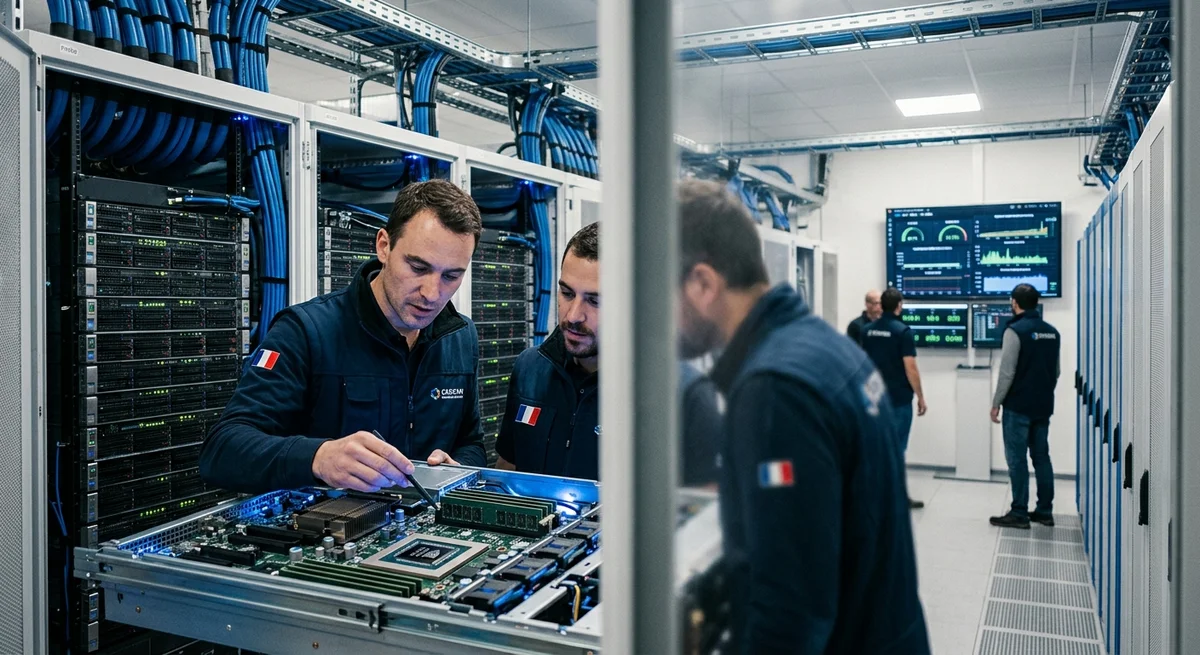
A consortium of French companies led by Scaleway has submitted an application for approximately $10 billion to build one of five AI high-power centers planned by the European Union. These are the so-called AI gigafactories — mega-infrastructure projects designed to strengthen the EU's technological independence from the USA and China in the development and training of advanced AI models.
Composition of the French Consortium
The AION consortium includes leading French companies and scientific institutions. Scaleway — the cloud platform of French telecommunications company Iliad — heads the initiative. Its partners include:
- Hugging Face — a platform with open language models, well-known in the AI community
- Mistral AI — developer of proprietary large language models, a competitor to OpenAI in the European market
- GENCI and Inria — leading French scientific centers, historical leaders in computer science
- SiPearl and Eviden — chipmakers and engineering solutions providers
Together, these players aim to create an integrated infrastructure for developing, training, and deploying world-class large language models. The $10 billion is not simply building construction. These are investments in high-performance equipment, reliable power supply (critical for data centers), cooling systems, and a complete support ecosystem. Gigafactories require serious government and private investments.
France Acts as a Single Country
France has chosen a unique strategy — to be the only country-participant in the competition rather than joining multi-country coalitions. There are several competitors: a Spanish-Portuguese coalition, a German-Dutch consortium, and other European proposals. This choice is geopolitical. Ownership of critical AI infrastructure means not only economic competitiveness but also technological sovereignty. France is sending a clear signal: Europe needs its own technological power, not distributed control in multi-country consortiums. It seeks to avoid dependence on U.S. cloud platforms and show the world that one European country can independently finance and control critical AI projects.
European Competition for Computing Resources
The European Union is increasingly aware of its lag behind the USA (OpenAI, Anthropic, Google DeepMind) and China in creating fundamental AI models of world-class power. Five gigafactory projects funded by the EU are an attempt to create its own pipeline of computing power for research, development, and commercial applications. France has a serious historical foundation: scientific centers like INRIA, decades of investment in computer science, and a new wave of innovative startups (Mistral, Hugging Face, SiPearl). The French consortium combines fundamental research, industrial chipmaking, and cloud services into one integrated value creation chain. This promises a more cohesive and controlled system than joining unfocused European coalitions.
What This Means for the AI Industry
The geopolitical struggle for AI leadership is shifting from software (algorithms, language models, frameworks) to hardware (computing power, electricity, chips). This is a fundamental shift. If the French consortium wins the bid, European startups, researchers, and companies will gain access to computing power independently of American cloud platforms like AWS and Azure. This will strengthen France's position in EU technological sovereignty and demonstrate its capacity for strategic investments in critical technologies. The results of the competition should be announced within several months.