NVIDIA spells out the difference between evaluating models and evaluating AI agents
NVIDIA has highlighted a fundamental difference in how AI systems are evaluated. A model benchmark checks language understanding and the ability to solve static tasks. Evaluating an agent is something else entirely: you have to test end-to-end behavior, including planning, tool calls and operation under uncertainty.
AI-processed from NVIDIA Developer Blog; edited by Hamidun News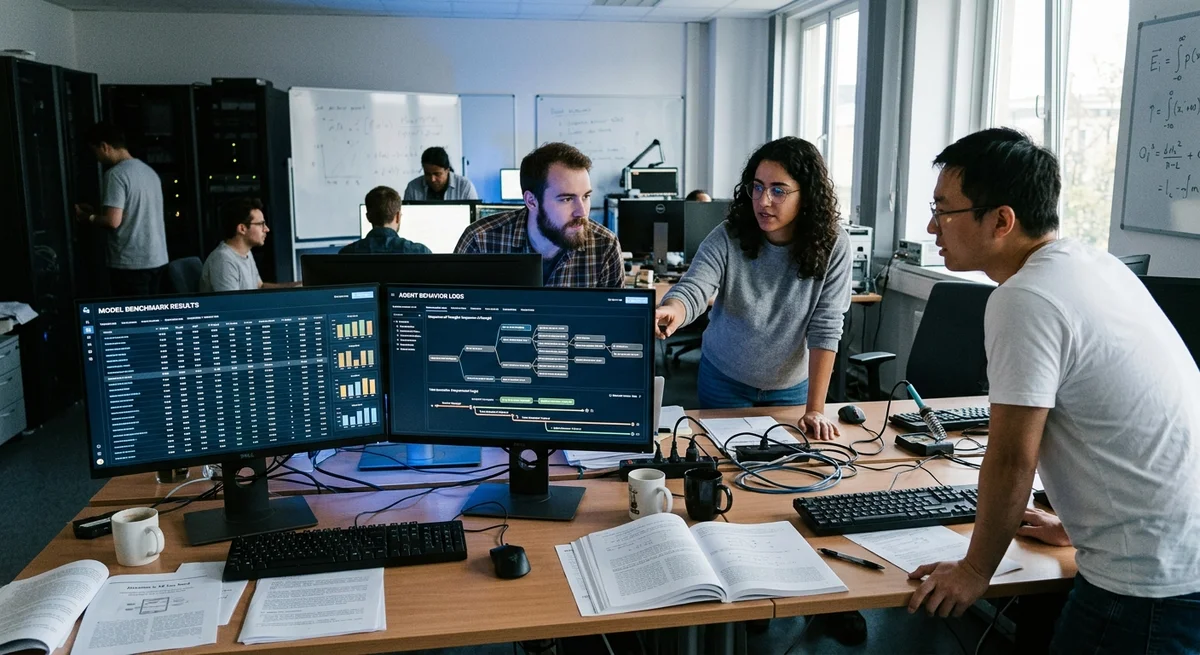
Evaluating an AI model and evaluating an AI agent are similar but fundamentally different tasks. On its blog, NVIDIA explained why you cannot judge agents by model metrics alone.
Model benchmarks: static tasks
When we evaluate a foundation model, we use benchmarks: we check how well it understands language, follows instructions, and solves math problems or logic puzzles. These are static sets of examples: the model receives text as input and must produce the correct answer. Classic benchmarks such as MMLU, GSM8K or HumanEval show a model's raw power well. But they answer only one question: can the system handle a task under ideal conditions?
An agent is a system in action
An agent is something else. It is not just a model that answers a question. It is a system that works end-to-end: it receives a task, plans steps, calls tools (a browser, a database, APIs), analyzes the results, and handles errors and uncertainty. Even if the model is very strong, an agent built on it can fail. Why?
- Planning can go wrong: the model picks the wrong tool
- The result-processing loop breaks: the agent does not notice an error in a tool's response
- Uncertainty and noise in the environment: real tools behave unreliably and data is incomplete
- Safety and reliability: an agent can be "tricked" or perform a dangerous action
- Efficiency: an agent can spend too many steps on a simple task
Why this matters for developers
Understanding this difference matters because evaluating an agent requires entirely different metrics. You cannot simply take a model's benchmark results and treat them as the final assessment of the system. NVIDIA stresses that agents need end-to-end evaluation. That means we must release the agent into a real or semi-real environment, give it a task, and see whether it can solve it while absorbing all the friction: tool errors, contradictory information, the need to replan.
What this means
Proper agent evaluation is becoming critical because these systems are starting to work on real tasks. If you rely only on model benchmarks, you may miss serious problems in the agent's behavior and run into them in production.
- Nov 2, 2026Karpathy builds a YouTube clone with 6454 videos from Hacker News recommendations in two hours
- Nov 2, 2026Karpathy used Claude to build HackerTube from 6,454 videos recommended on Hacker News
- Nov 2, 2026Arca gives AI agents finance tasks lasting up to 10 days, but leaves the trades to humans
- Nov 2, 2026DeepSeek open-sources Super-agent prototype: p95 task completion time of 15.7 minutes vs. 29.5
Key Questions Answered
What are the key details on Model benchmarks: static tasks?
When we evaluate a foundation model, we use benchmarks: we check how well it understands language, follows instructions, and solves math problems or logic puzzles. These are static sets of examples: the model receives text as input and must produce the correct answer. Classic benchmarks such as MMLU, GSM8K or HumanEval show a model's raw power well. But they answer only one question: can the system handle a task under ideal conditions?
What are the key details on An agent is a system in action?
An agent is something else. It is not just a model that answers a question. It is a system that works end-to-end: it receives a task, plans steps, calls tools (a browser, a database, APIs), analyzes the results, and handles errors and uncertainty. Even if the model is very strong, an agent built on it can fail. Why? Planning can go wrong: the model picks the wrong tool The result-processing loop breaks: the agent does not notice an error in a tool's response Uncertainty and noise in the environment: real tools behave unreliably and data is incomplete Safety and reliability:
Why this matters for developers?
Understanding this difference matters because evaluating an agent requires entirely different metrics. You cannot simply take a model's benchmark results and treat them as the final assessment of the system. NVIDIA stresses that agents need end-to-end evaluation. That means we must release the agent into a real or semi-real environment, give it a task, and see whether it can solve it while absorbing all the friction: tool errors, contradictory information, the need to replan.
Test Frontier LLMs & Autonomous Agents in One Workspace
Run Claude Opus 5.5, GPT-6, Gemini 3.1, and DeepSeek side-by-side in Nomad AI (nomadnet.ai) — unified model routing, deep research, and multimodal workflows under one subscription.
The AI world, distilled — once a week
Seven stories that actually mattered, hand-picked. No noise, no reposts, no press releases.
Done! Check your inbox for a confirmation.