NVIDIA Shows the Difference Between Evaluating Models and Evaluating AI Agents
NVIDIA highlighted a fundamental distinction in evaluating AI systems. A model benchmark tests language understanding and the ability to solve static tasks. Agent evaluation is something entirely different: you need to test end-to-end behavior including planning, tool invocation, and operation under uncertainty.
AI-processed from NVIDIA Developer Blog; edited by Hamidun News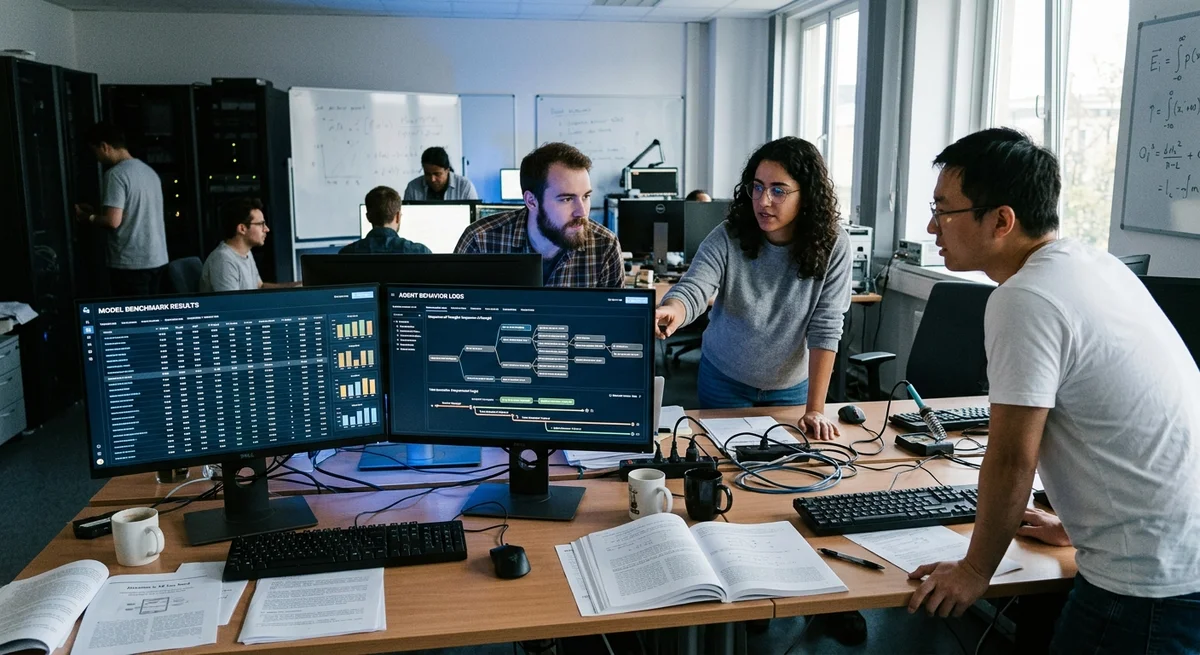
Evaluating an AI model and evaluating an AI agent are similar but fundamentally different tasks. NVIDIA explained on its blog why you cannot judge agents based solely on model metrics.
Model Benchmark — Static Tasks
When we evaluate a foundation model, we use benchmarks: testing how well it understands language, follows instructions, solves mathematical problems, or tackles logic puzzles. These are static sets of examples—the model receives text as input and must produce the correct answer. Classic benchmarks like MMLU, GSM8K, or HumanEval demonstrate the raw power of the model. But they answer one question: can the system handle a task under ideal conditions?
An Agent — A System in Action
An agent is something entirely different. It's not just a model that answers a question. It's a system that works end-to-end: receives a task, plans steps, invokes tools (browser, database, API), analyzes results, handles errors and uncertainty. Even if the model is very strong, an agent built on it can fail. Why?
- Planning can be incorrect — the model selects the wrong tool
- The result processing loop breaks — the agent fails to notice an error in the tool's response
- Uncertainty and noise in the environment — real tools work inconsistently, data is incomplete
- Safety and reliability — the agent can be 'deceived' or perform a dangerous action
- Efficiency — the agent may spend too many steps on a simple task
Why This Is Critical for Developers
Understanding this difference is important because evaluating an agent requires completely different metrics. You cannot simply take model benchmark results and consider them the final evaluation of the system. NVIDIA emphasizes: agents require end-to-end evaluation. This means we must release the agent into a real or semi-real environment, give it a task, and observe whether it can solve it, accounting for all costs: tool errors, contradictory information, and the need for replanning.
What This Means
Proper evaluation of agents is becoming critically important because these systems are starting to handle real-world tasks. If you rely solely on model benchmarks, you may miss serious issues in agent behavior—and encounter them in production.
- Oct 28, 2026WhoWins: The First Line of a Prompt Wins Conflicts 72–95% of the Time
- Oct 28, 2026Context Compaction Erases a Third of Anti-Cheat Rules in ProgramBench
- Oct 28, 2026Retell Grows to 100 Million Calls a Month on OpenAI Models and Codex
- Oct 28, 2026An Agent Builds a Motion Studio From 20 Open-Source Libraries, From Remotion to Whisper
Key Questions Answered
What are the key details on Model Benchmark — Static Tasks?
When we evaluate a foundation model, we use benchmarks: testing how well it understands language, follows instructions, solves mathematical problems, or tackles logic puzzles. These are static sets of examples—the model receives text as input and must produce the correct answer. Classic benchmarks like MMLU, GSM8K, or HumanEval demonstrate the raw power of the model. But they answer one question: can the system handle a task under ideal conditions?
What are the key details on An Agent — A System in Action?
An agent is something entirely different. It's not just a model that answers a question. It's a system that works end-to-end: receives a task, plans steps, invokes tools (browser, database, API), analyzes results, handles errors and uncertainty. Even if the model is very strong, an agent built on it can fail. Why? Planning can be incorrect — the model selects the wrong tool The result processing loop breaks — the agent fails to notice an error in the tool's response Uncertainty and noise in the environment — real tools work inconsistently, data is incomplete Safety and reli
Why This Is Critical for Developers?
Understanding this difference is important because evaluating an agent requires completely different metrics. You cannot simply take model benchmark results and consider them the final evaluation of the system. NVIDIA emphasizes: agents require end-to-end evaluation. This means we must release the agent into a real or semi-real environment, give it a task, and observe whether it can solve it, accounting for all costs: tool errors, contradictory information, and the need for replanning.
Delegate Deep Research, Coding & Multi-Step Workflows to Nomad Agent
Deploy autonomous task execution with Nomad Agent (agent.nomadnet.ai) — automated web research, data synthesis, code generation, and MCP tool orchestration.
The AI world, distilled — once a week
Seven stories that actually mattered, hand-picked. No noise, no reposts, no press releases.
Done! Check your inbox for a confirmation.