🎧 Robotics: The Week's Key Stories
🎧 Topical podcast Let's break this down step by step. Today we have, well, metaphorically, a whole stack of fresh material on the table for this deep dive. Yep, and I'd say this material pretty much upends the familiar picture. 100 percent. We've got closed startup reports, dry academic papers on new benchmarks, and... _Duration ~17 min · 2 hosts · discussion of the latest news_
AI-processed from Hamidun News Podcast; edited by Hamidun News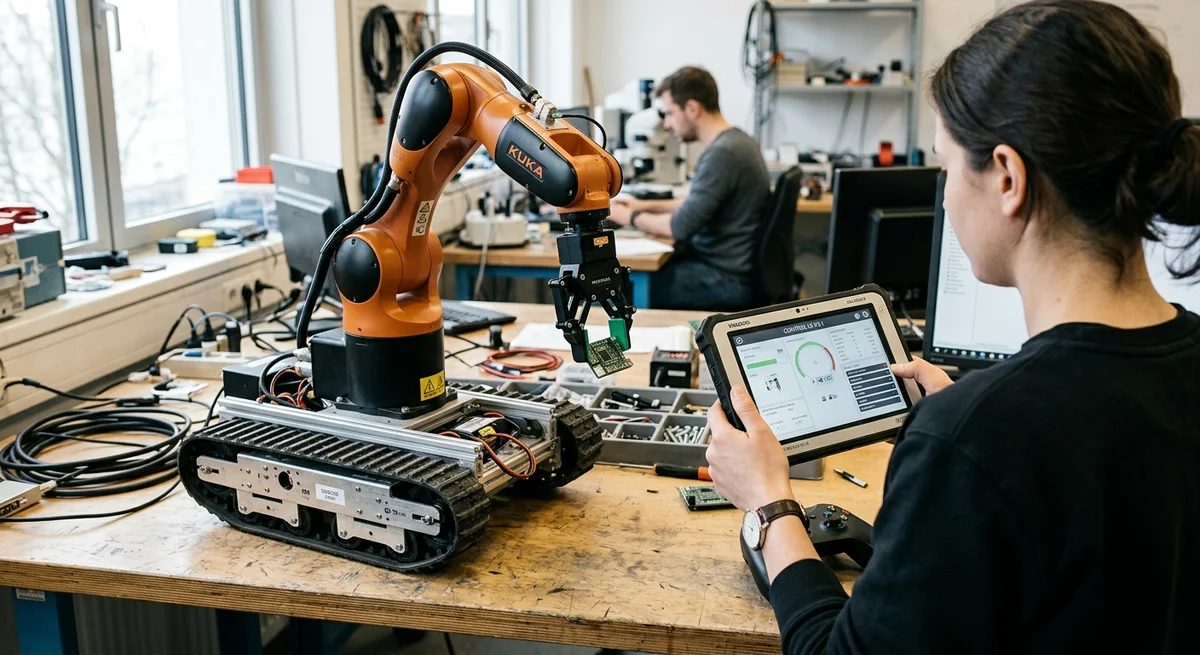
_Audio podcast: two AI hosts discuss the latest AI news. Full transcript below._
Host A (00:00): Okay, let's break this down step by step. Today we have, well, metaphorically, a whole stack of fresh material on the table for this deep dive.
Host B (00:11): Yep, and I'd say this material pretty much upends the familiar picture.
Host A (00:16): 100 percent. We've got closed startup reports, dry academic papers on new benchmarks, and even investment roundups from giants like Nvidia.
Host B (00:28): Right, all in one pile, but a very logical pile.
Host A (00:32): Exactly. And if you boil all these numbers, charts and news items down to one idea, we're standing on the edge of a fundamental shift.
Host B (00:41): A shift from rigid control to chaos, right?
Host A (00:44): Yes, specifically to surviving in chaos. We've all gotten used to the image of a modern factory, you know, one that costs hundreds of millions of dollars. Everything there runs like perfect clockwork.
Host B (00:56): Every part glides down the conveyor, and the robots make these beautiful, precisely calibrated sweeps.
Host A (01:03): Right, those perfect sweeps. But if someone accidentally leaves a wrench on the floor or nudges a workbench literally a couple of centimeters, that's it. The whole idyll falls apart.
Host B (01:17): The robot blindly crashes into obstacles. Crashes into obstacles.
Host A (01:19): Yes. A manipulator with strict geometric coordinates hard-coded into it just freezes, throws an error, or even, well, breaks expensive equipment.
Host B (01:31): And that problem of rigid programming has arguably been the industry's biggest anchor for decades.
Host A (01:37): One step left, one step right, and it's a disaster.
Host B (01:39): Exactly. Machines are brilliant at repeating the same mathematical action a million times, but they're completely helpless in the face of the basic, everyday chaos of the real physical world.
Host A (01:53): They just have no intuition.
Host B (01:55): Right, they lack what we call an understanding of physical context. Or rather, that was true until recently. Judging by the data in front of us, the rules of the game are being rewritten right now.
Host A (02:08): And that's the main mission of today's deep dive. We're looking at how artificial intelligence is acquiring a physical body right before our eyes.
Host B (02:18): Ditching the multivolume instruction manuals.
Host A (02:20): And learning to survive in an unpredictable environment. If you analyze all the sources, one striking insight emerges. The future of the real machine revolution isn't being built on giant compute at all.
Host B (02:32): Or on endless server farms.
Host A (02:35): Right. It's being built on incredibly elegant, compact, local solutions and muscular adaptability.
Host B (02:41): Look, to really grasp the scale of these changes, we need to go down to the basic level of mechanics. Before you trust a robot with a global supply chain, it has to master fundamental physics.
Host A (02:54): Like, just pick up a part and not break
Host B (02:56): it? Exactly. Grab an awkwardly shaped part lying at an angle without crushing it. And the documents show a very unusual approach here.
Host A (03:05): Oh yes, one of the studies describes a very telling experiment. An engineer took a small tracked robot with a manipulator arm and integrated a language model from Google, Gemini Nano.
Host B (03:18): And the numbers matter here.
Host A (03:19): Yes, these are the key numbers. The model has just 270 million parameters.
Host B (03:25): Which is microscopic next to the monstrous GPT versions, right? Those need entire data centers and practically nuclear power plants to run.
Host A (03:36): 100 percent. And the project's author describes this as real neuropunk. The robot trains in simulation, it has no internet access at all, and it doesn't call out to any cloud servers.
Host B (03:48): Everything is local.
Host A (03:49): Absolutely. And I want to pause here. Why cut a modern robot off from the cloud, where all that endless compute lives?
Host B (03:58): Well, because in the physical world, the cloud is death by latency. Signal delay is everything. Imagine a robot trying to hold onto a fragile object that's slipping. Uh-huh. The sensor signal has to travel to a server somewhere in another country, get processed by a huge model, and come back with a command to squeeze the fingers 2 millimeters harder.
Host A (04:21): And that takes half a second?
Host B (04:23): Yes, and in half a second the object has already shattered on the concrete floor.
Host A (04:28): So it's the difference between looking up the answer in a huge library across town and just jerking your hand away from a hot stove at the spinal-cord level?
Host B (04:36): Great analogy. What we need are local reflexes. And this compact 270 million-parameter model delivers the necessary autonomy.
Host A (04:46): Plus power consumption, I'd guess?
Host B (04:48): Of course. Keeping a live link to the cloud open all the time and streaming video kills a mobile agent's battery.
Host A (04:56): Got it. In this experiment, the compact model received joint angle data, coordinates, and images locally, and learned to move through trial and error right on board.
Host B (05:07): In simulators, yes.
Host A (05:08): But what we see here is 100 percent simulation. The model lives in a virtual box. Our sources also include a completely opposite approach to the same problem of chaos.
Host B (05:19): Oh, you mean Generalist?
Host A (05:21): Yes. And it sounds even more like science fiction. Generalist is a startup that, according to the roundups, Nvidia has invested in. These folks took a completely different path.
Host B (05:31): Instead of virtual reality, they use real people?
Host A (05:35): Yes. Instead of writing code, they use so-called dirty human data. Ordinary factory workers wear sensors on their wrists.
Host B (05:45): Mm, visually they look like advanced fitness bands.
Host A (05:49): Uh-huh. And these bands simply record the pure physics of human movement during the daily routine.
Host B (05:56): Every elbow angle, every micro-acceleration of the
Host A (06:00): wrist? The tiniest adaptations when a person picks up that awkwardly positioned part.
Host B (06:05): And the results of this approach, let's say, shatter the old dogmas of robotics. Generalist's reports cite a 99% success rate in real, unpredictable factory conditions. Human movements.
Host A (06:31): So the robot literally absorbs someone else's physical experience. When a part is positioned unusually, it doesn't throw a syntax error. It sort of recalls the pattern it picked up from a live operator?
Host B (06:43): Yes, it recalls the wrist adaptation.
Host A (06:46): Listen, a funny thought comes to mind. If the robot learns from raw human movement, couldn't it accidentally copy our bad habits?
Host B (06:54): Meaning?
Host A (06:55): Well, a worker gets lost in thought, scratches the back of his head with the band on, and then picks up the part. Will the robot also take a micro-pause to scratch its head?
Host B (07:04): Ha, well, that's exactly why you need data-cleaning algorithms to filter out noise like that. But there's some truth to it: the machine adopts human kinematics specifically. Yeah. And what matters here is how this collection of raw physical data fits with the first approach, Google's simulation.
Host A (07:23): Right, because at first glance these are two completely opposite poles. One sits in a sterile matrix, the other soaks up the chaos of a real
Host B (07:31): shop floor. But at a systems level, they solve different tasks in one chain. Look, simulation is the perfect safe testing ground.
Host A (07:38): Compact models can fall there a million times.
Host B (07:41): Exactly. Fall, crash into a wall, break a virtual manipulator. They learn basic logic without risking physical hardware worth hundreds of thousands of dollars.
Host A (07:52): Makes sense.
Host B (07:53): But no simulation, not even the most advanced one, can mathematically account for every nuance of the real world. Localized wear on a gear, a stray drop of oil.
Host A (08:04): Or glare from a window blinding a sensor.
Host B (08:08): Yes, and that's where the sample data comes in. Collecting physical metrics provides exactly the kind of intuitive muscle memory you simply can't generate in code.
Host A (08:21): So the industry is assembling a hybrid: a brain that learned logic in a virtual environment, and reflexes copied from harsh reality.
Host B (08:29): Exactly right.
Host A (08:31): And factory reality really is harsh. This is where our material gets most interesting. Say we've taught a robot to move perfectly; it's dexterous. But being dexterous for 5 minutes in a demo doesn't mean it can survive. A factory at 40 degrees is a brutal hardware test.
Host A (08:50): What happens if an agent runs 24/7 without breaks?
Host B (08:53): Oh, that question forced researchers to rethink how AI gets evaluated in the first place. The documents describe an entirely new testing standard, the MELT-1 benchmark.
Host A (09:03): For a long time, things were measured with tests like MMLU, right?
Host B (09:06): Yes, but that's static. You give the model a legal text, and it generates an answer.
Host A (09:12): Basically a trivia test in a vacuum.
Host B (09:15): But embodied AI needs different metrics. The MELT-1 benchmark measures the cost of successful decisions, reaction time under stress, and survival under so-called hardware drift.
Host A (09:28): The benchmark's conditions are worth spelling out, because they sound like torture. A temperature of 40 degrees, 30 days of continuous autonomous operation.
Host B (09:37): It's like leaving a laptop on a car dashboard in the sun and running a demanding game.
Host A (09:42): Exactly. And the numbers in the MELT-1 report are staggering. It features an architecture called Metabolic.AI, a metabolic AI that doesn't use transformers at all.
Host B (09:52): And on composite survival metrics, this metabolic AI beat the well-known Llama 7B INT8 model by a factor of 1600.
Host A (10:01): Think about that gap! 1600 times. The text even contains a chilling statement, quote: Transformers die after 11 hours under drift. Well,
Host B (10:13): if you break down the mechanics, it becomes clear why this collapse happens. Transformers were historically built for batch processing.
Host A (10:21): Meaning they receive requests?
Host B (10:23): They scan the weights, produce an answer, and, roughly speaking, go to sleep until the next request. But embodied AI isn't allowed to sleep. It has to read data streams every millisecond.
Host A (10:37): So what exactly does this drift mean, the thing that kills a model in 11 hours?
Host B (10:42): Hardware drift is the inevitable change in a system's properties over time. During long operation, motors heat up and produce different resistance. Factory lubricant loses viscosity.
Host A (10:54): Dust settles on the lenses?
Host B (10:56): Exactly, the signals get distorted, and transformers can't adapt to this continuous stream of changing data. They accumulate mathematical errors. After 11 hours, the errors overflow the context, and the robot freezes.
Host A (11:10): Or starts twitching chaotically. And the Metabolic.AI architecture works differently.
Host B (11:16): Yes, the word metabolic isn't accidental. It works like a digestive system for data, constantly digesting the stream, filtering out noise, and adapting to heat on the fly.
Host A (11:26): Remarkable. And it's important to highlight a detail: the intellectual property behind Metabolic.AI is protected by patents, but the MELT-1 benchmark itself is fully open to the community.
Host B (11:38): Now any engineer can put their robot through this test, and that's a huge step. We stop judging physical robots by how smartly they write text.
Host A (11:47): We test real durability. Okay, we've beaten factory chaos. But real chaos starts where there are pedestrians, cyclists, couriers
Host B (11:57): City streets.
Host A (11:58): Exactly. If we have resilient systems, it's time to let them out onto the streets. And two companies come up here. The first is London-based Wayve. Its CEO, Alex Kendall, is making a bold bet.
Host B (12:11): Yes, his strategy is to completely abandon hard-coded traffic rules. They don't program every scenario.
Host A (12:19): Like, what to do if a dog in a red collar runs out?
Host B (12:23): Something like that. They're deploying end-to-end AI that learns to drive right on real roads. The car goes out onto the streets of London, watches dense traffic, and develops an understanding of chaos.
Host A (12:36): And according to the report, they transfer the experience gathered in London to cars in San Francisco. And adapting to the new city happens a million times faster than competitors.
Host B (12:47): Who are still trying to annotate intersections in 3D maps.
Host A (12:50): But listen, as the skeptic, I have to push back. Training a model on live London streets, among real pedestrians, sounds like the setup for a massive lawsuit.
Host B (13:02): Well, it sounds risky, yes.
Host A (13:04): It's one thing when an algorithm makes a mistake in a simulator. It's something else entirely when a 2-ton hunk of metal decides to try a new pattern at a crosswalk.
Host B (13:14): That's a fair concern, but the testing architecture is more complex. They don't put a completely raw, unpredictable neural network on the road. There's a strict hybrid safety framework.
Host A (13:27): So, basic braking physics?
Host B (13:29): Yes. Braking and obstacle detection, which block critical errors. But the nuances of merging smoothly into traffic, the small concessions at intersections
Host A (13:40): The things that make driving feel human?
Host B (13:43): Yes, the car can only learn those empirically.
Host A (13:46): Got it, the framework won't let it hit anyone. What about the second company? Einride? That's logistics: autonomous electric trucks. Its head, Roozbeh Charli, makes some hard-hitting arguments.
Host B (13:58): Economic arguments.
Host A (13:59): Yes, he says autonomy radically breaks the financial model, since driver wages account for 30 to 40 percent of a logistics company's total costs.
Host B (14:10): That's a lot, isn't it?
Host A (14:10): And he adds the obligatory line that humans won't disappear but will move into a new role as operators in a dispatch center? The skeptic in me is sounding the alarm again.
Host B (14:21): That it's PR?
Host A (14:22): Yes, will people really still be needed, or is this just corporate reassurance to avoid scaring the public with unemployment?
Host B (14:29): On a one-to-two-year horizon, it looks like PR. But if you analyze the whole supply chain from the report, the picture is different. AI handles tactics brilliantly.
Host A (14:43): Keeping the truck in its lane, calculating braking distance?
Host B (14:46): But it's completely incapable of taking on macro-strategic and financial responsibility. The source has a key quote from Charli: we need people who understand logistics and technology at the same time.
Host A (15:01): Makes sense. The algorithm can masterfully steer a semi through a blizzard, but if there's a sudden strike at the border, the algorithm won't renegotiate with suppliers.
Host B (15:11): Exactly. The human role shifts up the chain. The monotonous turning of the wheel goes to the machine.
Host A (15:19): It doesn't sleep, doesn't drink coffee.
Host B (15:21): Right, and the human becomes a systems analyst. One operator in an office oversees a fleet of dozens of trucks. That's a genuine need for people, but with a different set of meta-skills.
Host A (15:33): And that brings us to the big takeaway. The era of hard code is ending. Local on-board language models have burst onto the scene.
Host B (15:41): Benchmarks like MELT-1 have appeared.
Host A (15:44): Robots are leaving sterile zones, copying the physics of our wrists, learning from the chaos of the streets, and the value of human intelligence isn't being reset, it's being transformed. Knowledge of rigid syntax is losing its value.
Host B (15:56): Systems thinking is taking its place. And most striking of all, this shift is showing up even in education. The materials mention LEGO Education.
Host A (16:09): Yes, they spent decades teaching kids to code, and by 2026 they're radically changing their approach and moving away from writing code by hand.
Host B (16:17): They're introducing AI assistants and intuitive card-based control. Kids no longer need to memorize commands; they need to learn logic and how to frame a problem.
Host A (16:29): And the machine will figure out how to drive the motors on its own. It's a perfect mirror of the adult industry. Looking at this evolution, I have one rather provocative thought.
Host B (16:39): What is it?
Host A (16:41): We talked about the startup Generalist. Robots learn physics by copying the movements of ordinary workers. They adopt our motor skills simply because that's how we're historically built.
Host B (16:51): Well, yes, we're teaching them.
Host A (16:52): But an algorithm's fundamental property is optimization. What happens in a few years, when these systems have processed a billion hours of our movements and start looking for more efficient paths?
Host B (17:04): So they'll go beyond human physics?
Host A (17:08): Yes. Could there come a moment when machines develop their own completely alien kinematics, a new muscle memory 1000 times more efficient than ours, unconstrained by our joints and fatigue?
Host B (17:20): That sounds a bit creepy.
Host A (17:22): And visually it might look jerky, frightening, incomprehensible to us. Given the pace at which AI adapts, this frightening efficiency no longer seems like science fiction. It's simply the inevitable next step in evolution.
- Nov 2, 2026Bun creator uses Claude Code to port 750K lines from Zig to Rust in 11 days
- Nov 2, 2026The Verge reviewer builds a $50 Meta Muse Charm alternative with Claude Code
- Nov 1, 202616 models tested on 7 search tools: Exa averaged 10.5 out of 14, SearXNG about 3
- Nov 1, 2026Google's StreamVibe video agent beats other models by 10.7% on response timing and quality
Test Frontier LLMs & Autonomous Agents in One Workspace
Run Claude Opus 5.5, GPT-6, Gemini 3.1, and DeepSeek side-by-side in Nomad AI (nomadnet.ai) — unified model routing, deep research, and multimodal workflows under one subscription.
The AI world, distilled — once a week
Seven stories that actually mattered, hand-picked. No noise, no reposts, no press releases.
Done! Check your inbox for a confirmation.