The Robots Are Coming: Industry Is Showering Hardware Specialists With Money
Industry has finally admitted it: without automation, it cannot survive. In 2025, job postings for robotics specialists jumped 32%. That is not just a nice-looking figure. It signals that companies have stopped treating robots as expensive toys for trade shows. Now they are a necessity, driven by a severe labor shortage. Employers are looking for everyone, from design engineers to operators of complex systems. Robotics is moving out of the lab and onto real factory floors across the country. That raises an obvious question: can the education system keep up with industry's appetite, or are we heading for a talent shortage worse than the chip shortage?
AI-processed from CNews AI; edited by Hamidun News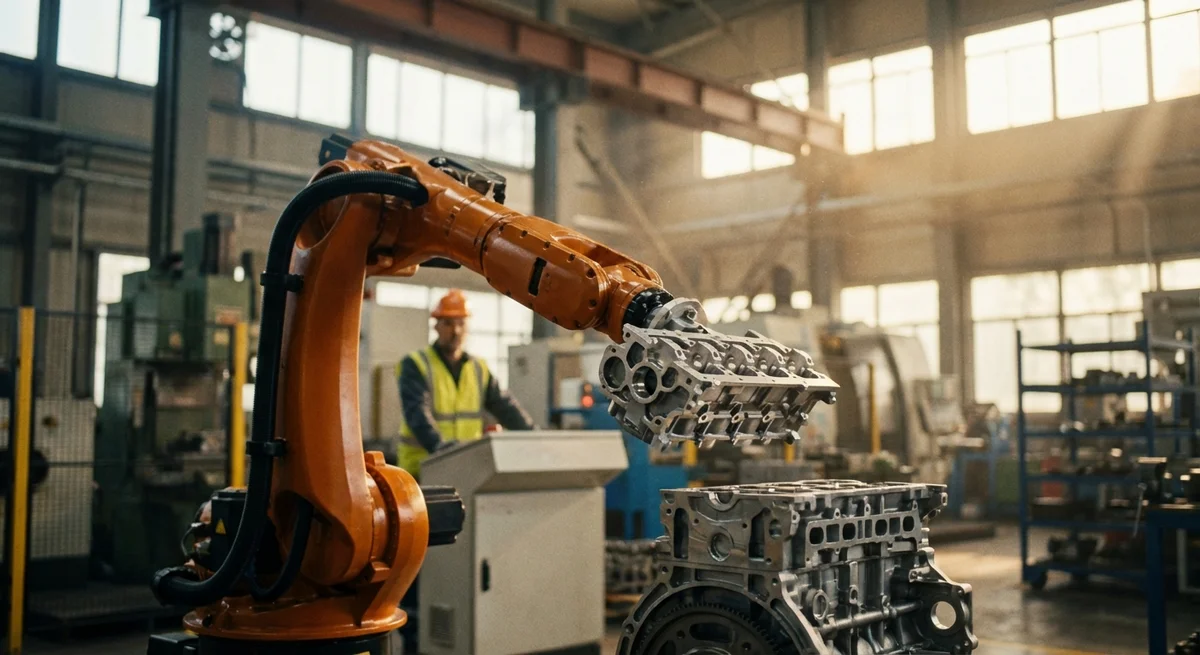
Let's be honest: the dream of a purely digital economy, where everyone does nothing but write code for mobile apps, has officially crashed into reality. While we were busy debating whether GPT-5 would replace copywriters and designers, the real world, the one that smells of machine oil and hot steel, ran into a harsh challenge. It turns out there are catastrophically few hands able to hold a wrench or run a machine tool. That is where the striking 32% jump in demand for roboticists comes from. It is not a fleeting trend or a nod to fashion, but a genuine survival instinct of the industrial sector.
For the past ten years, industrial robotics looked like a hobby for the rich. Large corporations bought a couple of Fanuc or Kuka manipulators, put them behind glass and proudly showed them to investors. It was innovation for PR, a display of status, but never the backbone of a business process. In 2025, however, the rules changed. Sensors got cheaper, software became intuitive, and above all, the labor market hit a wall. Today a factory owner no longer asks whether a robot looks cool. He cares about one thing: how quickly this iron arm can replace three missing workers on the night shift.
Interestingly, this growth is not confined to big-city technology parks. We are seeing a broad geographic expansion. Medium-sized and even small businesses across the country have suddenly realized that a cobot, or collaborative robot, pays for itself in a year and a half to two years. This creates a huge vacuum in the labor market. Companies no longer need mere theorists with engineering degrees. They want versatile people who can maintain and reprogram new machines and, hardest of all, integrate them into existing, often outdated production lines. A robotics specialist in 2025 is a hybrid of mechanic, developer and systems analyst in one person.
What does this mean for industry as a whole? We are entering an era of universal automation. We have moved past the stage when a robot could perform only one operation for decades. With machine vision and basic AI models integrated, these machines are becoming flexible. But that flexibility demands human oversight of a completely different level. The irony is that, to solve the shortage of simple workers, companies have to find even rarer and more expensive specialists. It is a race against time. If the education system does not stop turning out abstract managers and switch to training automation architects, the current growth in vacancies will become a chronic headache for the economy.
Looking a bit further ahead, large language models will merge with physical movement. Research centers are already testing systems in which a robot understands commands in natural language. Imagine that instead of writing five hundred lines of code, you simply tell the machine: rearrange the pallets for the morning shipment.
That would radically lower the barrier to entry into the profession, but we are not there yet. For now, a person who knows how to calibrate an industrial manipulator and get it working with a conveyor remains king of the labor market. Industry is ready to pay.
The only question is whether enough people will be willing to trade a cozy coworking space for a noisy factory floor where the future has already arrived.
Bottom line: The labor shortage has become a powerful driver of progress that people once only dreamed of. Either a company automates today, or tomorrow it turns into a museum of a bygone era. Are you ready to be the one who sets up this new world?
Test Frontier LLMs & Autonomous Agents in One Workspace
Run Claude Opus 5.5, GPT-6, Gemini 3.1, and DeepSeek side-by-side in Nomad AI (nomadnet.ai) — unified model routing, deep research, and multimodal workflows under one subscription.
The AI world, distilled — once a week
Seven stories that actually mattered, hand-picked. No noise, no reposts, no press releases.
Done! Check your inbox for a confirmation.