Jensen Huang and Michael Dell on the AI Agent and Memory Revolution
Businesses are racing toward agentic AI. Nvidia's Jensen Huang and Dell's Michael Dell discussed the coming shift: autonomous AI agents will need unprecedented amounts of RAM and compute. That is the main infrastructure challenge, but also a window for large-scale growth for chipmakers. Against the backdrop of trade restrictions in China, the two analyzed the transition to a new era of AI computing.
AI-processed from Bloomberg Tech; edited by Hamidun News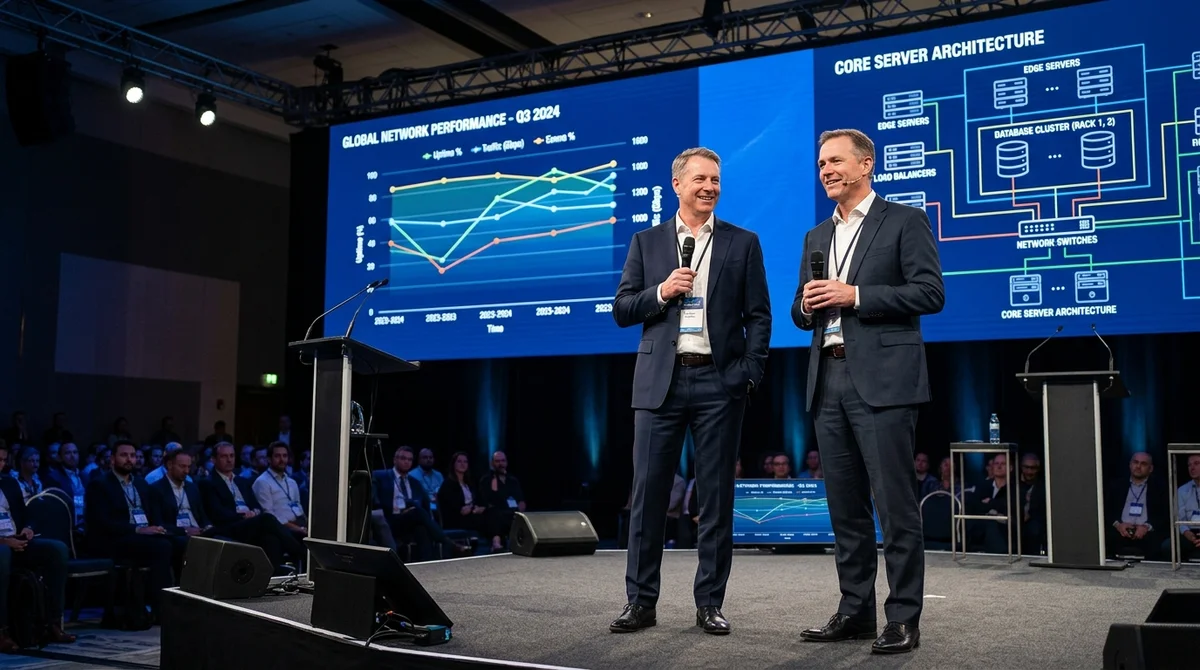
At Dell World in Las Vegas, Nvidia CEO Jensen Huang and Dell Technologies chief Michael Dell discussed the future of AI agents, the critical demand for memory, and how a transitional era forces a rethink of engineering priorities.
The main challenge: memory displaces compute
For years, in the LLM era, server architecture was optimized around the GPU. With agentic AI, the picture changes fundamentally. AI agents are systems that do not just generate text but carry out multistep tasks in browsers, interact with APIs and make decisions based on context. That takes memory. A huge amount of it.
In an interview with Bloomberg, Jensen Huang stressed that memory capacity must grow exponentially. Tens of gigabytes are enough for inference on a text model, but agentic AI needs hundreds of gigabytes of RAM on a single server. That is a challenge for system architects and an opportunity for companies that shift production to HBM (High Bandwidth Memory) and systems with new topologies.
Huang has repeated more than once that memory will grow faster than compute. That upends investment priorities.
Agentic AI is already in the field
OpenAI released Operator, a browser agent that can fill in forms, compare prices and make purchases on its own. Google introduced Gemini 2.0 with an agentic mode that can integrate with Workspace services. All of these systems need enormous amounts of memory at inference time: the agent must see the screen, remember the task history, call external APIs and weigh alternatives at the same time. On smaller GPUs this runs slowly and often with errors.
That is why Jensen Huang and Michael Dell describe memory as the key bottleneck. This is not theory. Developers already see it, and cloud providers are experiencing it right now.
Next-generation infrastructure
Michael Dell said Dell World 2026 showcases PowerEdge systems and an ecosystem of solutions reoriented toward agentic AI. Where TFLOPS (floating-point operations per second) used to be the headline metric, memory bandwidth and storage capacity now take that role. Dell has already launched new server configurations:
- HBM integration — High Bandwidth Memory chips on the boards next to the GPU to minimize memory access latency
- Reworked cooling — new thermal solutions, since memory plus compute requires 1.5 times more energy
- Network architecture — links between memory nodes require gigabit-class bandwidth, not kilobit
- Rethinking TPU-like solutions — specialized chips for agentic workloads, not only for LLM inference
These changes are not cosmetic. They require retooling production lines, revising supply chains and completely retraining system administrators.
Geopolitics and the Chinese market
Both CEOs touched indirectly on the geopolitical situation. Jensen Huang has said more than once that export restrictions on China are a serious challenge for Nvidia, but not a final verdict. The strategy is simple: invest in memory growth and speed up development of nanoservers, which are easier to integrate and require less compute density.
Michael Dell added that growth in memory volumes will offset losses in individual regions. If China is 15% of the market but memory requires re-equipping 100% of the market, producers in other countries all stand to win.
Both CEOs also mentioned that Europe and North America are accelerating agentic AI development and are ready to invest. Against this backdrop, Nvidia's and Dell's efforts are shifting toward the Atlantic side of the planet.
What this means
A memory-first architecture is not just an engineering shift; it is a change of paradigm. Companies that are first to redesign their data centers and server configurations for agentic AI will capture a significant share of the contract computing market.
Nvidia and Dell back their words with concrete products: new PowerEdge systems based on NVIDIA H-series with expanded memory are a direct answer to market demand. Large cloud providers are already negotiating with Dell and Nvidia over orders to retrofit data centers.
- Nov 1, 2026Local models lose to Opus and Codex: 0.21 on a MacBook versus 1.00 for Codex
- Nov 1, 2026Habr author fine-tunes YOLOv8l on dental X-rays and pushes mAP50 to 0.642
- Nov 1, 2026Voice bots built on LLMs turn to Jev, a fast classifier, for decisions in 200–500 ms
- Nov 1, 2026MoneyGate safety layer blocked all 42 fraudulent requests to local AI models
Key Questions Answered
What are the key details on The main challenge: memory displaces compute?
For years, in the LLM era, server architecture was optimized around the GPU. With agentic AI, the picture changes fundamentally. AI agents are systems that do not just generate text but carry out multistep tasks in browsers, interact with APIs and make decisions based on context. That takes memory. A huge amount of it. In an interview with Bloomberg, Jensen Huang stressed that memory capacity must grow exponentially. Tens of gigabytes are enough for inference on a text model, but agentic AI needs hundreds of gigabytes of RAM on a single server. That is a challenge for syste
What are the key details on Agentic AI is already in the field?
OpenAI released Operator, a browser agent that can fill in forms, compare prices and make purchases on its own. Google introduced Gemini 2.0 with an agentic mode that can integrate with Workspace services. All of these systems need enormous amounts of memory at inference time: the agent must see the screen, remember the task history, call external APIs and weigh alternatives at the same time. On smaller GPUs this runs slowly and often with errors. That is why Jensen Huang and Michael Dell describe memory as the key bottleneck. This is not theory. Developers already see it,
What are the key details on Next-generation infrastructure?
Michael Dell said Dell World 2026 showcases PowerEdge systems and an ecosystem of solutions reoriented toward agentic AI. Where TFLOPS (floating-point operations per second) used to be the headline metric, memory bandwidth and storage capacity now take that role. Dell has already launched new server configurations: HBM integration — High Bandwidth Memory chips on the boards next to the GPU to minimize memory access latency Reworked cooling — new thermal solutions, since memory plus compute requires 1.5 times more energy Network architecture — links between memory nodes requ
Test Frontier LLMs & Autonomous Agents in One Workspace
Run Claude Opus 5.5, GPT-6, Gemini 3.1, and DeepSeek side-by-side in Nomad AI (nomadnet.ai) — unified model routing, deep research, and multimodal workflows under one subscription.
The AI world, distilled — once a week
Seven stories that actually mattered, hand-picked. No noise, no reposts, no press releases.
Done! Check your inbox for a confirmation.