Nvidia's Jensen Huang: AI Is Creating a Huge Number of New Jobs
Jensen Huang, CEO of Nvidia, said that fears of AI-driven job losses are exaggerated. In his view, the technology is creating a huge number of new employment opportunities. Huang pointed to historical experience: new technologies have always created more work than they destroyed.
AI-processed from TechCrunch; edited by Hamidun News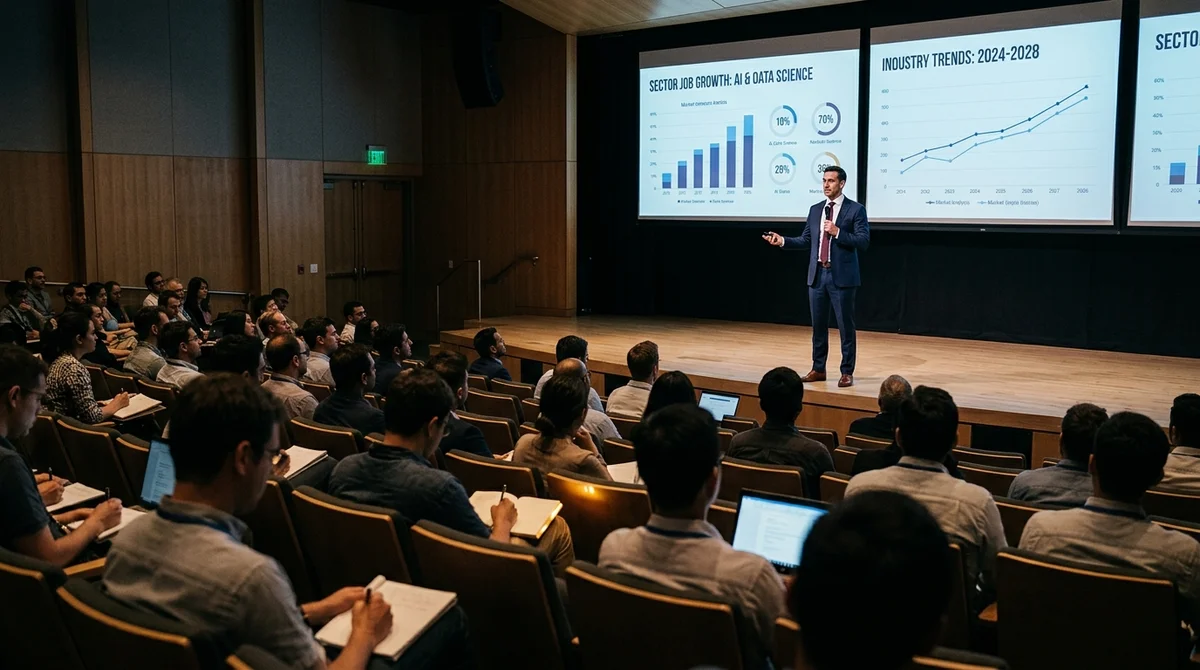
Jensen Huang, CEO of Nvidia, said that workers' concerns about AI-induced unemployment are greatly exaggerated. In his view, the history of technological revolutions shows that artificial intelligence is more likely to create new jobs than to destroy them.
What Huang says
The Nvidia CEO is convinced that fears of mass job losses because of AI have no serious basis. This is not the first time Huang has spoken on the subject, and he consistently stresses that AI is not the end of careers but the start of a new era of professional opportunity.
In his remarks, Huang explained that every technological revolution in history went through a similar period of fear and doubt, from the Industrial Revolution to the age of computerization and the mass spread of the internet. In every case, however, the number of jobs not only recovered but grew significantly.
Huang stresses that people often confuse the automation of individual processes with the complete disappearance of entire professions. The former does happen, but the latter remains the exception rather than the rule. Most professions simply evolve, changing the set of skills they require.
Historical context
History does support the Nvidia CEO's position. When cars appeared, people feared mass unemployment among coachmen, stable hands and workers in the horse industry. When computers arrived, they worried that machines would take jobs from clerks, accountants and typists. In both cases, however, the labor market not only recovered but expanded and diversified significantly.
Some concrete examples:
- Industrial Revolution: it destroyed traditional crafts and manual production, but created entire new branches of industrial manufacturing and mechanical engineering, and demanded an ever-growing army of workers and engineers
- Computerization: it displaced some office positions and roles, but gave rise to an entire IT sector, programming, web design and many related professions
- The internet: it threatened traditional retail and postal services, but at the same time spawned e-commerce, digital marketing, content production and dozens of new specialties
The current situation with AI
Huang is convinced that the situation with AI is fully analogous to these historical precedents. Yes, robotization and automation will replace some types of work, especially routine and repetitive tasks. But entirely new professions will appear at the same time, tied to training, managing, improving, supervising and developing AI systems.
Labor market data supports Huang's forecast. Demand for machine learning engineers, data scientists, AI safety specialists and other AI professionals is growing exponentially, while the supply of qualified candidates is not keeping up with demand. This creates a serious talent shortage in the industry.
Huang also notes that companies like Nvidia are reaping huge financial gains from the expansion of AI, and that these profits will inevitably translate into new jobs across the ecosystem. Although the transition period may be painful for some categories of workers, the long-term outlook remains optimistic.
What this means
Jensen Huang's view reflects the classic optimism of the tech establishment and of major players in the AI industry. His argument, however, is not entirely beyond dispute and does not account for every nuance of the situation. The transition period can indeed put serious pressure on the labor market, especially for workers who lack the skills needed to retrain.
Nevertheless, historical data suggests that in the long run new technologies do create more opportunities than they destroy.
- Nov 1, 2026Local models lose to Opus and Codex: 0.21 on a MacBook versus 1.00 for Codex
- Nov 1, 2026Habr author fine-tunes YOLOv8l on dental X-rays and pushes mAP50 to 0.642
- Nov 1, 2026Voice bots built on LLMs turn to Jev, a fast classifier, for decisions in 200–500 ms
- Nov 1, 2026MoneyGate safety layer blocked all 42 fraudulent requests to local AI models
Key Questions Answered
What Huang says?
The Nvidia CEO is convinced that fears of mass job losses because of AI have no serious basis. This is not the first time Huang has spoken on the subject, and he consistently stresses that AI is not the end of careers but the start of a new era of professional opportunity. In his remarks, Huang explained that every technological revolution in history went through a similar period of fear and doubt, from the Industrial Revolution to the age of computerization and the mass spread of the internet. In every case, however, the number of jobs not only recovered but grew significa
What are the key details on Historical context?
History does support the Nvidia CEO's position. When cars appeared, people feared mass unemployment among coachmen, stable hands and workers in the horse industry. When computers arrived, they worried that machines would take jobs from clerks, accountants and typists. In both cases, however, the labor market not only recovered but expanded and diversified significantly. Some concrete examples: Industrial Revolution: it destroyed traditional crafts and manual production, but created entire new branches of industrial manufacturing and mechanical engineering, and demanded an e
What are the key details on The current situation with AI?
Huang is convinced that the situation with AI is fully analogous to these historical precedents. Yes, robotization and automation will replace some types of work, especially routine and repetitive tasks. But entirely new professions will appear at the same time, tied to training, managing, improving, supervising and developing AI systems. Labor market data supports Huang's forecast. Demand for machine learning engineers, data scientists, AI safety specialists and other AI professionals is growing exponentially, while the supply of qualified candidates is not keeping up with
Test Frontier LLMs & Autonomous Agents in One Workspace
Run Claude Opus 5.5, GPT-6, Gemini 3.1, and DeepSeek side-by-side in Nomad AI (nomadnet.ai) — unified model routing, deep research, and multimodal workflows under one subscription.
The AI world, distilled — once a week
Seven stories that actually mattered, hand-picked. No noise, no reposts, no press releases.
Done! Check your inbox for a confirmation.