AI agents with vision cost several times more than a standard API
Browser agents with vision turn out to cost several times more than ordinary APIs. Every screenshot the agent sees has to be processed by an expensive vision model. When companies scale to thousands of operations a day, they find that one day of agent work costs more than a month of running text models.
AI-processed from 3DNews AI; edited by Hamidun News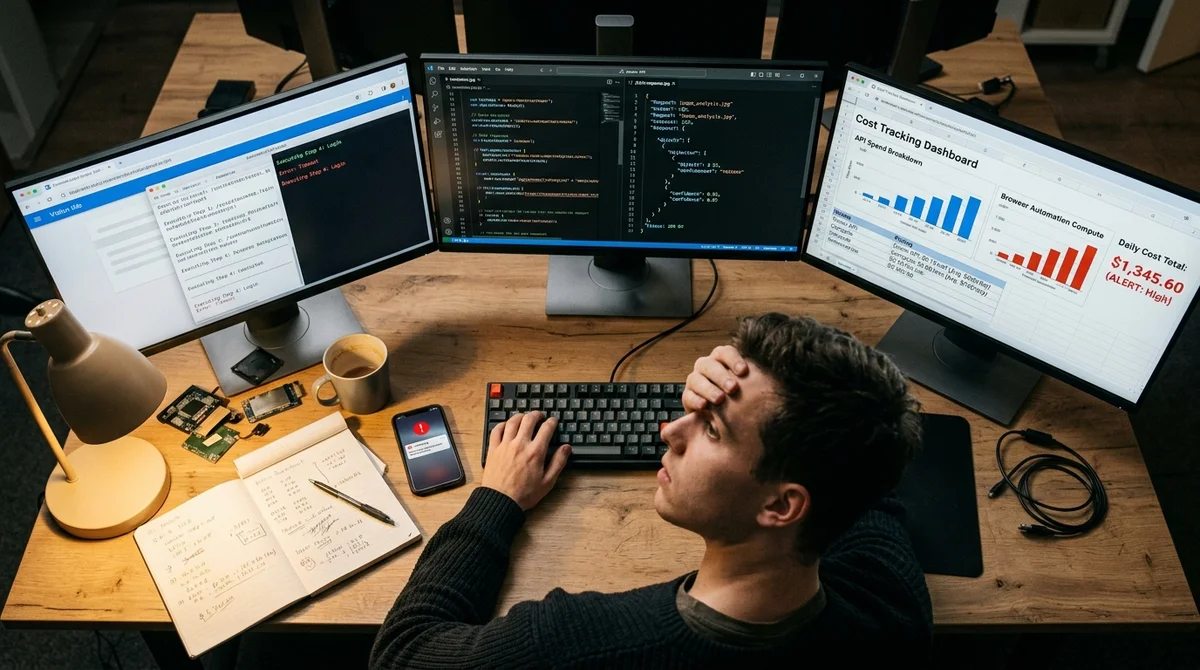
AI browser agents that see the screen and mimic human behavior cost companies an order of magnitude more than ordinary text-based AI models. The company Reflex analyzed the costs and found that agents with vision cost several times more than ordinary API requests.
Why vision costs more than text
When an agent processes only text, the task is relatively simple and cheap. The API takes its cut, the model handles the request, and that's it. But when the same agent sees a screenshot of the screen, a browser, a web form, a vision model kicks in, which needs significantly more computing resources and costs more.
The price of a single screenshot can be higher than the cost of processing an entire text session of dozens of sentences. One click by a browser agent can cost a company more than a full conversation with a text chatbot. This is not a hypothesis: it is an observation from developers who have scaled browser agents to production use.
The problem is made worse by the fact that an agent cannot "reuse" a screenshot. Every time something changes on the screen (which happens after every agent action), a new image is needed, a new vision API call, new costs. This creates a situation where costs grow exponentially as the number of actions increases.
How to calculate it in practice
When an agent fills out a form on a website, the work cycle looks like this:
- Take a screenshot of the screen (the vision model runs)
- Work out what the agent sees: buttons, fields, errors, hints
- Decide which action to perform (this is cheaper, it is logic)
- Perform the click, fill in the field, press the button
- Take a screenshot again, and call the vision API again
Each cycle with vision is a separate charge. When ordering food through DoorDash, an agent may take 5–10 screenshots: searching for a restaurant, choosing it, browsing the menu, adding dishes to the cart, checking out. That is 5–10 calls to an expensive vision model for a single task.
At thousands of such operations a day, the costs become unaffordable. A company quickly discovers that it spent more on one day of agent work than on a month of running text models. The numbers speak for themselves: if a vision request costs 10 times more than a text one, and the agent takes 10 screenshots per task, costs rise 100-fold.
The scaling problem
Companies that have experimented with browser agents often discover hidden costs. What seemed cheaper than hiring a person (one bot agent for a month costs less than a freelancer) ends up costing more in practice if you need to process tens of thousands of screens a day.
"The economics of vision agents are completely different from those of text agents.
Companies calculate ROI incorrectly," developers say.
This does not mean browser agents are unprofitable. It means they should not be launched without a clear calculation. An honest estimate is needed: how much one agent cycle costs, how many cycles per task, how many tasks per day, and what the result is. Without it, you can burn through the entire budget faster than expected.
What this means
The growth of browser agents calls for new approaches to pricing. Companies need to understand the cost of vision models before launching in production, not after the bill arrives. Otherwise, the savings from automation will turn into an unexpected expense.
This will temporarily slow the adoption of such agents, but it will force deliberate choices.
- Nov 2, 2026DeepSeek open-sources Super-agent prototype: p95 task completion time of 15.7 minutes vs. 29.5
- Nov 2, 2026Bun creator uses Claude Code to port 750K lines from Zig to Rust in 11 days
- Nov 2, 2026Microsoft releases 4B model Mage-VL-Cowork, which solves 66.0% of OSWorld-Verified tasks
- Nov 2, 2026Meta's Muse assistant keeps dossiers on loved ones and gets root on Ubuntu by default
Key Questions Answered
Why vision costs more than text?
When an agent processes only text, the task is relatively simple and cheap. The API takes its cut, the model handles the request, and that's it. But when the same agent sees a screenshot of the screen, a browser, a web form, a vision model kicks in, which needs significantly more computing resources and costs more. The price of a single screenshot can be higher than the cost of processing an entire text session of dozens of sentences. One click by a browser agent can cost a company more than a full conversation with a text chatbot. This is not a hypothesis: it is an observa
How to calculate it in practice?
When an agent fills out a form on a website, the work cycle looks like this: Take a screenshot of the screen (the vision model runs) Work out what the agent sees: buttons, fields, errors, hints Decide which action to perform (this is cheaper, it is logic) Perform the click, fill in the field, press the button Take a screenshot again, and call the vision API again Each cycle with vision is a separate charge. When ordering food through DoorDash, an agent may take 5–10 screenshots: searching for a restaurant, choosing it, browsing the menu, adding dishes to the cart, checking
What are the key details on The scaling problem?
Companies that have experimented with browser agents often discover hidden costs. What seemed cheaper than hiring a person (one bot agent for a month costs less than a freelancer) ends up costing more in practice if you need to process tens of thousands of screens a day. "The economics of vision agents are completely different from those of text agents. Companies calculate ROI incorrectly," developers say. This does not mean browser agents are unprofitable. It means they should not be launched without a clear calculation. An honest estimate is needed: how much one agent cyc
Test Frontier LLMs & Autonomous Agents in One Workspace
Run Claude Opus 5.5, GPT-6, Gemini 3.1, and DeepSeek side-by-side in Nomad AI (nomadnet.ai) — unified model routing, deep research, and multimodal workflows under one subscription.
The AI world, distilled — once a week
Seven stories that actually mattered, hand-picked. No noise, no reposts, no press releases.
Done! Check your inbox for a confirmation.