Wayve shows embedded AI is remaking self-driving development
Wayve CEO Alex Kendall described a radical approach to self-driving cars. Instead of hard-coded rules, the cars run embedded AI that learns on real roads. That lets robotaxis scale dozens of times faster and more cheaply.
AI-processed from Bloomberg Tech; edited by Hamidun News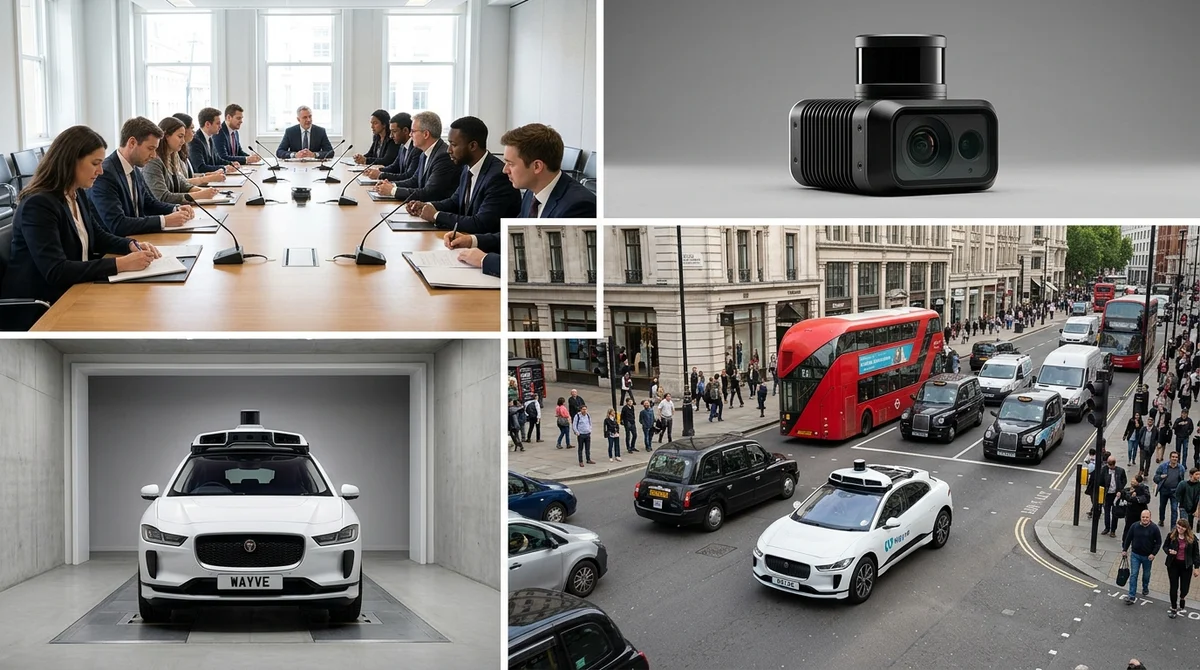
Embedded artificial intelligence and learning on real roads are remaking how self-driving cars are developed, Wayve CEO Alex Kendall told Bloomberg's Tom Mackenzie in an interview.
How the AI approach to self-driving works
The traditional route to autonomous vehicles is writing code by hand. Every rule for every situation: what to do at a red light, how to get around a parked car, how to park in a tight spot. Engineers write rules for the scenarios they anticipate, then test the car on those same scenarios. It is narrow and slow.
Wayve chose a very different path. Instead of hard-coded programming, it put embedded artificial intelligence in its cars. The system looks at the real road the way a driver does, learns from real situations and keeps improving. Cameras, lidars and radars collect video data, and a neural network processes it in real time and decides when to turn, accelerate and brake.
The key to this approach is not to lock the car in a controlled environment for training, but to put it on real streets with real people. That sounds dangerous, but Wayve claims the car learns millions of times faster this way than in an idealized simulation. Every trip is a lesson. Every encounter with a new scenario improves the model.
Why this speeds up robotaxi scaling
The main problem with the traditional approach is adapting to new cities. Every city is unique: different roads, signs, climate and driver behavior. With manual development, companies spend years adapting a car to London, then years more for San Francisco.
With the AI approach, the car adapts on its own. Put it on London's roads for a month and it learns the quirks of those roads, pedestrian behavior and the climate. Then move to San Francisco and the cycle repeats, but much faster, because the knowledge of how to learn is already built into the model.
This gives Wayve a big advantage:
- Embedded AI learns from every trip, so there is no need for huge datasets with manual annotation
- Updates are sent over the air to all cars at once
- Scaling does not require reprogramming for each city
- Robotaxis become economically viable sooner
Wayve has already deployed autonomous taxis in London and is expanding into new markets. Competitors such as Tesla and Cruise use similar AI approaches, but Wayve is clearly betting on it more than anyone, abandoning simulations and large labeled datasets.
What this means
If embedded AI works at scale, self-driving cars move from scientific experiment to industry. That means robotaxis will be available in more cities sooner than analysts predicted. Prices will fall, because companies will not need to spend millions adapting to each region.
- Nov 2, 2026DeepSeek Open-Sources Super-agent Prototype: p95 Task Time Drops from 29.5 to 15.7 Minutes
- Nov 2, 2026LLM Agent Built a Gearbox in KOMPAS-3D, but Scored Only 50 out of 100 on the Specification
- Nov 2, 2026Agents ignored the prompt to read memory in 7 of 7 sessions: an analysis of 13 thousand logs
- Nov 2, 2026Karpathy Built HackerTube, a Catalog of 6,454 Videos, in Two Hours with Claude Code
Key Questions Answered
How the AI approach to self-driving works?
The traditional route to autonomous vehicles is writing code by hand. Every rule for every situation: what to do at a red light, how to get around a parked car, how to park in a tight spot. Engineers write rules for the scenarios they anticipate, then test the car on those same scenarios. It is narrow and slow. Wayve chose a very different path. Instead of hard-coded programming, it put embedded artificial intelligence in its cars.
Why this speeds up robotaxi scaling?
The main problem with the traditional approach is adapting to new cities. Every city is unique: different roads, signs, climate and driver behavior. With manual development, companies spend years adapting a car to London, then years more for San Francisco. With the AI approach, the car adapts on its own. Put it on London's roads for a month and it learns the quirks of those roads, pedestrian behavior and the climate.
What this means?
If embedded AI works at scale, self-driving cars move from scientific experiment to industry. That means robotaxis will be available in more cities sooner than analysts predicted. Prices will fall, because companies will not need to spend millions adapting to each region.
Test Frontier LLMs & Autonomous Agents in One Workspace
Run Claude Opus 5.5, GPT-6, Gemini 3.1, and DeepSeek side-by-side in Nomad AI (nomadnet.ai) — unified model routing, deep research, and multimodal workflows under one subscription.
The AI world, distilled — once a week
Seven stories that actually mattered, hand-picked. No noise, no reposts, no press releases.
Done! Check your inbox for a confirmation.