AI data centers consume 6% of electricity in the UK and US
Data centers consume 6% of electricity in the UK and US, making them one of the main drivers of the energy crunch. Annual investment in them is approaching $1 trillion, almost 1% of the global economy. According to IDCA, energy consumption for AI has grown 15% over two years. That is fueling public resistance and calls for urgent solutions to keep growth sustainable.
AI-processed from Guardian; edited by Hamidun News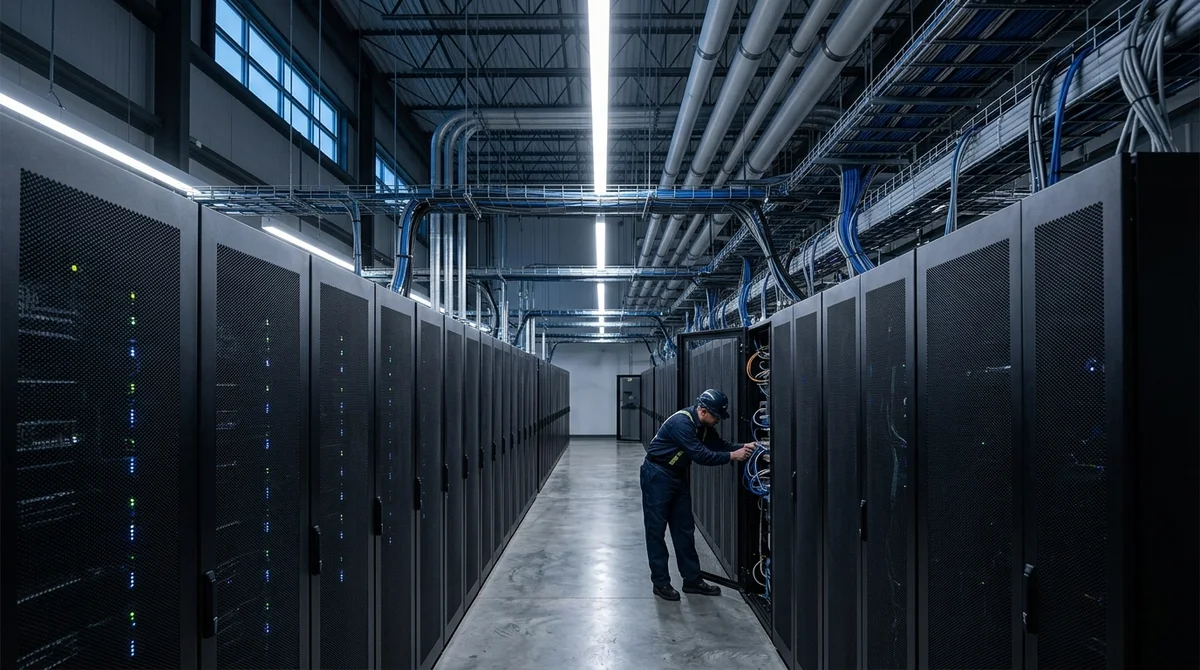
Data centers that power artificial intelligence and cloud services consume 6% of electricity in the UK and US. The share is growing fast and is already provoking pushback from local communities. A new study suggests the energy cost of AI will become one of the key problems of the coming decade.
Data center investment on the scale of a national economy
The International Data Center Association (IDCA) has published a study finding that annual global investment in data centers is approaching $1 trillion. That is roughly 1% of the global economy, a huge share comparable to the economies of entire countries. The figure shows how central infrastructure for storing and processing data has become in the modern world.
Data center electricity consumption has grown 15% worldwide over the past two years. That pace is more than double the average growth in electricity consumption, and it is driven mainly by the faster adoption of AI systems, from training large language models to running applications in production. For perspective: five years ago, the main energy consumers in data centers were video streaming and cloud storage. Today AI has been added, and it requires orders of magnitude more power.
- Training a single large neural network requires several months of continuous work on powerful GPU clusters
- Running inference (computing responses for users) requires a constant stream of computation, 24/7
- Duplicating and backing up infrastructure for reliability raises total consumption by 20-30%
- Server cooling is becoming one of the largest cost items and can account for up to 40% of total energy consumption
Why does AI need so much electricity
Behind every chatbot you use stand enormous computational processes. Data centers used to power mainly websites, streaming services and social networks; now AI has joined them, and it needs orders of magnitude more power.
Training one large model can take as much electricity as thousands of homes use in a year. For example, training GPT-4 took roughly as much energy as a small city uses in a month. And once the model is ready, serving it to millions of users demands a constant flow of energy, because the servers run without a break.
Companies also often train several versions of the same model and keep them in memory for fast access. That increases energy costs further.
"The energy cost of AI is a hidden cheat code in the economy," one IDCA researcher said in an interview with The Guardian.
Local communities push back against data center expansion
The wave of AI development has led to conflicts with local communities. Residents oppose the construction of new data centers, fearing higher electricity bills and a decline in quality of life. In some areas of the UK and US, resolutions against expanding capacity have already been adopted, and in some cases permits for new construction have been frozen.
The problem is acute: if data centers keep consuming electricity at the current growth rate of 15% a year, they will compete seriously with the needs of ordinary citizens, hospitals and industry. Some regions already see energy shortages during peak hours.
What this means
The AI development community and companies such as OpenAI, Google and Meta* face a harsh reality: technological progress has a real energy cost. Either a large-scale shift to renewable sources (wind, solar, nuclear) will be needed, or the algorithms themselves will have to be optimized to require less computation. Both paths require huge investment and time. Until that happens, the energy crisis will remain one of the main factors limiting AI development.
*Meta is designated an extremist organization and banned in Russia.
- Nov 19, 2026A Lawyer Taught an AI Agent to Make Surgical Edits in Word with Track Changes
- Nov 19, 2026RSAC 2026 in Hindsight: AI Assistants Invented 19.7% of Recommended Packages
- Nov 19, 2026Codex Agents Ran 1700 Investigations Into ChatGPT Slowdowns and Found the Cause in 600
- Nov 19, 2026Anthropic goes public and raises $81.3 billion, beating SpaceX's $75 billion record
Key Questions Answered
What are the key details on Data center investment on the scale of a national economy?
The International Data Center Association (IDCA) has published a study finding that annual global investment in data centers is approaching $1 trillion. That is roughly 1% of the global economy, a huge share comparable to the economies of entire countries. The figure shows how central infrastructure for storing and processing data has become in the modern world. Data center electricity consumption has grown 15% worldwide over the past two years.
Why does AI need so much electricity?
Behind every chatbot you use stand enormous computational processes. Data centers used to power mainly websites, streaming services and social networks; now AI has joined them, and it needs orders of magnitude more power. Training one large model can take as much electricity as thousands of homes use in a year. For example, training GPT-4 took roughly as much energy as a small city uses in a month.
What are the key details on Local communities push back against data center expansion?
The wave of AI development has led to conflicts with local communities. Residents oppose the construction of new data centers, fearing higher electricity bills and a decline in quality of life. In some areas of the UK and US, resolutions against expanding capacity have already been adopted, and in some cases permits for new construction have been frozen.
Test Frontier LLMs & Autonomous Agents in One Workspace
Run Claude Opus 5.5, GPT-6, Gemini 3.1, and DeepSeek side-by-side in Nomad AI (nomadnet.ai) — unified model routing, deep research, and multimodal workflows under one subscription.
The AI world, distilled — once a week
Seven stories that actually mattered, hand-picked. No noise, no reposts, no press releases.
Done! Check your inbox for a confirmation.