AI image generators don't get creative: why, and what to do about it
AI image generators exist, but they have a problem: they produce banal illustrations. Even powerful models are hard to push toward creativity. The fix? Describe what you need as precisely as possible. The network was trained on averaged content, and without details it picks the statistically likely solution.
AI-processed from Habr AI; edited by Hamidun News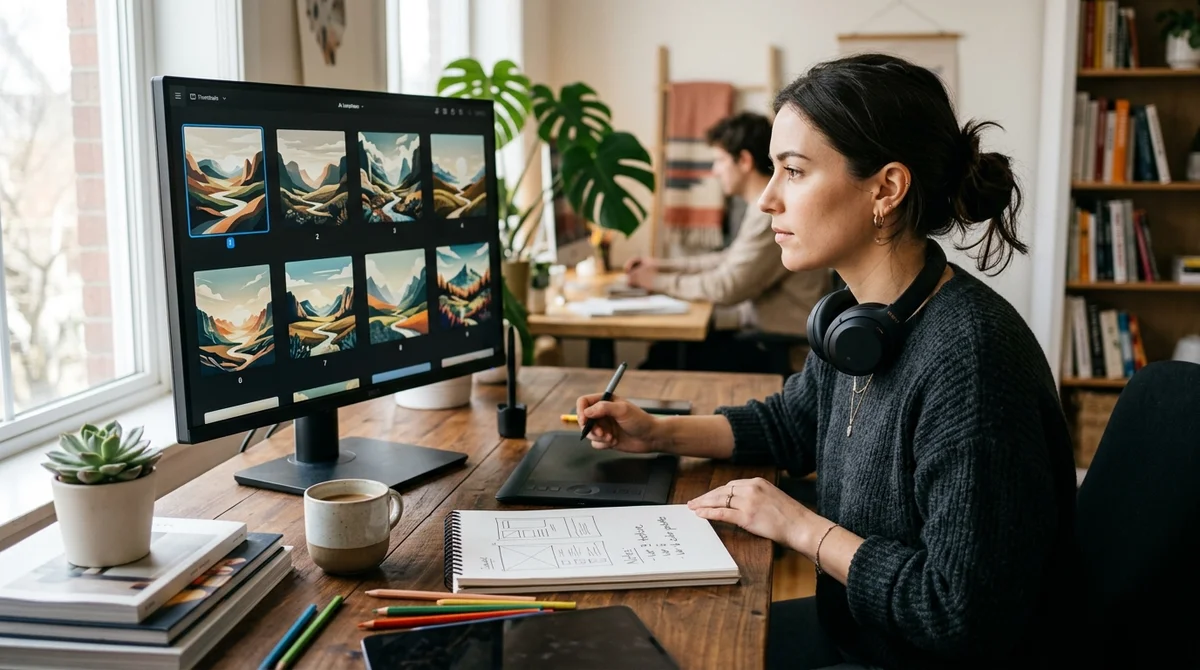
You can generate illustrations for a text in a couple of minutes. But why do the results often look generic and dull?
The generator is there, the creativity isn't
AI models that create images have given editors, marketers and webmasters a powerful tool. Text description → neural network → a finished illustration you don't have to commission from a designer. It would seem the problems with visual content are solved once and for all. In practice, it doesn't work out that way.
Even the most powerful models (DALL-E, Midjourney, Flux) readily produce banal, ordinary images. Derivative compositions. Faces without character. Scenes you've seen thousands of times.
The difficulty isn't that the picture doesn't fit the site's style. A wrong style can be fixed. The difficulty is something else entirely: with a standard prompt, the neural network simply doesn't get creative. It delivers what is reliable. What is familiar. What has already been generated a million times.
Why models are afraid to experiment
This is the root of the problem: AI is trained on millions of examples from the internet. And what share of them are truly original, creative images? Vanishingly small. Most content is repetition. Variations on a single theme. When you give a short description, the model reaches for an averaged, statistically likely result.
Neural networks also tend toward compromise. If you write "programmer in an office," the model will pick something midway between a thousand office photos from Pinterest and Adobe Stock. The result is safe and professional, but boring.
- The model relies on training-data statistics, where banal images are more common
- Short, imprecise prompts lead to averaged results
- The neural network avoids experiments without explicit instructions
- Standard descriptions almost guarantee standard pictures
- Getting something interesting out requires very precise wording
How to make a neural network get creative
There is no magic button. But there is a strategy: state as precisely as possible what you want. Just "office" is not enough; you need "1980s open-plan office with glass partitions, yellow fluorescent lighting, muted palette." Just "robot" is not enough; you need "robotic arm with hydraulics, close-up on the mechanism's details, cold metal, industrial lighting."
The more specifically you describe visual details, aesthetics, lighting, era, mood and texture, the lower the chance that the neural network switches into statistical-compromise mode.
Sometimes it helps to name a visual style or a source of inspiration: "in the style of a 1960s science poster," "a Tarkovsky film shot," "a National Geographic photograph."
What this means
Image generators do work, but they demand experience. It isn't just pressing a button. It is closer to a craft: the ability to see an image precisely and describe it so the neural network doesn't slide into statistical-compromise mode.
For content teams, this means demand for a new kind of specialist, somewhere between copywriter and designer, who masters both prompt engineering and visual language at once.
- Oct 25, 2026Shadow AI in the Enterprise: Why 90% of Security Officers Break Their Own Bans and How a 3-Zone Traffic Light System Works
- Oct 19, 2026Black Forest Labs: A 70-Person Team Takes On Silicon Valley's Giants
- Oct 11, 2026BBC: AI Is Devaluing Images and Raising the Price of Human-Made Work
- Oct 9, 2026Midjourney Adds Thinking Mode for V8.2 and Shared Folders in Alpha
Key Questions Answered
What are the key details on The generator is there, the creativity isn't?
AI models that create images have given editors, marketers and webmasters a powerful tool. Text description → neural network → a finished illustration you don't have to commission from a designer. It would seem the problems with visual content are solved once and for all. In practice, it doesn't work out that way. Even the most powerful models (DALL-E, Midjourney, Flux) readily produce banal, ordinary images. Derivative compositions. Faces without character. Scenes you've seen thousands of times. The difficulty isn't that the picture doesn't fit the site's style. A wrong st
Why models are afraid to experiment?
This is the root of the problem: AI is trained on millions of examples from the internet. And what share of them are truly original, creative images? Vanishingly small. Most content is repetition. Variations on a single theme. When you give a short description, the model reaches for an averaged, statistically likely result. Neural networks also tend toward compromise. If you write "programmer in an office," the model will pick something midway between a thousand office photos from Pinterest and Adobe Stock. The result is safe and professional, but boring. The model relies o
How to make a neural network get creative?
There is no magic button. But there is a strategy: state as precisely as possible what you want. Just "office" is not enough; you need "1980s open-plan office with glass partitions, yellow fluorescent lighting, muted palette." Just "robot" is not enough; you need "robotic arm with hydraulics, close-up on the mechanism's details, cold metal, industrial lighting." The more specifically you describe visual details, aesthetics, lighting, era, mood and texture, the lower the chance that the neural network switches into statistical-compromise mode. Sometimes it helps to name a vi
Test Frontier LLMs & Autonomous Agents in One Workspace
Run Claude Opus 5.5, GPT-6, Gemini 3.1, and DeepSeek side-by-side in Nomad AI (nomadnet.ai) — unified model routing, deep research, and multimodal workflows under one subscription.
The AI world, distilled — once a week
Seven stories that actually mattered, hand-picked. No noise, no reposts, no press releases.
Done! Check your inbox for a confirmation.