Basata automates the medical back office, and doctors can finally call patients back
Basata is bringing AI into clinic back offices to handle calls and patient scheduling. The result: patients can finally get through to their doctors. Administrators aren't afraid for their jobs yet. They're simply glad a machine is taking over the exhausting routine. Still, the question of where augmentation ends and displacement begins remains open.
AI-processed from TechCrunch; edited by Hamidun News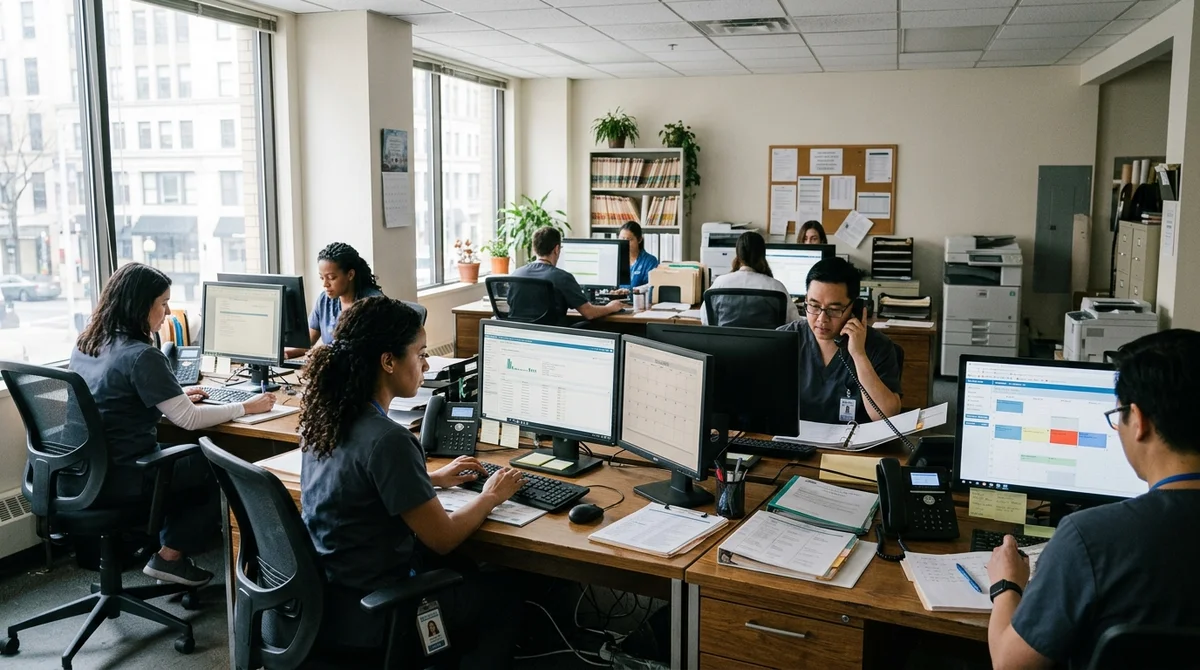
Why can't you get through to your doctor? The answer often lies not in a shortage of medical staff, but in an administrative disaster building up behind the scenes at the clinic. Receptionists, secretaries and assistants in medical facilities are so overloaded that handling incoming calls, booking appointments and dealing with insurance consumes all of their working time. Doctors simply don't have time to call patients back, because only processed, filtered information ever reaches them.
Automation that works
Basata is a startup that decided to automate exactly this part: the back office of medical facilities. The company has built an AI-based system that takes over routine administrative tasks. The system handles incoming calls, analyzes patients' complaints and questions, automatically books them into open slots, works with insurance companies and performs dozens of other mechanical operations. This frees people from the most tiresome part of the job and lets them focus on complex cases that require human judgment.
What the system takes on:
- Handling incoming calls and identifying the reason for the patient's contact
- Automatically booking patients into available slots in the doctor's schedule
- Interacting with insurance companies and confirming coverage of services
- Tracking the history of interactions with each patient and preparing summaries
- Sending patients reminders before appointments
Staff are grateful, not frightened
The most interesting part of the Basata story is the reaction of administrative staff. The company's founders note that the employees they work with are not afraid of losing their jobs to automation. On the contrary, people are glad.
Why? Because the current work wears them down mentally and physically. Answering the same questions 100 times a day, entering patients by hand into paper calendars, checking insurance in three phone calls, hunting for information across different systems: this is not creative work, it is boring routine, hour after hour, day after day.
AI takes that burden on, and people move on to more meaningful functions: talking with patients who need special help, resolving conflicts, and working to improve the quality of service.
"Staff aren't worried about their jobs.
They're literally drowning in the current workload."
But there is a big question
Behind this success story lies a deeper and more troubling problem, one that sooner or later will hit head-on many companies that automate human labor. Basata, like them, will at some point have to answer a harder question: where is the line between augmenting workers' abilities and replacing them entirely?
For now, administrators are grateful for the lighter load and are not worried about their jobs. But as Basata's system improves and its capabilities grow, the need for human hands will inevitably decline. In time, one well-tuned system could serve a clinic that previously needed three or four administrators. And then the party may end, and the sharp question of what happens to the people whose work was automated and is no longer needed will arise.
For now, Basata believes it has found the right balance: AI does the boring, mechanical work, while people handle interaction, critical thinking and personal support for patients.
What this means for medicine
AI in healthcare is usually associated with diagnostics: algorithms that read X-rays or predict disease risk. But Basata shows that the barrier between a patient and quality care is often not a lack of doctors, but plain administrative overload. Back-office automation can be a quick win for everyone: patients finally get through, doctors focus on medicine, and administrators don't burn out. The question is how long this balance will last.
- Nov 2, 2026Steering vectors in LLM fine-tuning improved SFT and distillation across three seeds
- Nov 2, 2026EDU-Jev 4B grades student work with 67.6% accuracy, beating commercial APIs by 9.4 points
- Oct 28, 2026Anthropic reveals how it builds Claude with Claude: the brain separate from the hands
- Oct 28, 2026Bayer Launches Multi-Agent Engine on AgentCore: 80% of Questions Handled Without Engineers
Key Questions Answered
What are the key details on Automation that works?
Basata is a startup that decided to automate exactly this part: the back office of medical facilities. The company has built an AI-based system that takes over routine administrative tasks. The system handles incoming calls, analyzes patients' complaints and questions, automatically books them into open slots, works with insurance companies and performs dozens of other mechanical operations. This frees people from the most tiresome part of the job and lets them focus on complex cases that require human judgment.
What are the key details on Staff are grateful, not frightened?
The most interesting part of the Basata story is the reaction of administrative staff. The company's founders note that the employees they work with are not afraid of losing their jobs to automation. On the contrary, people are glad. Why? Because the current work wears them down mentally and physically.
What are the key details on But there is a big question?
Behind this success story lies a deeper and more troubling problem, one that sooner or later will hit head-on many companies that automate human labor. Basata, like them, will at some point have to answer a harder question: where is the line between augmenting workers' abilities and replacing them entirely? For now, administrators are grateful for the lighter load and are not worried about their jobs. But as Basata's system improves and its capabilities grow, the need for human hands will inevitably decline.
Test Frontier LLMs & Autonomous Agents in One Workspace
Run Claude Opus 5.5, GPT-6, Gemini 3.1, and DeepSeek side-by-side in Nomad AI (nomadnet.ai) — unified model routing, deep research, and multimodal workflows under one subscription.
The AI world, distilled — once a week
Seven stories that actually mattered, hand-picked. No noise, no reposts, no press releases.
Done! Check your inbox for a confirmation.