MIT is building a "humble" diagnostic AI that openly shows its doubts
MIT wants medical AI to be "humble" rather than all-knowing: the model should flag when it lacks the data to make a diagnosis. Instead of a confident but potentially wrong answer, the system can request additional tests, patient history or a specialist consultation. The team is already building this approach into tools based on MIMIC and testing it with clinicians.
AI-processed from MIT News; edited by Hamidun News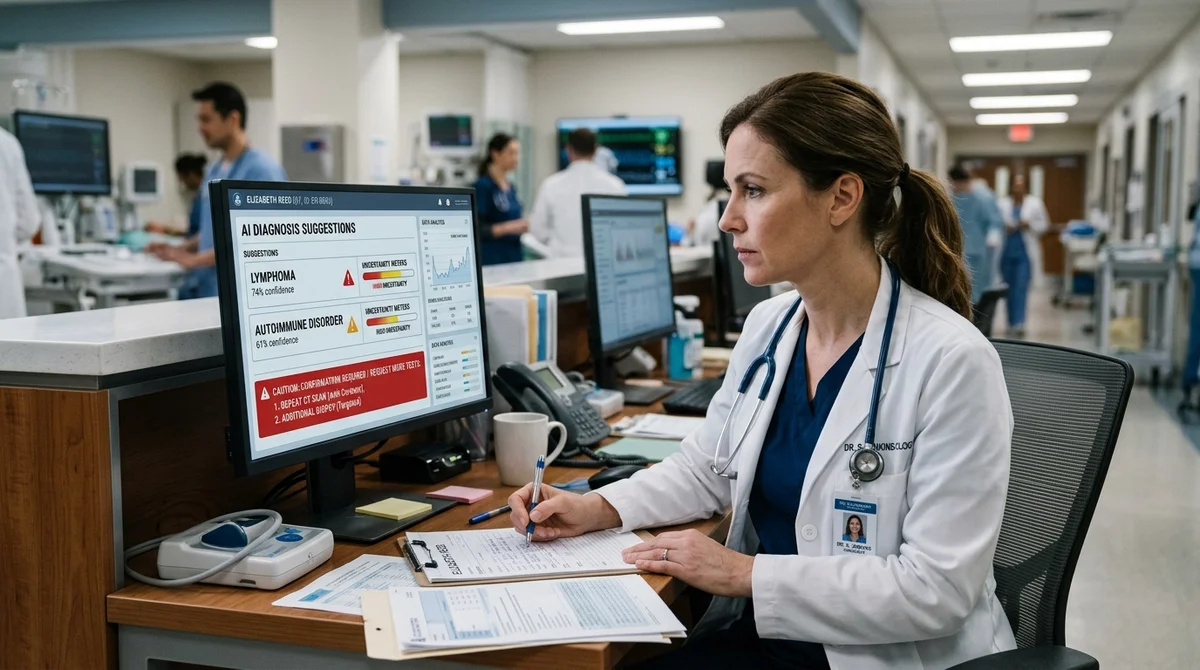
MIT researchers have proposed a new approach to medical AI: a clinical diagnostic system should not play the know-it-all, but openly show when it lacks data. Rather than an "oracle," the team wants to turn the model into a partner for the physician, one that helps gather missing information and does not pressure them with an authoritative answer.
Why this matters
AI systems have long promised to speed up diagnosis and help select treatment, but in the clinic they have a dangerous weakness: they often sound too confident even when they are wrong. The MIT team cites earlier studies in which intensive care physicians leaned toward an algorithm's advice if they considered it reliable, even when their own intuition suggested otherwise. The same logic applies to patients: an authoritative tone raises trust even in an incorrect recommendation.
The problem is not only model accuracy, but also how models present their answers. If a system delivers a diagnosis as final truth on incomplete context, the physician gets a false sense of certainty. In emergency departments and intensive care units this is especially risky: decisions are often made quickly, and the cost of error is high. So the researchers propose teaching the model not just to answer, but to explicitly signal the limits of its confidence.
How the approach works
The team describes a framework that can be built into existing clinical decision support systems. Its first module makes the model assess its own confidence before it issues a diagnostic prediction. For this, the researchers use a metric called the Epistemic Virtue Score, developed together with scientists from the University of Melbourne. In essence, it is a self-awareness check: the model's confidence should match the complexity of the case and the amount of available data.
If the system sees that its confidence is higher than the evidence allows, it should not push the conclusion through, but change its behavior:
- flag the mismatch between confidence and data quality
- request specific tests, history details or missing features
- suggest a consultation with a relevant specialist
- indicate what information would help resolve the uncertainty
- warn that the current answer requires cautious interpretation
"Right now we use AI as an oracle, but it can be turned into a coach and a true co-pilot," says
Leo Anthony Celi.
Celi's team previously helped create large datasets for medical AI, including the MIMIC database. Now the researchers are trying to build the new approach into systems that run on this data and to show it to clinicians in the Beth Israel Lahey Health network. They say the same approach can be applied beyond text-based diagnostic assistants, including systems that analyze X-ray images or choose treatment tactics in the emergency room.
The data problem
The work on "humble" AI is part of a broader MIT program to build medical models that are designed not only for people but together with them. The researchers separately stress the risk of data bias: many popular models are trained on public US datasets and inevitably inherit a particular view of disease, treatment and care organization. What is well described in one health system may work worse in another or quietly exclude entire groups of patients.
There is also a more down-to-earth problem: electronic health records were not originally created as an ideal source for training diagnostic models. They often lack the context a physician gets from conversation, observation or experience. In addition, some patients do not appear in such datasets at all because of limited access to healthcare, for example people from rural areas. At MIT Critical Data workshops, researchers, physicians, social scientists and patients themselves check together who is missing from a dataset and which structural biases a model may entrench.
What this means
The next stage of medical AI is not only a fight for a couple more percentage points of accuracy on benchmarks, but the ability to doubt at the right time. If this approach reaches real clinics, the model's value will lie not in replacing the physician, but in more transparent, cautious and collaborative work with them.
Key Questions Answered
Why this matters?
AI systems have long promised to speed up diagnosis and help select treatment, but in the clinic they have a dangerous weakness: they often sound too confident even when they are wrong. The MIT team cites earlier studies in which intensive care physicians leaned toward an algorithm's advice if they considered it reliable, even when their own intuition suggested otherwise. The same logic applies to patients: an authoritative tone raises trust even in an incorrect recommendation. The problem is not only model accuracy, but also how models present their answers. If a system de
How the approach works?
The team describes a framework that can be built into existing clinical decision support systems. Its first module makes the model assess its own confidence before it issues a diagnostic prediction. For this, the researchers use a metric called the Epistemic Virtue Score, developed together with scientists from the University of Melbourne. In essence, it is a self-awareness check: the model's confidence should match the complexity of the case and the amount of available data. If the system sees that its confidence is higher than the evidence allows, it should not push the c
What are the key details on The data problem?
The work on "humble" AI is part of a broader MIT program to build medical models that are designed not only for people but together with them. The researchers separately stress the risk of data bias: many popular models are trained on public US datasets and inevitably inherit a particular view of disease, treatment and care organization. What is well described in one health system may work worse in another or quietly exclude entire groups of patients. There is also a more down-to-earth problem: electronic health records were not originally created as an ideal source for tra
Test Frontier LLMs & Autonomous Agents in One Workspace
Run Claude Opus 5.5, GPT-6, Gemini 3.1, and DeepSeek side-by-side in Nomad AI (nomadnet.ai) — unified model routing, deep research, and multimodal workflows under one subscription.
The AI world, distilled — once a week
Seven stories that actually mattered, hand-picked. No noise, no reposts, no press releases.
Done! Check your inbox for a confirmation.