Hollywood's Screenwriters Have Retrained as AI Model Trainers
Hollywood screenwriters left jobless by strikes and industry cutbacks are retraining out of necessity. They now take low-paid contracts training AI for various platforms and companies. One writer shared his own experience: over the past 8 months he completed 20 contracts for five different companies, and he calls the work deeply demoralizing.
AI-processed from Wired; edited by Hamidun News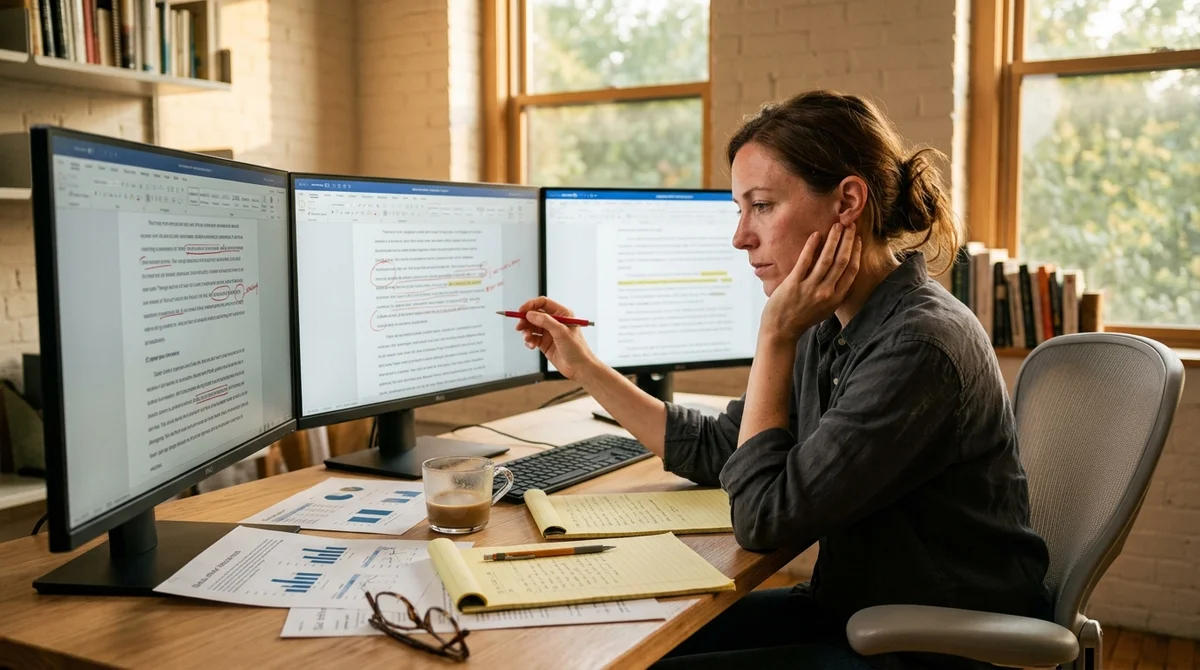
Hollywood screenwriters who lost income to strikes and industry cutbacks have found an unexpected source of work: they train AI models by rating text generated by neural networks and building training datasets. It is a visible symptom of deep changes in the market for creative labor.
From scripts to data labeling
One Hollywood screenwriter shared a detailed account: in eight months he signed twenty contracts with five different AI development platforms. The work is monotonous and demands attention to detail: rating the quality of text generated by a neural network, finding errors and inaccuracies, writing additional examples, and flagging systemic biases in training datasets. Fees start at a few hundred dollars and rarely exceed a thousand per contract. For a writer used to working on TV shows with far larger fees, this is a financial disaster. But it beats earning nothing at all and feeling cast out of the industry to which he devoted his career.
Why everyone is doing this at once
The author stresses that he is not alone. Directors, producers, costume designers and other writers are all signing the same kind of contracts with AI platforms at the same time. It marks the end of an era in which creative workers could make a living from their main job in the film industry, with guaranteed income and social status. Several factors converged:
- The 2023 strikes by the Writers Guild (WGA) and actors (SAG-AFTRA) paralyzed production for months
- Studios are rapidly adopting AI tools, reducing demand for new original scripts
- Content consumption has moved to streaming platforms, and traditional commissions are gone
- Huge demand has emerged for workers to train AI: labeling, annotation, quality control
The creative workforce was ready: many unemployed writers with writing and editing skills and experience spotting errors in texts. For them, it was a natural choice.
An uncomfortable analogy
The author uses an old Hollywood analogy: actors have historically waited for their break by working as waiters and taxi drivers. But the scale has changed. When everyone is looking for part-time work at once, part-time work becomes full-time employment, and a half-career becomes the everyday norm.
AI platforms clearly win: cheap, skilled labor, no long-term obligations to workers, and direct licensing of the output. Screenwriters win only conditionally: they have income, a chance to stay within the industry's ecosystem, if only on the periphery, and a sense of taking part in creating content.
The end of an era
The phenomenon shows AI ceasing to be merely a tool and becoming a new labor market: one of labeling, annotation and correction. Screenwriters no longer write for people. They write training data for machines that are gradually pushing them out of their own profession.
It is unclear how long demand for human labeling and editing will last. In a few years, AI will probably start labeling its own errors well, and the demand will vanish. But one thing is clear: Hollywood's retraining has already begun, in real time. It is only the first wave of a major shift in the content industry.
Key Questions Answered
What are the key details on From scripts to data labeling?
One Hollywood screenwriter shared a detailed account: in eight months he signed twenty contracts with five different AI development platforms. The work is monotonous and demands attention to detail: rating the quality of text generated by a neural network, finding errors and inaccuracies, writing additional examples, and flagging systemic biases in training datasets. Fees start at a few hundred dollars and rarely exceed a thousand per contract.
Why everyone is doing this at once?
The author stresses that he is not alone. Directors, producers, costume designers and other writers are all signing the same kind of contracts with AI platforms at the same time. It marks the end of an era in which creative workers could make a living from their main job in the film industry, with guaranteed income and social status.
What are the key details on An uncomfortable analogy?
The author uses an old Hollywood analogy: actors have historically waited for their break by working as waiters and taxi drivers. But the scale has changed. When everyone is looking for part-time work at once, part-time work becomes full-time employment, and a half-career becomes the everyday norm. AI platforms clearly win: cheap, skilled labor, no long-term obligations to workers, and direct licensing of the output.
Ship AI Faster with Founders, Engineers & Weekly Architecture Reviews
Inside Vibe Club (hamidun.com/club) — weekly live masterminds with Zhemal Khamidun, Tech Radar, full LMS access, and 370+ production Claude Code skills.
The AI world, distilled — once a week
Seven stories that actually mattered, hand-picked. No noise, no reposts, no press releases.
Done! Check your inbox for a confirmation.