OpenAI shows how Codex helps business operations teams prepare decisions for leadership
OpenAI has published a guide on how business operations teams can use Codex in their daily work. The tool pulls context from KPI dashboards, project trackers, meeting notes and correspondence, then drafts a first version of a brief, a leadership update or a decision packet. The company stresses that final judgment and recommendations still rest with the team.
AI-processed from OpenAI Blog; edited by Hamidun News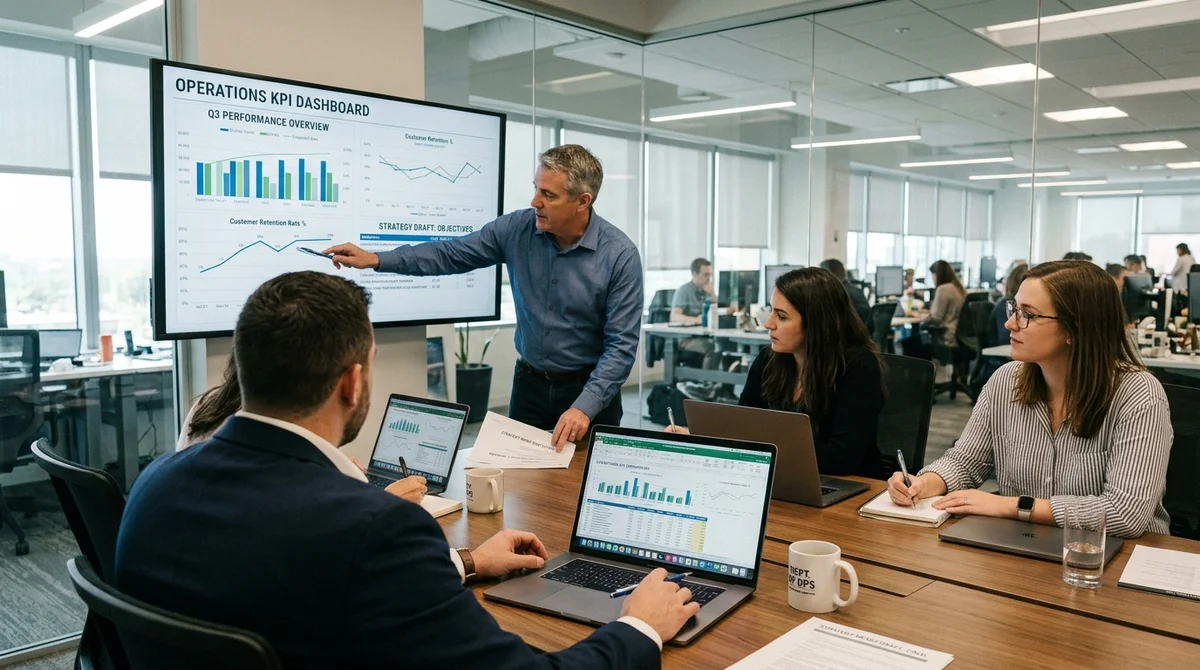
On May 15, 2026, OpenAI Academy published a practical guide on how business operations teams can use Codex not to write code, but to prepare management documents. The idea is to gather KPIs, project trackers, meeting notes, stakeholder discussions and other working inputs in one place, then get a first draft that is ready to take to review.
How the approach works
In the guide, OpenAI describes a typical problem for operations teams: important information is almost always scattered across several systems. Some data sits in task trackers, some in dashboards, some in spreadsheets, emails, Slack threads and post-meeting notes. Assembling the full picture usually takes a lot of time, and the result is still a document that someone manually rewrites for a executive, the board of directors or a weekly status update.
In this setup, Codex acts as a tool for quickly assembling the first working artifact. It does not make decisions for the team, but it helps turn scattered context into a coherent draft: a short brief on a troubled initiative, a strategic update, a decision packet, a progress report or a scenario model with tradeoffs. OpenAI separately stresses that assessment, interpretation and the final recommendation still remain with people.
Five working formats
The page is laid out as a set of applied scenarios with ready-made prompts. In every case the logic is similar: the team uploads source documents, decision history, figures and comments from workstream owners to Codex, and gets back a structure that can be quickly checked, refined and passed along the process.
- A brief on an initiative that has started to go off the rails: what changed, why deviations arose, what the risks are, the options for action and what decision ask is needed from leadership.
- A regular health update on a strategic initiative: progress, deltas, blockers, open decisions, next steps and stale items that need to be followed up with owners.
- A leadership decision packet: a pre-read with a recommendation, rationale, options, tradeoffs, assumptions, risks and a list of open questions.
- A progress update for the board of directors, the exec team or the whole company: an end-to-end story, supporting metrics, problem areas and next milestones.
- A scenario and tradeoff model: a comparison of several paths by cost, timing, risk, owners and impact on the business or the customer.
It is also useful that OpenAI does not stop at generic talk of "document automation." For each format, the company lists exactly which inputs to give the model: executive ask, KPI dashboards, financial model, decision log, stakeholder threads, owner updates, prior briefs and other real working artifacts. In other words, this is not about generating text out of thin air, but about compressing existing organizational context into a more convenient form.
Where oversight is needed
The most important part of the guide is not the list of scenarios but the framework for use. Codex is positioned as a helper for synthesis and the first pass of preparation, not as a system that determines the right decision on its own. In its starter prompts, OpenAI repeats the same idea several times: the model should separate confirmed facts from interpretations and flag claims, figures or assumptions that the process owner needs to verify.
"The team remains responsible for conclusions and recommendations;
Codex helps get a working draft in front of the right people faster."
For business operations this is critical, because final documents often go up the chain with little time left for corrections. If a wrong figure ends up in a decision packet or board update, the error quickly becomes a management error. So the strength of the approach is not that Codex replaces an analyst or a chief of staff, but that it takes over the routine of assembling, reconciling and packaging materials before human review. It looks especially useful in combination with Google Drive, Slack, Gmail, spreadsheets, presentations and a calendar.
What this means
OpenAI continues to promote Codex as a work tool well beyond engineering teams. The new material shows a clear direction: the model is becoming not only an environment for code but also an interface for management preparation, from short briefs to scenario models for leadership. For companies, this could shorten the time between "we have scattered data" and "we have a document we can base a decision on," provided the sources are in order and final responsibility stays with the team.
*Meta is recognized as an extremist organization and banned in Russia.
- Nov 1, 2026Local models lose to Opus and Codex: 0.21 on a MacBook versus 1.00 for Codex
- Nov 1, 2026Kimi scores 96.2% on a 1C database analytics test and emerges as a fallback if Claude access is blocked
- Nov 1, 2026OpenAI Rewrites GPT Behavior Rules: Five Values and a Chain of Command
- Nov 1, 2026Google admits AI Mode cuts search revenue, shares fall 15%
Key Questions Answered
How the approach works?
In the guide, OpenAI describes a typical problem for operations teams: important information is almost always scattered across several systems. Some data sits in task trackers, some in dashboards, some in spreadsheets, emails, Slack threads and post-meeting notes. Assembling the full picture usually takes a lot of time, and the result is still a document that someone manually rewrites for a executive, the board of directors or a weekly status update. In this setup, Codex acts as a tool for quickly assembling the first working artifact. It does not make decisions for the tea
What are the key details on Five working formats?
The page is laid out as a set of applied scenarios with ready-made prompts. In every case the logic is similar: the team uploads source documents, decision history, figures and comments from workstream owners to Codex, and gets back a structure that can be quickly checked, refined and passed along the process. A brief on an initiative that has started to go off the rails: what changed, why deviations arose, what the risks are, the options for action and what decision ask is needed from leadership. A regular health update on a strategic initiative: progress, deltas, blockers
Where oversight is needed?
The most important part of the guide is not the list of scenarios but the framework for use. Codex is positioned as a helper for synthesis and the first pass of preparation, not as a system that determines the right decision on its own. In its starter prompts, OpenAI repeats the same idea several times: the model should separate confirmed facts from interpretations and flag claims, figures or assumptions that the process owner needs to verify. "The team remains responsible for conclusions and recommendations; Codex helps get a working draft in front of the right people fast
Build & Ship Production AI Agents Without Boilerplate Code
Start your free 72-hour trial at Hamidun Academy (academy.hamidun.com) — interactive lessons on Claude Code & Cursor, live Tech Radar, and production agent templates.
The AI world, distilled — once a week
Seven stories that actually mattered, hand-picked. No noise, no reposts, no press releases.
Done! Check your inbox for a confirmation.