African countries spent $2 billion on Chinese AI surveillance and control systems
The AI surveillance market is growing rapidly in Africa: according to a new report, 11 governments have already spent more than $2 billion on Chinese systems with facial recognition and movement tracking. Experts say that under the banner of national security, such tools are being deployed with almost no regulation, and their impact goes far beyond fighting crime, leaving citizens without clear oversight mechanisms.
AI-processed from Guardian; edited by Hamidun News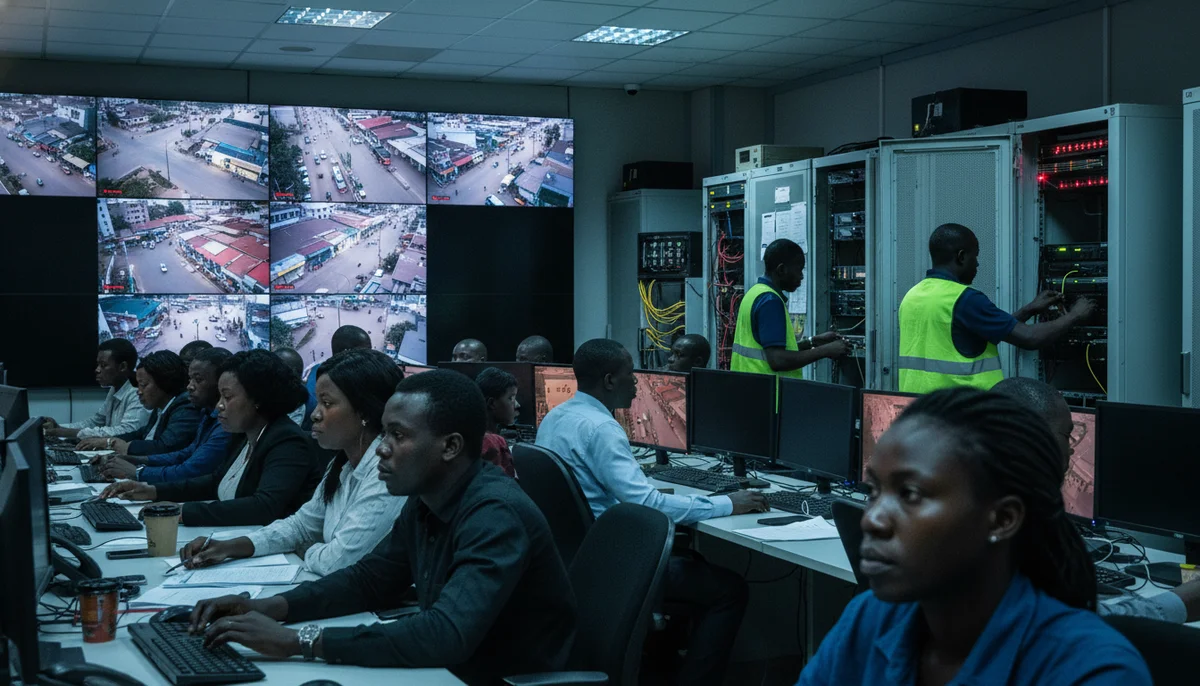
African governments are rapidly deploying AI systems for mass surveillance, and human rights advocates say the price of this course is citizens’ privacy and freedom. A new report by the Institute of Development Studies says that 11 countries have already spent more than $2 billion on Chinese surveillance technologies.
What the experts found
The report’s authors describe the rapid growth of infrastructure capable of recognizing faces, tracking movements, and collecting data on people’s behavior in cities. This is not about targeted tools for investigations, but about systems that can operate continuously and at broad scale.
According to the researchers, 11 countries on the continent have already purchased Chinese solutions worth more than $2 billion in total. The main criticism is not only the very fact of deployment, but also that the rules governing the use of such systems are either weak or fail entirely to keep pace with their spread.
Experts emphasize that states often justify these purchases with national security, crime-fighting, and public-order concerns. But the report says such measures must be necessary and proportionate to the risk, and in practice they often fail that test.
When cameras, analytics, and AI models are deployed without independent oversight, citizens have little idea what data is being collected about them, how long it is stored, and who gets access to it.
Why this is alarming
Human rights advocates speak of the so-called chilling effect, when people start changing their behavior not because they broke the law, but because they feel under constant surveillance.
This can undermine freedom of assembly, journalistic work, political activity, and ordinary everyday life.
Even if authorities say the systems are needed for security, the very ability to track routes and faces at scale creates an asymmetry of power: the state sees citizens ever more clearly, while citizens understand less and less about how this control works.
“Such systems cannot be considered necessary or proportionate,” the
report’s conclusions say.
A separate risk is that AI tools are often deployed faster than laws, audit procedures, and appeal mechanisms emerge. If a person is mistakenly flagged by a facial recognition system or movement analytics, they may have no simple way to find out about it and challenge the consequences.
For countries with fragile institutions, this is especially sensitive: a technology presented as neutral quickly becomes a political instrument.
How it is being deployed
The published data suggests that the market is taking shape around ready-made Chinese solutions that governments buy as part of broader digital infrastructure and security programs. In practice, this means surveillance is being deployed not one camera at a time, but as a set of connected services, from video analytics to movement monitoring.
The more tightly such a system is woven into urban and state infrastructure, the harder it becomes to limit its use later.
- Cameras with facial recognition in public places
- Systems for tracking the movements of people and transport
- Integration of surveillance into urban and security platforms
- Launch without clear rules for storage, access, and independent auditing
It is precisely this lack of transparency that makes the issue so explosive. Even when the state does not disclose the full list of suppliers, coverage areas, and usage scenarios, the very architecture of such solutions pushes toward expansion: there is pressure to merge data, extend retention periods, and widen the circle of users.
As a result, a tool purchased for one task gradually starts being used far more broadly. And the later public discussion begins, the harder it becomes to place real limits on this process.
What this means
The story of AI surveillance in Africa points to a broader trend: states are increasingly buying ready-made control systems before they manage to build rules for their use. For citizens, this is a question not only of privacy, but of the balance of power.
If regulation remains weak, mass surveillance quickly becomes the norm — and rolling that norm back later is much harder than introducing it in the first place. That is why the dispute here is no longer really about technology, but about the boundaries of acceptable state control.
Want to stop reading about AI and start using it?
AI News is a curated feed of AI/tech news. Hamidun Academy teaches you to use AI systematically in your work.
The AI world, distilled — once a week
Seven stories that actually mattered, hand-picked. No noise, no reposts, no press releases.
Done! Check your inbox for a confirmation.