SK Hynix to spend nearly $8 billion on ASML EUV tools for next-generation memory
SK Hynix is preparing one of the largest equipment purchases in the industry: the company wants to spend 11.9 trillion won, or about $7.9 billion, on advanced ASML EUV systems. The goal is to speed up production of next-generation memory needed for AI workloads and servers. It is another sign that the race for AI infrastructure depends more and more on memory makers and fab equipment.
AI-processed from Bloomberg Tech; edited by Hamidun News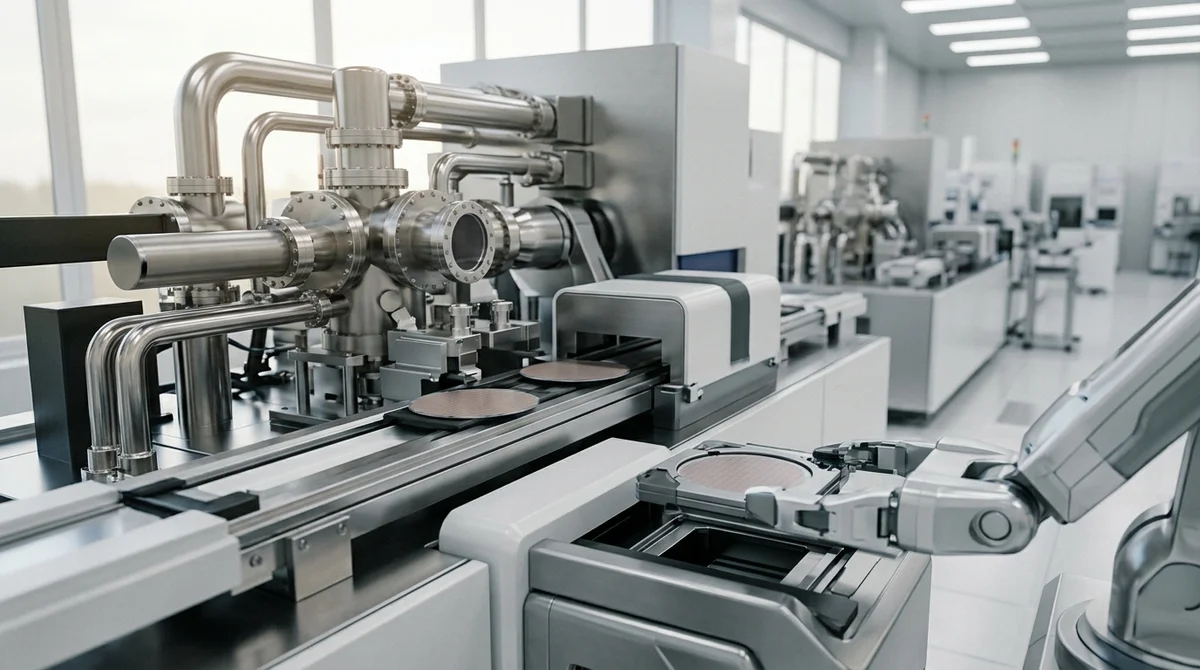
SK Hynix plans to invest 11.9 trillion won, or about $7.9 billion, in advanced ASML lithography tools. The purchase should strengthen the South Korean chipmaker's bet on next-generation memory, demand for which is growing fast alongside the AI market.
A major purchase
The equipment in question is for EUV lithography, the most complex and expensive machines in the semiconductor industry. These tools are needed to produce thinner, denser circuits, and therefore more advanced memory chips.
For SK Hynix this is not just a fleet upgrade: the 11.9 trillion won figure shows the company is preparing for a long capacity-expansion cycle, not a one-off output increase for a single product or a single customer.
The deal has a second side. ASML remains effectively irreplaceable as a supplier of EUV systems, without which reaching the leading edge of process technology is not possible today. If SK Hynix is reserving this much equipment, it means not only heavy capital spending but also a fight for access to a limited number of machines that nearly all leading manufacturers need. That is why such purchases are usually read as a marker of a company's confidence in future orders.
Why EUV matters
EUV lithography uses extreme ultraviolet light to form very small features on silicon wafers. To an end user this sounds like a factory detail, but details like this determine whether memory can be made faster, denser and more energy-efficient.
During the AI boom this is critical: models are getting heavier, servers demand more and more memory bandwidth, and the bottleneck is often not the accelerators themselves but how fast they receive data.
When SK Hynix talks about next-generation memory, the market reads it as preparation for new classes of high-performance DRAM and other solutions for AI servers. Even though the company does not disclose specific product lines in this announcement, the logic is clear: without a more advanced manufacturing process, it is hard to deliver both higher volumes and better performance at once. So investment in fab equipment here is not a side story but one of the main fronts of the AI race.
Why it matters
The deal shows that the AI market continues to drive not only model developers and GPU makers, but the entire supply chain around memory and lithography. Money at this level is rarely spent for short-term demand: this is usually planning years ahead and an attempt to claim a place in the queue for the industry's scarcest tools.
For the industry this already has several practical consequences:
- Memory makers book scarce equipment in advance to avoid running into capacity shortages.
- ASML strengthens its status as the key bottleneck of the entire semiconductor industry.
- AI infrastructure capex is shifting deeper into manufacturing, not just into data centers.
- Competition in AI memory will be fought not only on price but also on how fast new process technologies reach production.
For SK Hynix customers this is a good signal: the supplier is preparing to invest billions so as not to fall behind in performance and volume. But it is also a reminder of the price of the AI boom. Every new wave of models requires not only compute but also colossal investment in infrastructure that remains invisible to most users, from lithography machines to factory lines and materials supply chains. That is where future capacity reserves are being built now.
What it means
SK Hynix's investment shows that the next stage of the AI race is decided not only in model labs but also in fabs. Whoever secures advanced equipment and next-generation memory output first will gain an edge in supplying AI servers for several years ahead.
For the market this means that the fight for AI leadership will depend more and more on manufacturing chains, not just on the quality of models and accelerators.
Key Questions Answered
What are the key details on A major purchase?
The equipment in question is for EUV lithography, the most complex and expensive machines in the semiconductor industry. These tools are needed to produce thinner, denser circuits, and therefore more advanced memory chips. For SK Hynix this is not just a fleet upgrade: the 11.9 trillion won figure shows the company is preparing for a long capacity-expansion cycle, not a one-off output increase for a single product or a single customer. The deal has a second side. ASML remains effectively irreplaceable as a supplier of EUV systems, without which reaching the leading edge of
Why EUV matters?
EUV lithography uses extreme ultraviolet light to form very small features on silicon wafers. To an end user this sounds like a factory detail, but details like this determine whether memory can be made faster, denser and more energy-efficient. During the AI boom this is critical: models are getting heavier, servers demand more and more memory bandwidth, and the bottleneck is often not the accelerators themselves but how fast they receive data. When SK Hynix talks about next-generation memory, the market reads it as preparation for new classes of high-performance DRAM and o
Why it matters?
The deal shows that the AI market continues to drive not only model developers and GPU makers, but the entire supply chain around memory and lithography. Money at this level is rarely spent for short-term demand: this is usually planning years ahead and an attempt to claim a place in the queue for the industry's scarcest tools. For the industry this already has several practical consequences: Memory makers book scarce equipment in advance to avoid running into capacity shortages. ASML strengthens its status as the key bottleneck of the entire semiconductor industry. AI infr
Test Frontier LLMs & Autonomous Agents in One Workspace
Run Claude Opus 5.5, GPT-6, Gemini 3.1, and DeepSeek side-by-side in Nomad AI (nomadnet.ai) — unified model routing, deep research, and multimodal workflows under one subscription.
The AI world, distilled — once a week
Seven stories that actually mattered, hand-picked. No noise, no reposts, no press releases.
Done! Check your inbox for a confirmation.