SK Hynix Prepares a US Listing to Scale Up Memory Output for the AI Market
SK Hynix wants to list in the US as early as the second half of 2026 through ADRs. The goal is simple: raise more capital to expand output of HBM and other memory that underpins the AI server market. The company has already confidentially submitted documents to the SEC, and is meanwhile stepping up investment in new fabs, packaging and lithography.
AI-processed from Bloomberg Tech; edited by Hamidun News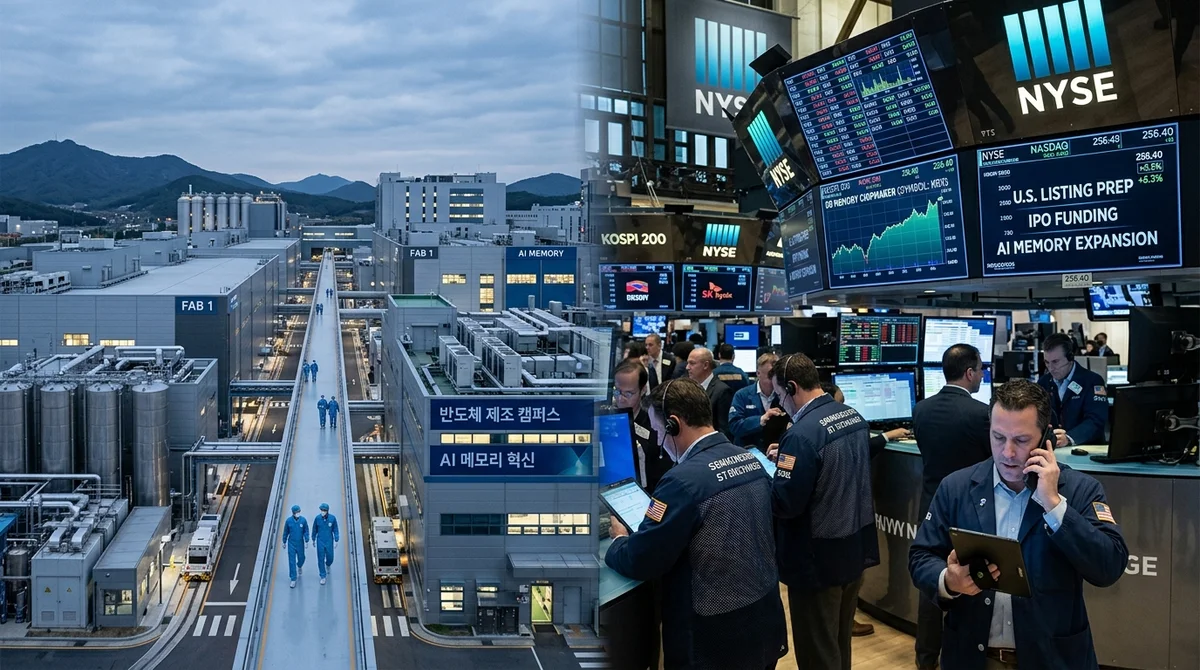
SK Hynix is preparing to enter the US market through an ADR and wants to complete the listing as early as the second half of 2026. The South Korean memory maker hopes to tap a deeper pool of capital so it can keep pace with explosive demand for HBM and other chips for AI servers.
Why list in the US
The company confirmed that on March 24, 2026 it confidentially filed registration documents with the US Securities and Exchange Commission. This is not a direct offering of ordinary shares but an ADR listing: American depositary receipts, which give foreign issuers access to American investors without a full overhaul of their listing structure. SK Hynix says the exact size of the offering, its timing and its format have not yet been approved. Everything will depend on the SEC review, market conditions and investor demand.
The logic of the deal is twofold. The first goal is money to expand production at a time when memory for AI has gone from a commodity segment to a bottleneck for the entire infrastructure. The second is a re-rating of the business. Management says outright that it wants the company valued as a global AI infrastructure player, not only as a Korean memory maker. The market links this to an attempt to narrow the so-called Korea discount: SK Hynix shares trade noticeably cheaper than US peers, including Micron, even amid record profit and leadership in HBM.
Where the money will go
The AI boom has already forced SK Hynix to sharply accelerate its investment cycle. The company announced that over the long term it wants to build up more than 100 trillion won in net cash, so it can sustain large capital spending even in weaker years. For comparison, at the end of 2025 it had about 12.7 trillion won in net cash, and by the end of the first quarter of 2026 the figure had grown to roughly 35 trillion won. The growth is explained by demand for HBM, server DRAM and SSDs for AI systems remaining very high, while quarterly revenue in early 2026 exceeded 50 trillion won for the first time.
"Financial stability is critical to sustaining investment and growth in the AI era,"
CEO Kwak Noh-jung said at the shareholder meeting.
The list of areas where the company needs money is already fairly clear:
- The Yongin cluster, where SK Hynix plans to develop several advanced memory fabs
- New capacity in Cheongju, aimed partly at HBM
- A project in Indiana worth about $5 billion to expand its presence in the US
- An order for ASML equipment worth almost $8 billion through the end of 2027 to produce next-generation memory
In effect, the company is trying to head off the main risk of the coming years: a shortage of production capacity at a time when AI infrastructure customers are booking memory far ahead. The deeper the market moves into HBM4 and more complex DRAM processes, the more SK Hynix needs not only technological advantages but also a balance sheet that lets it buy equipment quickly and build new lines.
What worries investors
The deal has a weak spot: dilution of existing shareholders. At the meeting, investors asked directly why the company is pursuing an ADR by issuing new shares rather than using treasury stock. The answer was cautious: the structure has not yet been determined. But the problem is that in February SK Hynix already cancelled treasury shares worth about 12 trillion won, and it no longer has a meaningful reserve for such a scheme. The market is discussing a scenario in which about 2-3% of capital could be placed in the US, raising up to $14 billion, although the company has not officially confirmed this estimate.
Supporters of the deal argue that even with moderate dilution, a US listing can pay off through a higher valuation of the business and better access to global funds. TSMC is often cited as a precedent, as its US listing helped bring it much closer to the largest technology investors.
What this means
The AI market depends more and more not only on GPUs but also on memory, which has become a scarce asset in its own right. If SK Hynix places its shares successfully in the US, it will gain not just a new funding channel but an additional lever in the race for HBM and AI infrastructure. Competition between memory suppliers will then be fought not only over technology, but also over access to capital.
Key Questions Answered
Why list in the US?
The company confirmed that on March 24, 2026 it confidentially filed registration documents with the US Securities and Exchange Commission. This is not a direct offering of ordinary shares but an ADR listing: American depositary receipts, which give foreign issuers access to American investors without a full overhaul of their listing structure. SK Hynix says the exact size of the offering, its timing and its format have not yet been approved. Everything will depend on the SEC review, market conditions and investor demand. The logic of the deal is twofold. The first goal is
Where the money will go?
The AI boom has already forced SK Hynix to sharply accelerate its investment cycle. The company announced that over the long term it wants to build up more than 100 trillion won in net cash, so it can sustain large capital spending even in weaker years. For comparison, at the end of 2025 it had about 12.7 trillion won in net cash, and by the end of the first quarter of 2026 the figure had grown to roughly 35 trillion won. The growth is explained by demand for HBM, server DRAM and SSDs for AI systems remaining very high, while quarterly revenue in early 2026 exceeded 50 tril
What worries investors?
The deal has a weak spot: dilution of existing shareholders. At the meeting, investors asked directly why the company is pursuing an ADR by issuing new shares rather than using treasury stock. The answer was cautious: the structure has not yet been determined. But the problem is that in February SK Hynix already cancelled treasury shares worth about 12 trillion won, and it no longer has a meaningful reserve for such a scheme. The market is discussing a scenario in which about 2-3% of capital could be placed in the US, raising up to $14 billion, although the company has not
Test Frontier LLMs & Autonomous Agents in One Workspace
Run Claude Opus 5.5, GPT-6, Gemini 3.1, and DeepSeek side-by-side in Nomad AI (nomadnet.ai) — unified model routing, deep research, and multimodal workflows under one subscription.
The AI world, distilled — once a week
Seven stories that actually mattered, hand-picked. No noise, no reposts, no press releases.
Done! Check your inbox for a confirmation.