Colusa Indian Energy and Strata Expanse to build an AI campus on tribal land in California
In California, the tribal company Colusa Indian Energy has agreed with Strata Expanse to build an AI and energy campus on community land. The first phase includes a site for testing AI workloads, a connection to the existing microgrid, and an expansion of the project to more than 100 acres and 100 MW within the next 18 months. For the market, it is one more signal: the main bottleneck in AI is no longer models but energy and land.
AI-processed from Bloomberg Tech; edited by Hamidun News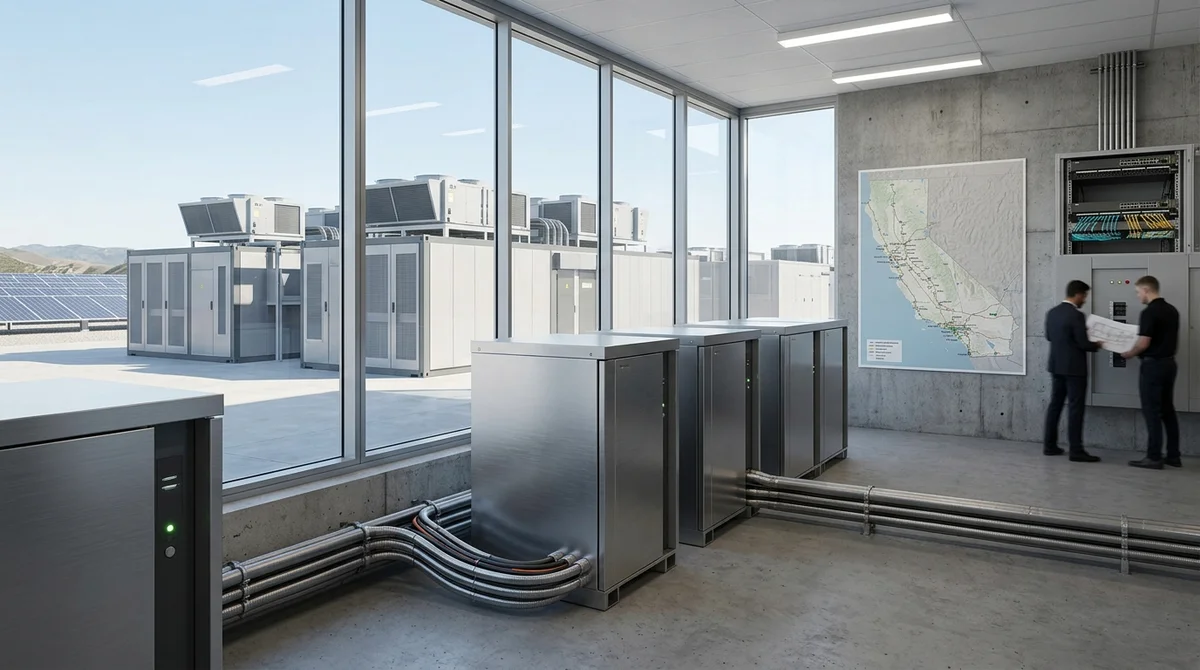
In the agricultural Sacramento River valley, one of California's Indigenous peoples has decided to join the AI boom not only as a landowner but as an infrastructure partner. Colusa Indian Energy, together with Strata Expanse, is preparing an AI and energy campus on the land of the Cachil Dehe Band of Wintun Indians, betting that in the era of generative AI the scarce resources are not only chips but also electricity, sites and speed of grid connection.
How the project works
The basic setup is simple: Colusa Indian Energy, wholly owned by the Colusa Indian Community, is teaming up with the developer Strata Expanse to build infrastructure for AI computing in northern California. The first phase includes a Center of Excellence, a working site where workloads for new AI systems will be tested and validated. For Strata Expanse this is the first partnership with a tribal community, and for the community itself it is a step from the energy business into the higher-margin segment of digital infrastructure.
According to Bloomberg, the project begins with a lease of several acres on tribal land, and over the next 18 months its scale could exceed 100 acres. In parallel, the partners are also talking about expanding their own generation to more than 100 MW.
That is an important detail: the campus is not being built on the classic model, where developers wait years for grid capacity and only then launch a data center. Here the logic is reversed: the compute site is tied from the start to available energy and local infrastructure.
A bet on energy
The project's key advantage is the existing Colusa Indian Community microgrid. According to the company itself and U.S. Department of Energy materials, it has operated in island mode for more than two decades, and for over 14 years without unplanned outages.
For AI infrastructure this is not just a nice reliability figure. If the market is hitting a shortage of power and long waits for connection to the main grid, a site with proven local generation immediately becomes much more valuable than ordinary land.
The project has already named technology partners who are supposed to cover the compute and engineering side of the campus:
- DDN — storage systems and data infrastructure
- Supermicro — server platform
- Nvidia, Intel and AMD — compute components
- Amphix Center of Excellence — an environment for pilot launches and AI workload validation
For tribal territories this model looks especially attractive because it shortens the path from idea to launch. Colusa Indian Energy's materials explicitly mention on-site generation, a shorter approval cycle, and the ability to build such facilities faster than under the conventional grid model. With utilities and grid operators across the country failing to keep up with demand from AI data centers, energy is becoming the main argument in negotiations over where to place new capacity.
Why it matters to the tribe
The story is interesting not just as another data center in the U.S., but as an example of tribal communities trying to capture a larger share of the value chain. Around AI today, money is made not only by model developers but also by owners of land, power generation, cooling, fiber and construction permits.
Colusa Indian Energy presents the project as a tool for economic diversification: revenue can come not only from leasing but also from energy, infrastructure maintenance, long-term service contracts and new jobs. The community already has farmland, its own energy base and experience running critical infrastructure, including a casino resort and utility capacity. Now it is trying to turn that set of assets into a platform for AI computing.
In one statement, the company's COO Kenneth Ahmann put it as directly as possible: tribes want to be seen not as a territory with special incentives but as equal partners in building the new technology economy.
"We have shown the way forward and ask that tribes be treated as equal partners," —
Kenneth Ahmann.
What this means
The AI boom is shifting ever more from models to physical infrastructure: land, electricity, cooling and the right to build quickly. The Colusa Indian Energy case shows that in this race the winners may include not only Big Tech and traditional data center operators but also tribal communities, if they already control land, energy and time to launch.
- Nov 1, 2026Local models lose to Opus and Codex: 0.21 on a MacBook versus 1.00 for Codex
- Nov 1, 2026Habr author fine-tunes YOLOv8l on dental X-rays and pushes mAP50 to 0.642
- Nov 1, 2026Voice bots built on LLMs turn to Jev, a fast classifier, for decisions in 200–500 ms
- Nov 1, 2026MoneyGate safety layer blocked all 42 fraudulent requests to local AI models
Key Questions Answered
How the project works?
The basic setup is simple: Colusa Indian Energy, wholly owned by the Colusa Indian Community, is teaming up with the developer Strata Expanse to build infrastructure for AI computing in northern California. The first phase includes a Center of Excellence, a working site where workloads for new AI systems will be tested and validated. For Strata Expanse this is the first partnership with a tribal community, and for the community itself it is a step from the energy business into the higher-margin segment of digital infrastructure. According to Bloomberg, the project begins wi
What are the key details on A bet on energy?
The project's key advantage is the existing Colusa Indian Community microgrid. According to the company itself and U.S. Department of Energy materials, it has operated in island mode for more than two decades, and for over 14 years without unplanned outages. For AI infrastructure this is not just a nice reliability figure. If the market is hitting a shortage of power and long waits for connection to the main grid, a site with proven local generation immediately becomes much more valuable than ordinary land. The project has already named technology partners who are supposed
Why it matters to the tribe?
The story is interesting not just as another data center in the U.S., but as an example of tribal communities trying to capture a larger share of the value chain. Around AI today, money is made not only by model developers but also by owners of land, power generation, cooling, fiber and construction permits. Colusa Indian Energy presents the project as a tool for economic diversification: revenue can come not only from leasing but also from energy, infrastructure maintenance, long-term service contracts and new jobs. The community already has farmland, its own energy base a
Ship AI Faster with Founders, Engineers & Weekly Architecture Reviews
Inside Vibe Club (hamidun.com/club) — weekly live masterminds with Zhemal Khamidun, Tech Radar, full LMS access, and 370+ production Claude Code skills.
The AI world, distilled — once a week
Seven stories that actually mattered, hand-picked. No noise, no reposts, no press releases.
Done! Check your inbox for a confirmation.