British teachers: AI tools are worsening students' thinking, spelling, and speech
Concern is growing in British schools over the everyday use of AI. According to the survey, two-thirds of teachers believe students are writing worse, practicing critical thinking less often, solving problems less effectively, and increasingly offloading work to AI tools. A separate concern is the sense that literacy is no longer necessary and that voice and text tools will fix everything for the user, even in school assignments.
AI-processed from CNews AI; edited by Hamidun News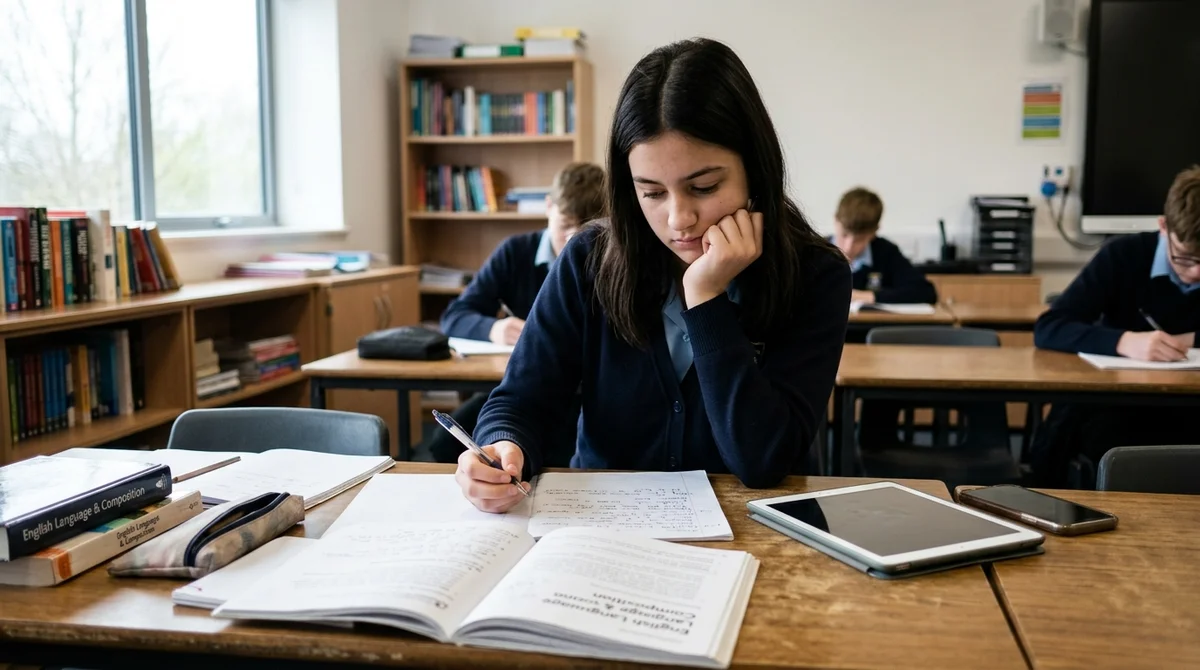
British teachers increasingly connect everyday use of AI with a noticeable decline in basic academic skills among schoolchildren. According to a survey, two-thirds of secondary school teachers believe that because of AI, students reason worse, write worse, and struggle with tasks without external prompts.
What Teachers Noticed
A survey among teachers in British secondary schools revealed not an isolated problem, but a sustained sense of a shift in student behavior. Teachers say children increasingly turn to AI not as a supplementary tool, but as a replacement for their own effort. Instead of first formulating a thought, checking facts, or independently arriving at an answer, schoolchildren often immediately ask the system to provide ready-made text, solutions, or formulations. As a result, the skill of thinking step by step weakens, not just the quality of a specific homework assignment.
"Students using AI technologies are losing critical thinking skills,
spelling, problem-solving, and even conversational abilities."
Teachers are also concerned that the change is already visible not only in written assignments. According to their observations, some schoolchildren have worse class discussions, less often develop their own arguments, and lose the thread of conversation more quickly if they can't simply ask a chatbot. This is an important signal: it's not about a debate over new technology, but about a risk to basic cognitive habits that school typically trains daily.
Which Skills Are Declining
Teachers' main complaint is that AI starts addressing not complex, but the most fundamental tasks. If previously a student was forced to write, rewrite, correct, and think about formulation, now a significant portion of this work goes into the service interface. When such a scenario repeats constantly, the skill stops being reinforced. This is especially noticeable where the technology creates a sense of instant backup and removes the cost of error.
- Critical thinking — less independent analysis and answer verification
- Spelling — lower motivation to memorize rules and notice own mistakes
- Problem-solving — stronger habit of seeking ready-made results instead of the solution process
- Oral communication — harder to maintain conversation and formulate thoughts without prompts
Teachers separately point to the 2026 paradox: children increasingly don't feel the need to write correctly, because machine speech recognition, autocorrection, and text generation tools make literacy seem "optional." Formally, the output text may look neat, but this doesn't mean the student actually understands the rule, grasps sentence structure, or can reproduce the same result without a digital crutch.
Why This Matters to Schools
The problem isn't in the fact of using AI itself. Neural networks can help with finding ideas, explaining complex topics, or practicing with examples. But if they appear in the learning process before basic skills are formed, substitution occurs: the student gets results without the internal work that builds those skills.
For schools this is particularly sensitive, because most learning relies on repetition, mistakes, corrections, and gradual task complexity. Now teachers apparently have to redefine the boundary between helpful support and harmful automation. One scenario is to use AI after the schoolchild has already written their own answer and can compare it to an alternative.
Another is to allow neural networks only for checking structure, not for generating content. Without such boundaries, schools risk a situation where students work faster on the surface, but in practice read worse, argue weaker, and get lost faster without their digital helper.
What This Means
The story with British schools shows that the main question around AI in education is no longer about access to tools, but about the mode of their use. If neural networks start replacing basic thinking work, schools get a smoother result on screen, but a weaker skill in the student. This means the next stage will not be banning AI, but strict rules for where it helps learning and where it hinders the learning process itself.
Want to stop reading about AI and start using it?
AI News is a curated feed of AI/tech news. Hamidun Academy teaches you to use AI systematically in your work.
The AI world, distilled — once a week
Seven stories that actually mattered, hand-picked. No noise, no reposts, no press releases.
Done! Check your inbox for a confirmation.