Habr author tests whether ChatGPT can rebuild articles from short prompts
A Habr author took two popular articles and tried to reconstruct them with ChatGPT from compressed prompts. In the first case, 67 words were enough to produce nearly the same text, at 651 words. In the second, the model grasped the argument but failed on concrete artifacts: bytes, key sizes, PR numbers and other details that only emerged from manual research.
AI-processed from Habr AI; edited by Hamidun News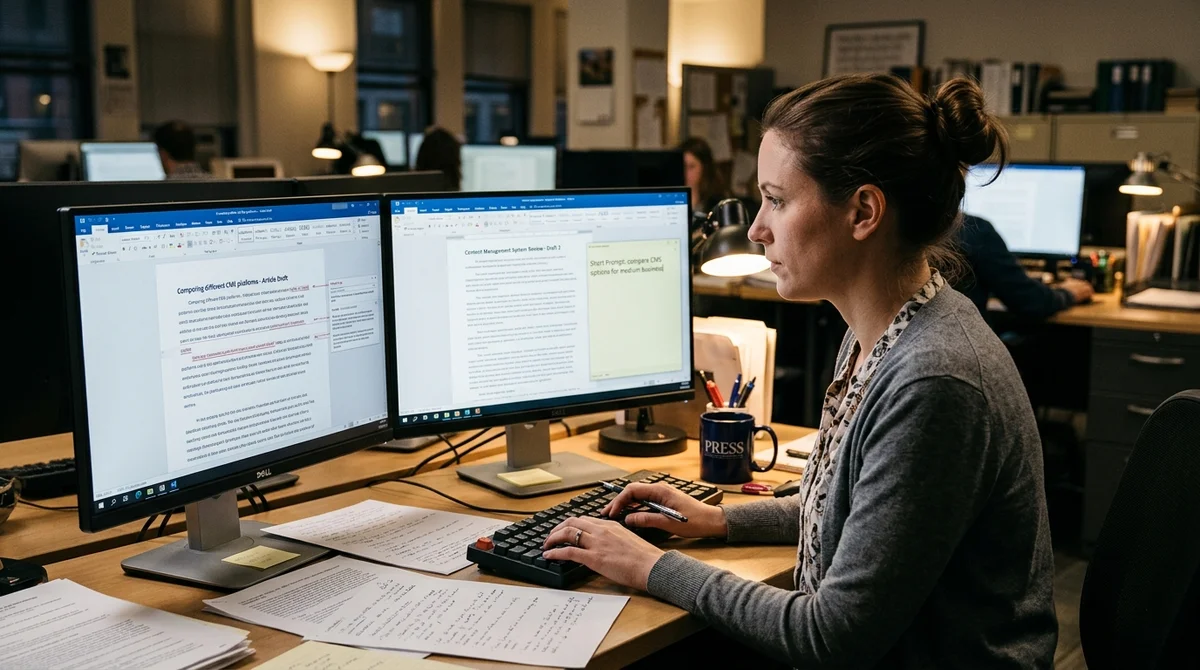
A Habr author set out to test a bold idea: that any text can be compressed into a short prompt and then restored through ChatGPT with almost no loss. Instead of citing "Cambridge researchers," he took real articles from the platform and ran his own test.
How the test was set up
The trigger was the reaction to an earlier translation of The Prompt article, which claimed that some Cambridge researchers can reduce any text to a minimal prompt with 98% reconstruction accuracy. Readers quickly noticed that the story reads like a pastiche of "British scientists," which pushed the author to test not the legend but the principle itself.
For the experiment he chose Habr as a platform with a demanding technical audience, where weak arguments and stretches rarely survive long.
The setup was simple: take two recent, highly rated articles, compress them into a prompt, and ask ChatGPT to write a new text in a similar genre without searching the internet. The author looked beyond overall tone at more down-to-earth questions: whether the structure, key figures, important episodes and order of arguments were preserved. He also watched for the points where the model starts filling in the story itself, because such insertions are easy to mistake for real details.
Where it worked
The first test came close to a demonstration of the power of template-based reconstruction. The article argued that irreplaceable employees are not a flaw in a team's architecture but a valuable resource. A prompt of just 67 words was enough, and ChatGPT generated a 651-word text. By the author's assessment, the match was so close that next to the original, the reconstruction looked unnervingly convincing.
- The main thesis about the value of "irreplaceable" employees survived
- The criticism of standard ways to reduce the bus factor returned
- The model reproduced the recommendations: pay 1.5–2 times more, document through process, hire self-reliant people
- Two practical scenarios and the exact 40% raise figure stayed in place
- ChatGPT even added a plausible detail, a nine-month timeline of the failure, which was not in the source
The compression ratio in this case was roughly 10:1. But alongside the impressive result came a problem: the model does not merely restore familiar logic, it confidently fills gaps with what "looks like the truth." For a reader without the original at hand, the difference between the restored and the real article may be almost invisible, especially if the text rests on common management patterns the model has long known.
Where the method hits its limit
On the second article the experiment gave a very different result. The piece was not about abstract conclusions but about Telegram blocking, DPI, and how the developer community manually fixed specific bugs in the FakeTLS implementation. To approach the original logic, the author had to write a 357-word prompt, almost five times longer.
ChatGPT produced 914 words, but an important part of the text still dissolved. What was missing was precisely what separates a retelling from real engineering work: concrete TLS extension values, the discrepancy between the declared and actual key size, the pull request number, the commit hash, the name of the community that contributed the fix, and other artifacts extracted from traffic and code. In other words, the model reconstructed the general debate but could not return what had been found by hand in a live system rather than sitting in the training data.
"ChatGPT restored the argument.
It did not restore the work."
Here the author draws the line between convenient imitation and real knowledge. If a text's value rests on structure, familiar theses and typical conclusions, it compresses well and unfolds back reasonably. But if an article consists of manual reverse engineering, measurements, packet capture and new observations, those "2% of losses" become nearly everything readers came to such material for.
What this means
The Habr experiment does not prove that LLMs can already replace authors entirely, but it shows fairly precisely where the practical boundary lies. Opinion columns, explainers and management essays built on common patterns are noticeably easier for models to reassemble than pieces with unique facts and original measurements.
For editors and readers, the takeaway is a simple test: what matters is not only how convincing an article sounds, but whether it contains something the author actually found, verified and proved. That part of the content is, for now, the one that survives compression into a prompt and reassembly worst.
- Nov 2, 2026Meta's Muse assistant keeps dossiers on loved ones and gets root on Ubuntu by default
- Nov 1, 2026Local models lose to Opus and Codex: 0.21 on a MacBook versus 1.00 for Codex
- Nov 1, 2026Kimi scores 96.2% on a 1C database analytics test and emerges as a fallback if Claude access is blocked
- Nov 1, 2026OpenAI Rewrites GPT Behavior Rules: Five Values and a Chain of Command
Key Questions Answered
How the test was set up?
The trigger was the reaction to an earlier translation of The Prompt article, which claimed that some Cambridge researchers can reduce any text to a minimal prompt with 98% reconstruction accuracy. Readers quickly noticed that the story reads like a pastiche of "British scientists," which pushed the author to test not the legend but the principle itself. For the experiment he chose Habr as a platform with a demanding technical audience, where weak arguments and stretches rarely survive long. The setup was simple: take two recent, highly rated articles, compress them into a
Where it worked?
The first test came close to a demonstration of the power of template-based reconstruction. The article argued that irreplaceable employees are not a flaw in a team's architecture but a valuable resource. A prompt of just 67 words was enough, and ChatGPT generated a 651-word text. By the author's assessment, the match was so close that next to the original, the reconstruction looked unnervingly convincing. The main thesis about the value of "irreplaceable" employees survived The criticism of standard ways to reduce the bus factor returned The model reproduced the recommenda
Where the method hits its limit?
On the second article the experiment gave a very different result. The piece was not about abstract conclusions but about Telegram blocking, DPI, and how the developer community manually fixed specific bugs in the FakeTLS implementation. To approach the original logic, the author had to write a 357-word prompt, almost five times longer. ChatGPT produced 914 words, but an important part of the text still dissolved. What was missing was precisely what separates a retelling from real engineering work: concrete TLS extension values, the discrepancy between the declared and actu
Test Frontier LLMs & Autonomous Agents in One Workspace
Run Claude Opus 5.5, GPT-6, Gemini 3.1, and DeepSeek side-by-side in Nomad AI (nomadnet.ai) — unified model routing, deep research, and multimodal workflows under one subscription.
The AI world, distilled — once a week
Seven stories that actually mattered, hand-picked. No noise, no reposts, no press releases.
Done! Check your inbox for a confirmation.