Petr Tripolsky on Habr presents an AI agent for analyzing Bitcoin news and signals
Habr has published a detailed breakdown of an AI agent that analyzes the news backdrop of the crypto market. Petr Tripolsky criticizes popular GitHub approaches built on agent swarms and raw indicators. Instead, he proposes a model that looks for events from the past few hours and returns a simple signal: BUY, SELL or WAIT. In a test on Bitcoin for 5–9 April 2026, the agent changed its decision as the news context changed.
AI-processed from Habr AI; edited by Hamidun News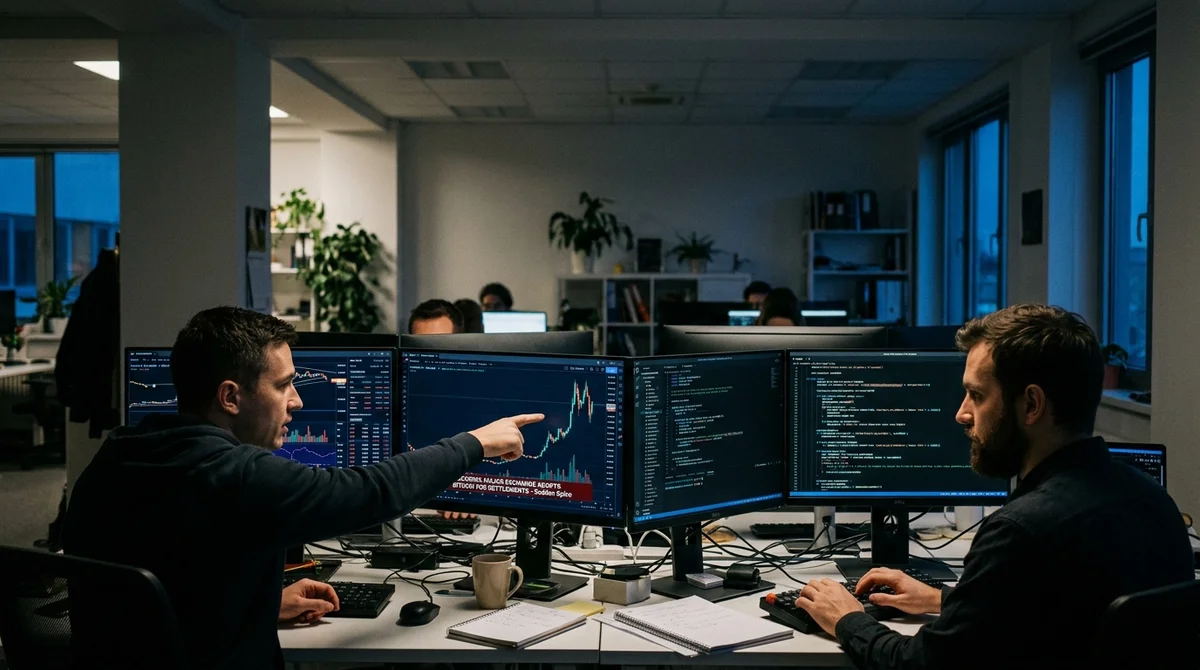
Petr Tripolsky has published on Habr the design of an AI agent for news analysis of the crypto market. In the article he examines why popular GitHub solutions for trading signals break down on real-world events, and presents a more practical design: the agent first searches for fresh market triggers and only then issues a short BUY, SELL or WAIT signal.
Where the alternatives break down
The author starts by criticizing two popular approaches. The first is swarms of agents that argue with each other based on raw indicators such as RSI, Stoch RSI and other metrics. On paper this looks convincing: one agent argues for a rise, another for a fall, and the user picks the number of debate rounds. In practice, Tripolsky writes, the model often latches onto the first signal it comes across and builds an explanation around it, ignoring conflicting data. As a result, the system looks more like a polished simulation of analysis than a real decision-making tool.
The second approach seems more solid: several agents split fundamental topics among themselves — ETF flows, on-chain reserves, hashrate, the actions of large holders, macroeconomics and price. The problem is that this kind of analysis is too static. It can be useful for a monthly big picture, but it reacts poorly to sudden market shocks, when the price is moved not by a balance of indicators but by a single sharp event in a specific hour. This is precisely where, in the author's view, the market manages to move in a completely different direction.
New search logic
Instead of a debate among abstract agents, the author proposes a design built on the "reasoning + action" pattern. The point is that the model should not be locked inside a pre-loaded set of metrics. Between reasoning steps, it needs to be able to search the internet for facts again and clarify what exactly happened in the last few hours. That way the agent does not discuss the market in general but reacts to the specific context of the date and moment. This is an attempt to make the query to the world adaptive rather than one-off.
"Sharp events outweigh lagging analysis."
In the published web-search code, the agent is given strict rules: do not peek into the future, do not use material without a clear date, and do not copy a single opinion from an article as a ready-made conclusion. In essence, the agent works like a fast editor of a market digest who must gather several confirmations before issuing a signal. To do this, it is instructed to run several search queries and cross-check the picture against independent publications.
- Searches for breaking news on the asset over the last 4–12 hours
- Checks regulatory actions, exchange hacks and withdrawal halts
- Tracks macro surprises such as a Fed decision or a CPI release
- Looks at abnormal volumes and the causes of sharp price moves
- If the picture is contradictory, chooses WAIT instead of a forced forecast
The author also formalizes the output format. The model must return not a long review but one of three actions and a short explanation of which events led to it. This makes the system less of an analytical essay and more of an operational tool that can be plugged into a backtest or a trading loop. The format is especially convenient where the signal then needs to be checked automatically against history or passed on to trading logic.
Testing on the market
For the demonstration, Tripolsky ran the agent on Bitcoin news for April 2026. Over a long horizon, the general fundamental analysis looked bearish: high interest rates, weak volumes, pressure from miners and ambiguous institutional flows pushed the model toward a SELL signal. But the article then shows why such a frame alone is not enough. The monthly picture and a decision for the next few hours turn out to be different tasks. This is the gap the author tries to close with the news agent.
On 5 April 2026, the agent saw rising geopolitical tension after a US ultimatum to Iran, but did not find a clean, unambiguous enough catalyst for entry. The result was WAIT. On 8 April 2026, after the announcement of a two-week ceasefire with Iran, the system recorded a sharp jump in Bitcoin to $72,000, the liquidation of about $425 million in short positions and a surge in volume — and issued BUY. Then on 9 April 2026 the signal switched back to WAIT: the bullish impulse ran into pressure from miners, options and new risks, so the model opted for caution.
This passage is the main point of the whole article. The author does not promise a "smart oracle" that always guesses the market. Instead, he shows a more disciplined mechanism: first isolate the sharp event, then check for confirmations, and only after that decide whether there is any basis for a trade at all. For AI agents in finance this matters more than elegant reasoning about fundamentals, because the error here arises not from a lack of data but from the wrong order of working with it.
What this means
The Habr article offers not a ready-made trading grail but a useful design for news-driven AI agents. The key idea is simple: in a fast-moving market, the model must be able to rediscover context by date, acknowledge uncertainty and choose WAIT more often when fresh facts are insufficient. This approach may be useful not only in crypto but in any system where the decision depends on news from the last hours and minutes.
- Nov 2, 2026DeepSeek open-sources Super-agent prototype: p95 task completion time of 15.7 minutes vs. 29.5
- Nov 2, 2026Bun creator uses Claude Code to port 750K lines from Zig to Rust in 11 days
- Nov 2, 2026Microsoft releases 4B model Mage-VL-Cowork, which solves 66.0% of OSWorld-Verified tasks
- Nov 2, 2026Meta's Muse assistant keeps dossiers on loved ones and gets root on Ubuntu by default
Key Questions Answered
Where the alternatives break down?
The author starts by criticizing two popular approaches. The first is swarms of agents that argue with each other based on raw indicators such as RSI, Stoch RSI and other metrics. On paper this looks convincing: one agent argues for a rise, another for a fall, and the user picks the number of debate rounds. In practice, Tripolsky writes, the model often latches onto the first signal it comes across and builds an explanation around it, ignoring conflicting data. As a result, the system looks more like a polished simulation of analysis than a real decision-making tool. The se
What are the key details on New search logic?
Instead of a debate among abstract agents, the author proposes a design built on the "reasoning + action" pattern. The point is that the model should not be locked inside a pre-loaded set of metrics. Between reasoning steps, it needs to be able to search the internet for facts again and clarify what exactly happened in the last few hours. That way the agent does not discuss the market in general but reacts to the specific context of the date and moment. This is an attempt to make the query to the world adaptive rather than one-off. "Sharp events outweigh lagging analysis."
What are the key details on Testing on the market?
For the demonstration, Tripolsky ran the agent on Bitcoin news for April 2026. Over a long horizon, the general fundamental analysis looked bearish: high interest rates, weak volumes, pressure from miners and ambiguous institutional flows pushed the model toward a SELL signal. But the article then shows why such a frame alone is not enough. The monthly picture and a decision for the next few hours turn out to be different tasks. This is the gap the author tries to close with the news agent. On 5 April 2026, the agent saw rising geopolitical tension after a US ultimatum to I
Test Frontier LLMs & Autonomous Agents in One Workspace
Run Claude Opus 5.5, GPT-6, Gemini 3.1, and DeepSeek side-by-side in Nomad AI (nomadnet.ai) — unified model routing, deep research, and multimodal workflows under one subscription.
The AI world, distilled — once a week
Seven stories that actually mattered, hand-picked. No noise, no reposts, no press releases.
Done! Check your inbox for a confirmation.