VTB opens Data Fusion 2026: robots, HiRAG, and a debate over applied AI
On April 8, 2026, VTB's Data Fusion 2026 kicked off at the Lomonosov cluster. The first day stood out for a packed venue, robots on site, and more practical discussions — from HiRAG for VK Video to debates over where AI popularization ends and real product work begins. Interest in recommendation systems and robotics is clearly growing.
AI-processed from Habr AI; edited by Hamidun News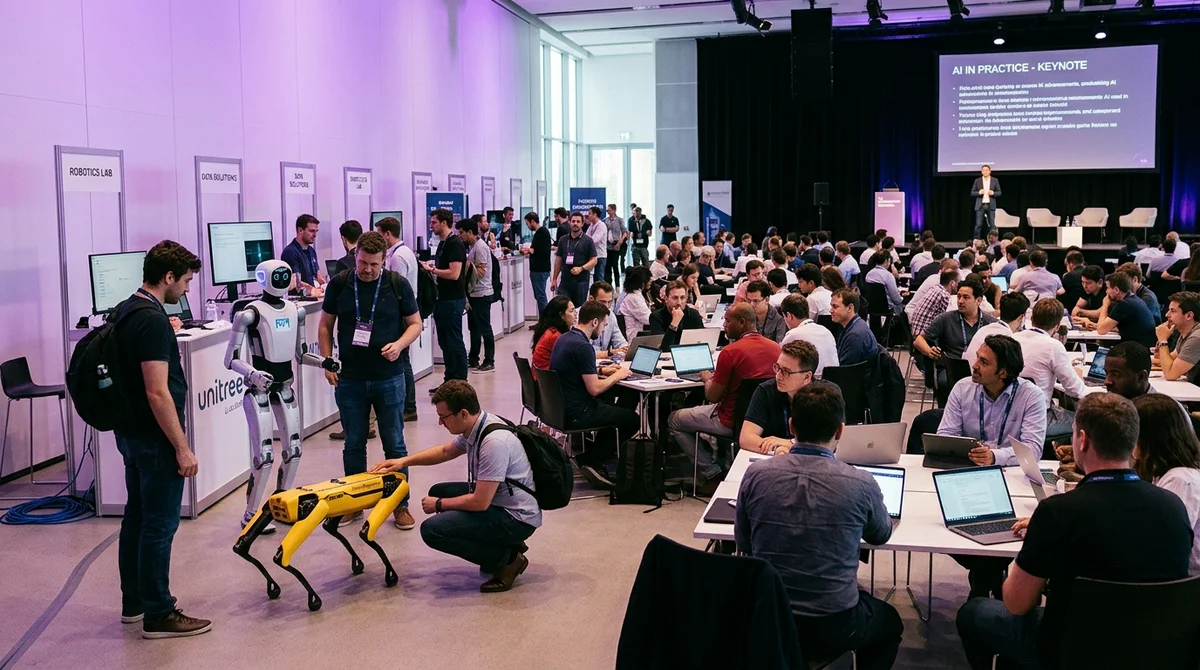
On April 8, 2026, the first day of the Data Fusion 2026 conference took place at the Lomonosov cluster, organized by VTB. According to participants' impressions, the event once again filled halls to capacity and demonstrated that conversations about AI in Russia are increasingly shifting from abstract promises toward products, robots, and practical scenarios.
Full Halls and Active Venue
The first signal of scale was simple: without prior registration, you could no longer get into the first day. For Data Fusion, this is an important marker, because the conference has long operated not as a narrow gathering of researchers, but as a major public platform where business, engineers, and academia discuss the same market from different angles. The organization, according to reviews, remained at its characteristically high level, and the atmosphere itself resembled a mix of a technology fair and an overview forum on AI.
- Full capacity from day one entry
- Demonstrations of quadruped and humanoid robots
- Open sessions on LLM, RAG, and model memory
- A talk on HiRAG for recommendations in VK Video
- Presentations by international speakers in English
Robots particularly stood out at the venue: they escorted guests, shook hands, danced, stood on their hind legs, and did backflips. It was not just a visual attraction, but a clear demonstration of how robotics is becoming a mandatory part of AI events. At the same time, the overall impression was mixed: the hardware already looks convincing, but behind the striking exterior, a key question persists—how ready are these systems for real autonomous work outside the walls of an exhibition.
From LLM to HiRAG
Substantively, the first day again revolved around a familiar set of topics: LLM, RAG, fine-tuning, datasets, context, and model memory. This clearly shows which narratives currently dominate even at large offline conferences: participants discuss not so much new fundamental breakthroughs as ways to better organize knowledge, retrieval, and interaction with existing models. For part of the audience, this format is convenient as a quick market overview, but for specialists, many of the theses already sound like repetition of the basic vocabulary of the past two years.
The most interesting applied narrative was HiRAG, which was demonstrated in the context of VK Video. The idea is that the system builds a hierarchy of knowledge: first it groups related entities, then moves up to more general concepts, to find not only direct matches but also semantic connections between categories. This approach is particularly important for recommendation services, where it is not enough to simply guess the next click.
The logic is shifting toward agentic recommendations, which help users formulate their interests while enabling the platform to more precisely manage attention and content consumption scenarios.
Between Show and Maturity
A separate thread of the first day was the gap between spectacle and technological maturity. Robots on stage and in corridors made a strong impression, but the participants themselves described the current state of the market quite soberly. Some machines were controlled remotely, which means true fully autonomous behavior in complex environments is still far off. This does not negate commercial potential: robots have already found their place at events, in service scenarios, and marketing activations. But in real business, value will be determined not by the chassis itself, but by software quality, control models, and behavioral safety.
"For real robot use, you need more software to support it."
This thought summarizes the conference itself well. Data Fusion remains a place where it is convenient to quickly map out terminology, see working directions, and understand what the industry currently considers promising. But it is more of a platform for synchronization and context updates than a source of deep technical expertise on each topic. Even the scientific track, according to participants' impressions, often balanced between overly superficial popularization and complex presentations without sufficient practical explanation.
What This Means
The first day of Data Fusion 2026 showed that the Russian AI market is increasingly connecting three layers at once: public demonstrations, practical LLM tools, and early robotic products. For companies, this is a signal to look not only at headline models, but also at the bundle of data, retrieval, recommendations, and software that transforms a striking demo into a working service.
Want to stop reading about AI and start using it?
AI News is a curated feed of AI/tech news. Hamidun Academy teaches you to use AI systematically in your work.
The AI world, distilled — once a week
Seven stories that actually mattered, hand-picked. No noise, no reposts, no press releases.
Done! Check your inbox for a confirmation.