Kia lowered its 2030 EV target, plans a pickup and Atlas deployment in the U.S.
Kia revised its 2030 strategy: it lowered its EV sales target to 1 million vehicles a year, expanded its hybrid lineup to 13 models, and confirmed an electric pickup for North America. At the same time, the company is preparing to deploy Atlas humanoid robots: first at Hyundai Metaplant America in 2028, then at Kia AutoLand Georgia in the second half of 2029.
AI-processed from TNW; edited by Hamidun News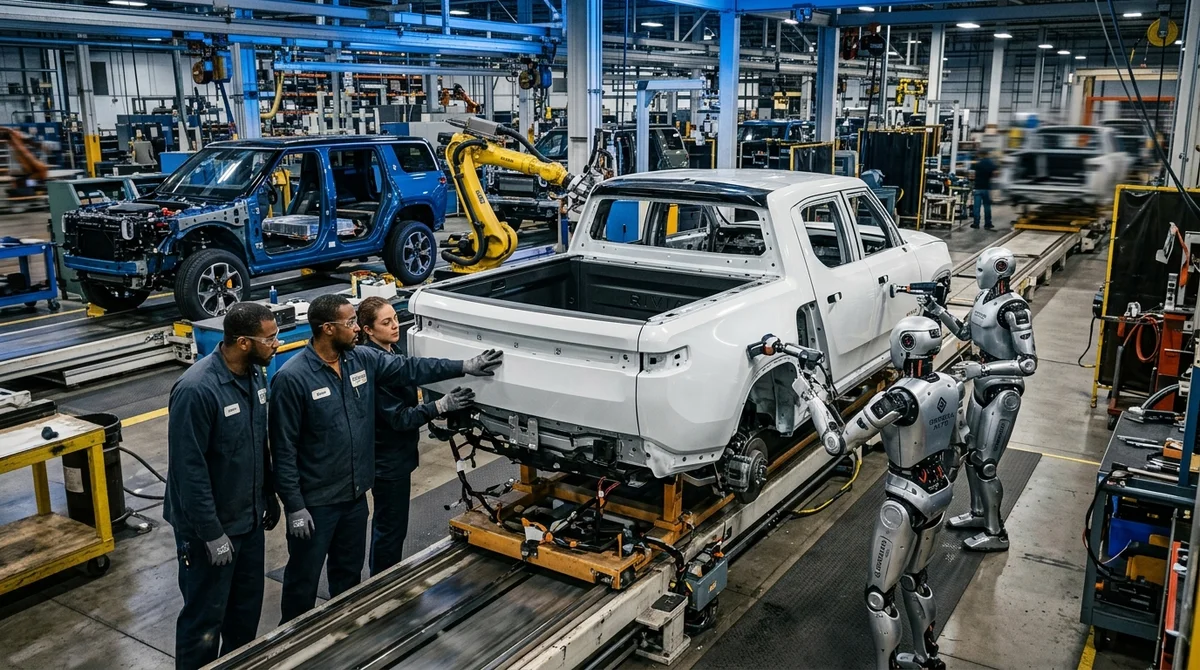
Kia has restructured its strategy through the end of the decade: the company has cut its target volume of electric vehicle sales by 2030, dramatically expanded its bet on hybrids, confirmed an electric pickup for North America, and outlined the deployment of the Atlas robot at factories in the state of Georgia. The announcement was made on April 9, 2026, at the CEO Investor Day in Seoul—the same day new 25% tariffs on South Korean imports went into effect in the US.
Betting on hybrids
The main change is a new EV target: Kia now expects to sell 1 million electric vehicles per year by 2030 and hold 3.8% of the global market for them. A year ago the target was higher—1.26 million, and in 2023 the company was talking about 1.6 million. Formally, Kia doesn't call this a retreat, but the numbers show a more cautious scenario: the company no longer puts all its growth into pure EVs and is distributing risk across multiple types of powertrains.
- 14 EV models by 2030 instead of 11 in 2026
- 13 hybrid models by 2030
- 1.1 million HEV sales per year by 2030
- 4.13 million total vehicle sales by 2030
- 49 trillion won in investments in 2026–2030
In the short term, the logic is straightforward: hybrids should compensate for the market's slower transition to battery-powered vehicles. Kia forecasts 122.3 trillion won in revenue for 2026 and separately factors in tariff pressure and cost pressures into its calculations. In parallel, the company is scaling localized production: EV2 and EV4 for Europe, EV6 and EV9 for the US, and regional models for emerging markets. This is no longer a single global EV bet, but a set of local scenarios.
Pickup for America
The most notable announcement for North America is Kia's first confirmed electric pickup. The vehicle will be built on a new EV platform designed not only for city driving but also for heavier use: the company promises a spacious cabin, large cargo bed, serious traction system, off-road capability, and modern multimedia and safety electronics. The model's target is ambitious: around 90,000 sales per year in the medium and long term, and 7% of the regional pickup market.
Against the backdrop of trade pressure, this project looks like more than just a lineup expansion—it's a response to the rules of the American market. The company has not yet named the assembly location for the pickup, but the logic is clear: Kia's own plant in West Point and Hyundai Motor Group Metaplant America in Georgia give the opportunity to produce such vehicles closer to the customer and outside the import tariff. For Kia, this is also a way to strengthen its position in a segment where the brand has had no electric offering for the US market.
Atlas in the factories
A separate section of the presentation was devoted to robotics. Kia and Boston Dynamics have moved the Atlas subject from demonstrations into a concrete production schedule: in 2028, humanoid robots should begin full-scale deployment at Hyundai Motor Group Metaplant America, and in the second half of 2029, the program will expand to Kia AutoLand Georgia. Both facilities are in the state of Georgia, so this is not a one-off pilot but a gradual roboticization of the group's key American cluster.
"Electric vehicles, hybrids, autonomous driving, and robotics will become the key drivers of
Kia's fastest growth," said company CEO Ho Sung Song.
Kia is simultaneously rolling out the Software-Defined Factory concept at its American facilities. Initially, Atlas will be selectively deployed in 16 core manufacturing processes to increase safety, quality, and productivity, and then the range of tasks will expand as systems learn. This is an important detail: the company is not promising the immediate replacement of people on the assembly line. Rather, it is building an industrial scenario where humanoids first take on standardized operations, and then move on to more complex assembly.
What this means
Kia is effectively acknowledging that the electric vehicle market will grow unevenly by 2030. Therefore, the company is making a more grounded bet: fewer pure EVs in its forecast, more hybrids, local production for the US, and early deployment of humanoid robots at real factories. For the entire automotive industry, this is a signal: the winners will not be those who make the loudest promises, but those capable of quickly switching between technologies, demand, trade rules, and the requirements of different regions.
Executive AI Consulting, Custom Agents & Team Workshops
Work directly with Zhemal Khamidun at hamidun.com — enterprise AI architecture, production RAG & multi-agent systems, and executive training.
The AI world, distilled — once a week
Seven stories that actually mattered, hand-picked. No noise, no reposts, no press releases.
Done! Check your inbox for a confirmation.