Sam Altman and OpenAI sharply reduce AI infrastructure spending plan through 2030
OpenAI sharply reduced its long-term computing infrastructure spending target: from $1.4 trillion to roughly $600 billion by 2030. For the market, this is a crucial signal: investors are beginning to demand not just bold promises about hyperscaling, but coherent economics. Even amid rising revenue, the company is moving to more tightly link capital expenditures to future revenue.
AI-processed from Habr AI; edited by Hamidun News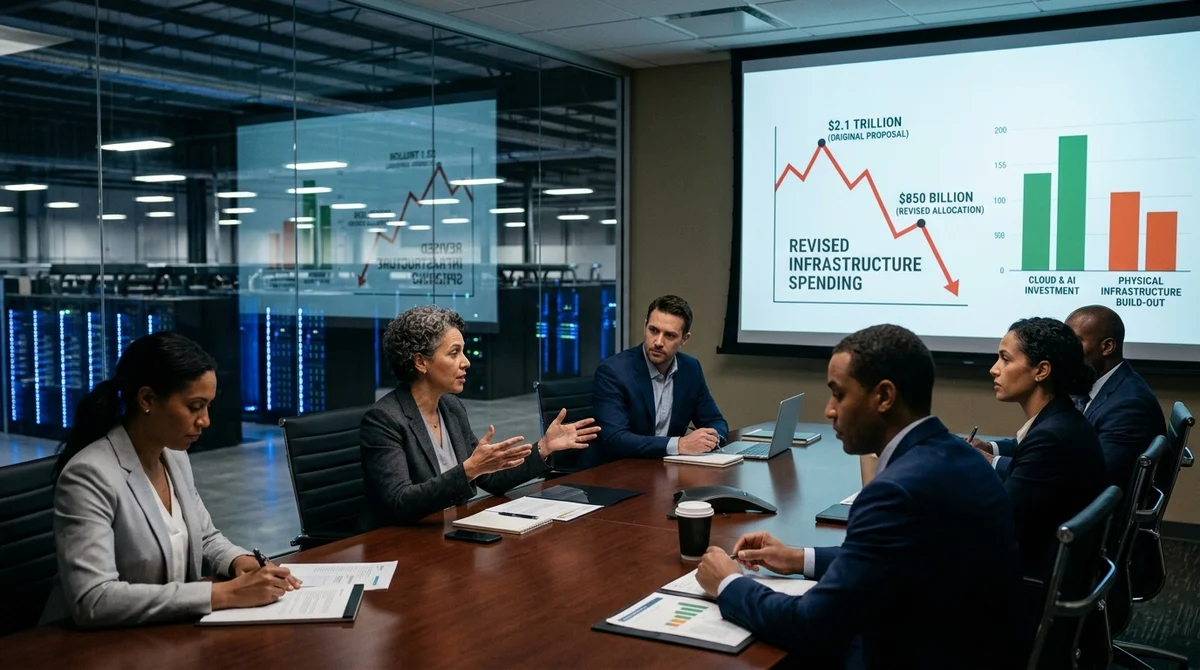
OpenAI has markedly reduced the scale of its long-term infrastructure expectations: while just a few months ago Sam Altman spoke of a trajectory that reached $1.4 trillion in computational commitments by 2030, the company is now orienting investors toward approximately $600 billion. For the market, this is an important signal: the AI race is not being canceled, but the rhetoric of "any price for growth" is beginning to give way to more grounded economics.
The revision concerns primarily compute spend—the cumulative costs of computational power, data centers, accelerators, and related infrastructure needed to train and serve models. The more-than-halved reduction does not mean abandoning expansion. But it shows that even the market's most aggressive player is forced to balance ambitions with revenue, access to capital, and monetization speed.
Not long ago, giant figures were perceived as proof that the industry was moving toward superintelligence through simple scaling. Now there is noticeably less confidence left in that logic. Against this backdrop, the current financial ratio is particularly telling.
According to data discussed with investors, OpenAI's 2025 revenue came to approximately $13 billion—higher than the previous internal forecast of $10 billion. Yet the company's expenses for the same year reached roughly $8 billion, meaning the business continues to burn capital actively even amid rapid growth. By 2030, OpenAI is reported to expect more than $280 billion in cumulative revenue, roughly evenly split between consumer and enterprise directions.
The new compute spend target, apparently, is needed to tie infrastructure investments to this more concrete financial model. There is another layer to this story—preparation for a potential IPO and new large financing rounds. It is easier for a private company to live with broad formulations while the market is willing to believe in future hypergrowth.
But the closer the conversation gets to public valuation, the more important it becomes to have understandable return horizons and spending discipline. The $600 billion target still looks colossal, but it now allows discussion not of an abstract "build of the century," but of a scenario that can at least be tied to future cash flows. The revision of plans matters not only for OpenAI itself.
The entire AI ecosystem was built around the assumption that demand for chips, cloud power, and new data centers would grow almost without limits. On this assumption, NVIDIA, the largest cloud providers, and hyperscalers—which have already announced multihundred-billion capital expenditure programs—all benefited. When the industry leader lowers its own bar from $1.
4 trillion to $600 billion, this inevitably forces the market to reassess how realistic the remaining forecasts are. Especially if some of the earlier agreements were formalized as framework intentions rather than as finally closed commitments. Skeptics interpret this move as an early sign that the AI hype is passing its peak phase and giving way to harsh economic reality checks.
Their arguments are clear: each next step in scaling costs more, data center power consumption grows, and noteworthy improvements in model quality come with increasing difficulty. OpenAI supporters view the situation differently: the company is not abandoning the race, but simply transitioning it from a mode of loud symbolic figures to a mode of managed growth. And this too is a plausible explanation.
For a mature market, spending discipline may be not a sign of weakness, but a sign that the industry is exiting the stage of slogans. The main conclusion is different: for the first time, the AI market is getting from OpenAI not an expansion of promises, but their reduction and concretization. This does not mean the end of the boom, but it does mean the end of the period when trillion-dollar plans could be presented as a self-sufficient argument.
Now investors, partners, and clients will look not only at model size and GPU count, but at how these capacities are converted into revenue, products, and sustainable business. For the entire industry, this may be one of the most important shifts in the last two years.
Want to stop reading about AI and start using it?
AI News is a curated feed of AI/tech news. Hamidun Academy teaches you to use AI systematically in your work.
The AI world, distilled — once a week
Seven stories that actually mattered, hand-picked. No noise, no reposts, no press releases.
Done! Check your inbox for a confirmation.