KDnuggets showed how to run Qwen3.5 on an old laptop with Ollama and OpenCode
KDnuggets broke down an easy way to turn an old laptop into a local AI machine for development. The Ollama, Qwen3.5 4B, and OpenCode stack lets you run the model without the cloud, keep data from being sent outside, write simple code, check dependencies, and test small projects right on your own machine. That is enough for basic tasks, but on complex multi-step scenarios the model already starts to struggle.
AI-processed from KDnuggets; edited by Hamidun News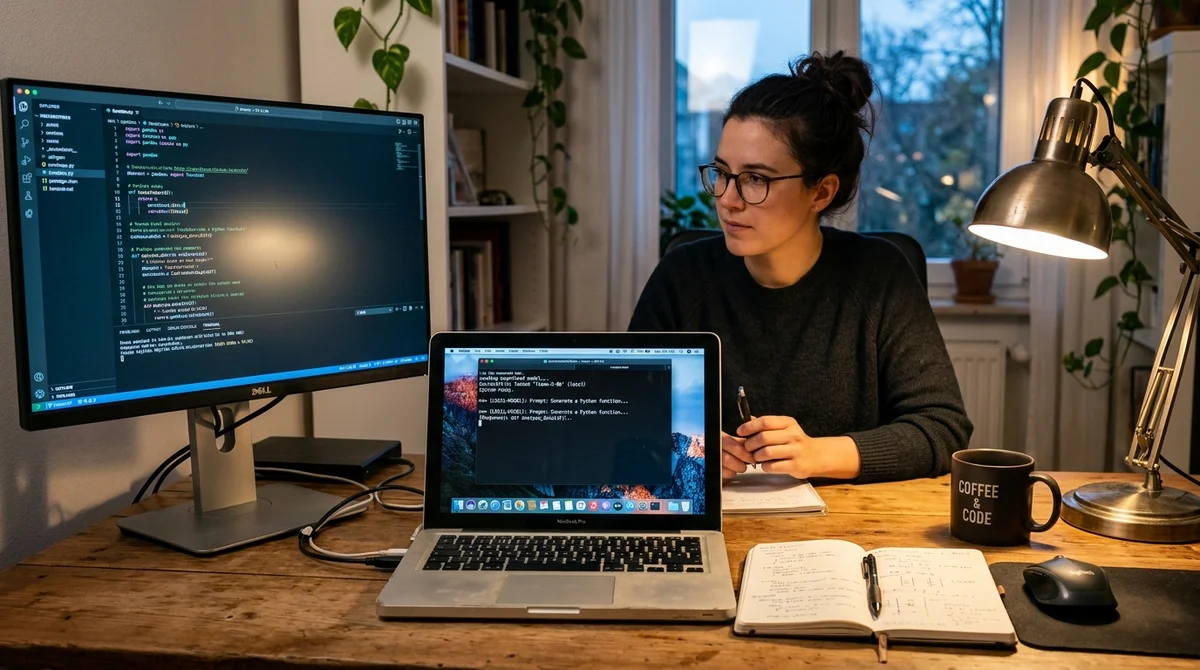
On April 8, KDnuggets published a practical breakdown of how to turn an old laptop into a local AI workspace without expensive hardware and cloud service subscriptions. At the center of the setup — Qwen3.5 in the 4B version, Ollama for local model deployment, and OpenCode as an agent for working with code directly from the terminal.
Why You Need This
The main point of the article is that local AI tools no longer require a powerful workstation or a separate server. The author shows that even an aging laptop can be used as a private environment for experiments, coding, and quick checks if you take a compact open model and avoid overcomplicating the stack with unnecessary layers. In this scenario, Qwen3.
5 4B is presented as a reasonable compromise between answer quality, work speed, and hardware requirements. At the same time, this is not about replacing cloud flagship models. This setup serves a different purpose: to give developers, students, and enthusiasts an inexpensive way to run AI locally, avoid sending files and prompts to external services, and quickly test ideas on their own machine.
For rough code, educational tasks, simple terminal scripts, and small tests, this is already sufficient, even if answer quality doesn't always match the best commercial systems.
How the Setup Works
The basic stack consists of two parts. Ollama handles downloading, storing, and running the language model on a local device, while OpenCode connects on top and transforms it into a more practical agent interface for code work. The article uses the Qwen3.5:4B variant, which, according to the author's assessment, typically requires about 3.5 GB of RAM. This is exactly why this version looks like a realistic choice for an old laptop with limited GPU and memory headroom.
- install Ollama on Windows, Linux, or macOS
- if needed, manually launch a local Ollama server
- download and open the Qwen3.5 4B model through the terminal
- install OpenCode via a quick script
- run OpenCode with the local model already connected
After this, the user gets a local interface where the model can be asked to create a project, install dependencies, or review code. A separate advantage of the guide is that it maintains a low barrier to entry: no Docker orchestration, manual API configuration, or lengthy environment setup. Against the backdrop of many materials about local AI, this looks like a genuinely practical scenario that can be replicated in an evening, not a separate engineering project spanning several days.
Testing on a Real Task
To demonstrate not just installation but actual utility of this approach, the author tasked the Qwen3.5 and OpenCode combination with creating a small Python project from scratch — a Guess the Word game for the terminal. The agent had to generate the project structure itself, write the code, install dependencies, and bring the application to a working state.
Based on the test results, the system did indeed assemble a working game with clear logic, score tracking, and correct handling of input characters — that is, this was not a decorative demo scene but a full-fledged local execution of a chain of tasks. At the same time, the article honestly documents the limitations. The compact quantized model handles basic code, simple scripts, educational projects, and research queries well, but starts to struggle when the task gets longer and requires sustained multi-step planning.
The author specifically notes that the model sometimes stopped midway through a process, and then had to manually push it forward with the next command. For experiments, this is tolerable, but for a stable everyday pipeline, it already looks like a notable limitation.
"Sometimes you just had to type 'continue' to get it to finish the task."
What This Means
The KDnuggets guide demonstrates an important shift: local agent AI combinations are becoming cheaper, simpler, and more useful in everyday development. They don't yet replace strong cloud models, but they already provide a working option for private experiments, learning, prototypes, and small engineering tasks.
Need AI working inside your business — not just in your newsfeed?
I build production AI for companies — custom CRM, internal tools, autonomous agents, workflow automation. Owned by you, shaped to your process, no per-seat tax. Built by Zhemal Khamidun, CPO of AlpinaGPT (AI platform, 6,000+ users).
The AI world, distilled — once a week
Seven stories that actually mattered, hand-picked. No noise, no reposts, no press releases.
Done! Check your inbox for a confirmation.